Scientific Writing
 From http://www.biojobblog.com/
| How to write papers that people will read: A mixed bag of stuff!
|
Sources
| You can start with |
 |
- Never finish with it! Note it is not (and never will be) peer-reviewed
- e.g global warming
- Where do the figures come from?
- but here is the important link
- Hansen, J., et al. (2006) "Global temperature change". Proc. Natl. Acad. Sci. 103: 14288-14293
Writing Science
- Do you want people to read your work?
- Do you want to be understood?
- Do you want your ideas to be taken seriously?
- Edit your own writing by asking yourself
- Was my message clear?
- Could I have used simpler language?
- Did I eliminate awkward passages or phrases?
- How could I have shortened it?
- Did I use an active voice?
- How can I improve it?
Plagiarism
-
Deliberate Plagiarism:
- Downloading an essay, changing the name of the author and submitting it as your own.
- Downloading 10 essays, taking paragraphs from each one and submitting it as your own.
- Hearing about someone's idea at a conference and then submitting it as your own. (Theft of intellectual property)
Accidental Plagiarism:
mostly
- Always acknowledge your sources
- Err on the side of acknowledging too much.
- Exact format doesn't usually matter in this course: I suggest that you name the source in the body of the paper, with a footnote to the exact place.
Plagiarism
What follows is plagiarized from the library website!
Plagiarism is defined by the
Merriam-Webster Dictionary as "the act of stealing and passing off the
ideas or words of another as one's own."
What that means for you as
a student is that if you do not use footnotes, endnotes, or bibliographies
properly when submitting assignments, you too may be accused of plagiarism.
According to Carleton
University's Academic Regulations,(section E. 14) anyone caught plagiarizing
has committed an instructional offence. Students found guilty may be:
a) expelled;
b) suspended from all studies
at the University;
c) suspended from full-time
studies;
d) awarded a reprimand;
e) refused permission to
continue or to register in a specific degree program but subject to having
met all academic requirements shall be permitted to register and continue
in some other program;
f) placed on Academic Warning;
g) awarded an F or Abs in
a course or examination.
Many students think that as long
as they write things in their own words, they don't need to acknowledge
the original source. This is not true! Any information that is not an original
idea of your own, that you get from another source, needs to be noted.
In a research paper there are 2 main ways of incorporating other people's
ideas
Direct quote:
This is used if you are including the exact words used in the written source.
If it's a short quotation, you usually incorporate it directly into your
sentence and use quotation marks around it. If it is longer, you usually
set it out in a block of text, indented from the rest of your text, without
quotation marks
Paraphrasing: This
is when you use your own words to express ideas you have read about. In
this case, you still need to acknowledge the source, even if you aren't
using a direct quotation.
How
to acknowledge the source?
Okay, so now you know that
you have to somehow give credit to your sources of information. The way
you do this may depend on what discipline you are in or on what citation
style you are using. In general, you usually acknowledge the source both
within the body of your text (usually very brief information such as author
and year, or footnote/endnote number), and then also in a fuller bibliography
at the end of the paper (This listing is much more detailed with author,
title, date, page...) There are a number of different styles used in academic
writing. The one you use will be determined by one of the following:
-
your professor may tell you what
style to use
-
your department may have a preferred
style
-
you may be allowed to choose
the style you want to use (in NSCI 1000 we have no strong requirements)
Some of the more common styles
used are APA style (American Psychological Association), especially
in the social sciences, and MLA style (Modern Language Association
) , often used in the Humanities. The important thing is that you should
be consistent: use the same style throughout your paper.
Some
examples
-
According
to Jane Doe , "Excessive use of snowboards may lead to permanent spinal
damage, especially in those under 18 years of age." (12)
In this example,
a footnote or endnote number is used, which points the reader to a list
somewhere which will provide the details of the information source
-
Students
who live away from home spend almost twice as much on alcohol as those
who live with their parents (Smith, 2001)
In this example,
the author and year of the source are indicated in parentheses at the end
of the sentence containing the paraphrased information. Again, a full list
at the end of the paper will give more detailed information on the source
Referencing Guidelines for Science
Johanna Leggate
Sometimes you may be unsure if a reference is required. The general rule is, "When in doubt, reference it". If you had to look up the information you are putting in a report, then where you found that information should be referenced. One standard format is
Sugars bearing anomeric carbons whose hydroxyl groups have not formed glycosidic linkages are termed reducing sugars, since they readily reduce mild oxidizing agents (Voet et al., 2000).
Notice that " et al." is used in the citation because there were more than two authors. For one author it is simply (Smith, 1999), two authors is (Smith and Pierce, 1998). Don't forget to reference your figures too:
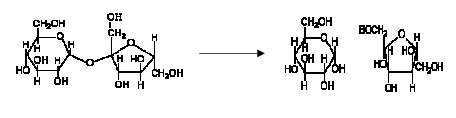 Sucrose α-glucose + α-fructose
Figure 2: The invertase-catalyzed hydrolysis of sucrose to form glucose and fructose (Stanford University, 2003).
Sucrose α-glucose + α-fructose
Figure 2: The invertase-catalyzed hydrolysis of sucrose to form glucose and fructose (Stanford University, 2003).
Notice that Stanford University is cited (not the website). If there had been an author's name on the website, that would be cited.
An example of a properly formatted bibliography that contains references for websites, lab manuals, textbooks and journal articles is as follows:
- References
- Carleton University. 2002. Biochemistry 63.305 Practical biochemistry 2002-2003. Carleton University Press, Ottawa. pp. 68-72
- Jones, M. (2000). Organic chemistry. Second edition. W. W. Norton & Company Ltd. New York. pp. 858-860
- Matic, I., F. Taddei and M. Radman. (2000). No genetic barriers between Salmonella enterica serovar Typhimurium and Escherichia coli in SOS-induced mismatch repair-deficient cells. J. Bact.. 182(20): 5922-5924
- Stanford University (2003). Analysis of Foods for Starch and Vitamin C. http://www.chem.csustan.edu/CHEM2000/Exp8/bkg.htm (Apr 6, 2003)
- Voet, D., J.G. Voet, and C.W. Pratt. (2002). Fundamentals of biochemistry. Upgrade edition. John Wiley & Sons, New York. pp. 200-204
-
An excellent tool that can help in figuring out proper referencing format for some of the trickier electronic resources is The Columbia Guide to online style:
http://www.columbia.edu/cu/cup/cgos/idx_basic.html
- What if you don't know the source?
- Usually It is well known that the whale is not a fish
or It is widely believed that it rains more in winter than in summer.
- Don't use either of these constructions too often, or you'll just look lazy! If it is an idea that is in many places, you can give an example
- The kinetic theory of gases gives a direct link between the energy of gas molecules and the temperature (see, e.g., Giancoli, Basic Physics).
- a rule of thumb: if something is less than 20 years old, refer to the original article. If it's more than 20, chances are it is well known. But be careful
Useful
links:
-
Carleton
University's Writing Tutorial Service includes links to:
-
Citation Links: these are links
to books and Web sites that will illustrate the various citation styles
-
How
Not to Plagiarize
-
How
to Use Sources and Avoid Plagiarism
-
Information
Ethics for the Informed Consumer
-
Plagiarism.org
-
Plagiarism:
What it is and How to Recognize and Avoid it
-
Turnitin.com
This is just one of the services
available to professors for catching students who plagiarize
Mechanics
so how do we write the paper?
Up to 1990 (roughly)
- Write the paper in long-hand
- Get someone to type it
- Send it to the journal
- Journal employs type-setters, give you draft
- You correct the draft
- Journal re-employs type-setters, give you a finished product
- Problems: Slow, at least two sets of transcription (with associated errors), expensive
Now most journals demand camera-ready copy: much faster, but you need a sophisticated set of tools
Tools
Text
- Some journals will let you send in MS-Word files (.doc) or Rich-Text Format (.rtf files)
- Good for papers with a few, short equations.
- Most powerful (since infinitely extensible) is TeX: type-setting language. (pronounced Tech: go figure!)
- Free editors available (Search for LaTeX for Windows or Mac)
- Huge free support system
- Steep learning curve (but EVERYONE starts from sample files).
- Need templates
- Hard to read actual TeX files
e.g.
Plotting Graphs
You can plot them by hand, scan the results but the journal won't take them.
- Plotting software widely availoble: e.g most spreadsheet programs (Excel, Open Office ... )
- Statistical packages (SPSS, R, )
- Specialist packages (ProFit, Sigmaplot) are much more flexible.
- Plot is free for Mac, or try
http://www.fileguru.com/apps/plot_curve
Putting in formulae
Mathtype is industry-standard,( reduced versions included with various word-processors)
References
-
We have about one million articles per year. How do you find the one you read three years ago.....?
- Firstly (if possible) download the file on your own computer (usually .pdf file from journal
-
Need a info manager. Very good (and free) but ugly is Bibtex: integrates with TeX
- Good interfaces via BibDesk for Mac
- or BibDB for Windows.
- Not free, but more user friendly, is Endnote
-
can use these to include links to your own files
- with a Latex processor, have automatic integration with BibTex (i.e. don't need to shift references around
the results:
Bad Writing and how to avoid it!
Well, I've got Microsoft Word and that catches al the grammatical errors...
Peer edit: Most
good writers recognize the value of a second opinion. Because writing
is so personal, we commonly get too close to our work and have a hard
time seeing our own mistakes. What may seem clear and simple to you,
may be ambiguous and complicated to someone else. Sometimes a different
viewpoint can make all the difference.
Pomposity
Science Cliches
Mistakes in English
Eats, Shoots and Leaves How to punctuate, and why it matters.
There are a lot of places to go to with "bad writing". This (http://kimberlychapman.com/essay/badwriting.html) is a very good one.
Golden Bull
A lot of good advice comes from the writing tutorial service which is here http://www.carleton.ca/wts/
Authors
Usually, a paper will have more than one author:
e.g. OPAL Collaboration
Physics Letters B Vol: 490, Issue: 1-2, September 28, 2000 pp. 71-86
A measurement of the rate of charm production in W decays
Authors:
Abbiendi, G.; Ackerstaff, K.; Ainsley, C.; ökesson, P.F.; Alexander, G.; Allison, J.; Anderson, K.J.; Arcelli, S.; Asai, S.; Ashby, S.F.; Axen, D.; Azuelos, G.1; Bailey, I.; Ball, A.H.; Barberio, E.; Barlow, R.J.; Baumann, S.; Behnke, T.; Bell, K.W.; Bella, G.; Bellerive, A.; Benelli, G.; Bentvelsen, S.; Bethke, S.; Biebel, O.; Bloodworth, I.J.; Boeriu, O.; Bock, P.; Böhme, J.2; Bonacorsi, D.; Boutemeur, M.; Braibant, S.; Bright-Thomas, P.; Brigliadori, L.; Brown, R.M.; Burckhart, H.J.; Cammin, J.; Capiluppi, P.; Carnegie, R.K.; Carter, A.A.; Carter, J.R.; Chang, C.Y.; Charlton, D.G.3; Clarke, P.E.L.; Clay, E.; Cohen, I.; Cooke, O.C.; Couchman, J.; Couyoumtzelis, C.; Coxe, R.L.; Csilling, A.4; Cuffiani, M.; Dado, S.; Dallavalle, G.M.; Dallison, S.; de Roeck, A.; de Wolf, E.; Dervan, P.; Desch, K.; Dienes, B.; Dixit, M.S.; Donkers, M.; Dubbert, J.; Duchovni, E.; Duckeck, G.; Duerdoth, I.P.; Estabrooks, P.G.; Etzion, E.; Fabbri, F.; Fanti, M.; Feld, L.; Ferrari, P.; Fiedler, F.; Fleck, I.; Ford, M.; Frey, A.; Förtjes, A.; Futyan, D.I.; Gagnon, P.; Gary, J.W.; Gaycken, G.; Geich-Gimbel, C.; Giacomelli, G.; Giacomelli, P.; Glenzinski, D.; Goldberg, J.; Grandi, C.; Graham, K.; Gross, E.; Grunhaus, J.; Gruwö, M.; Gönther, P.O.; Hajdu, C.; Hanson, G.G.; Hansroul, M.; Hapke, M.; Harder, K.; Harel, A.; Harin-Dirac, M.; Hauke, A.; Hauschild, M.; Hawkes, C.M.; Hawkings, R.; Hemingway, R.J.; Hensel, C.; Herten, G.; Heuer, R.D.; Hill, J.C.; Hocker, A.; Hoffman, K.; Homer, R.J.; Honma, A.K.; Horvöth, D.5; Hossain, K.R.; Howard, R.; Höntemeyer, P.; Igo-Kemenes, P.; Ishii, K.; Jacob, F.R.; Jawahery, A.; Jeremie, H.; Jones, C.R.; Jovanovic, P.; Junk, T.R.; Kanaya, N.; Kanzaki, J.; Karapetian, G.; Karlen, D.; Kartvelishvili, V.; Kawagoe, K.; Kawamoto, T.; Keeler, R.K.; Kellogg, R.G.; Kennedy, B.W.; Kim, D.H.; Klein, K.; Klier, A.; Kluth, S.; Kobayashi, T.; Kobel, M.; Kokott, T.P.; Komamiya, S.; Kowalewski, R.V.; Kress, T.; Krieger, P.; von Krogh, J.; Kuhl, T.; Kupper, M.; Kyberd, P.; Lafferty, G.D.; Landsman, H.; Lanske, D.; Lawson, I.; Layter, J.G.; Leins, A.; Lellouch, D.; Letts, J.; Levinson, L.; Liebisch, R.; Lillich, J.; List, B.; Littlewood, C.; Lloyd, A.W.; Lloyd, S.L.; Loebinger, F.K.; Long, G.D.; Losty, M.J.; Lu, J.; Ludwig, J.; Macchiolo, A.; Macpherson, A.6; Mader, W.; Marcellini, S.; Marchant, T.E.; Martin, A.J.; Martin, J.P.; Martinez, G.; Mashimo, T.; Möttig, P.; McDonald, W.J.; McKenna, J.; McMahon, T.J.; McPherson, R.A.; Meijers, F.; Mendez-Lorenzo, P.; Menges, W.; Merritt, F.S.; Mes, H.; Michelini, A.; Mihara, S.; Mikenberg, G.; Miller, D.J.; Mohr, W.; Montanari, A.; Mori, T.; Nagai, K.; Nakamura, I.; Neal, H.A.7; Nisius, R.; O'Neale, S.W.; Oakham, F.G.; Odorici, F.; Ogren, H.O.; Oh, A.; Okpara, A.; Oreglia, M.J.; Orito, S.; Pösztor, G.; Pater, J.R.; Patrick, G.N.; Patt, J.; Pfeifenschneider, P.8; Pilcher, J.E.; Pinfold, J.; Plane, D.E.; Poli, B.; Polok, J.; Pooth, O.; Przybycien, M.9; Quadt, A.; Rembser, C.; Renkel, P.; Rick, H.; Rodning, N.; Roney, J.M.; Rosati, S.; Roscoe, K.; Rossi, A.M.; Rozen, Y.; Runge, K.; Runolfsson, O.; Rust, D.R.; Sachs, K.; Saeki, T.; Sahr, O.; Sarkisyan, E.K.G.; Sbarra, C.; Schaile, A.D.; Schaile, O.; Scharff-Hansen, P.; Schröder, M.; Schumacher, M.; Schwick, C.; Scott, W.G.; Seuster, R.; Shears, T.G.10; Shen, B.C.; Shepherd-Themistocleous, C.H.; Sherwood, P.; Siroli, G.P.; Skuja, A.; Smith, A.M.; Snow, G.A.; Sobie, R.; Söldner-Rembold, S.11; Spagnolo, S.; Sproston, M.; Stahl, A.; Stephens, K.; Stoll, K.; Strom, D.; Ströhmer, R.; Stumpf, L.; Surrow, B.; Talbot, S.D.; Tarem, S.; Taylor, R.J.; Teuscher, R.; Thiergen, M.; Thomas, J.; Thomson, M.A.; Torrence, E.; Towers, S.; Toya, D.; Trefzger, T.; Trigger, I.; Tröcsönyi, Z.12; Tsur, E.; Turner-Watson, M.F.; Ueda, I.; Vannerem, P.; Verzocchi, M.; Voss, H.; Vossebeld, J.; Waller, D.; Ward, C.P.; Ward, D.R.; Watkins, P.M.; Watson, A.T.; Watson, N.K.; Wells, P.S.; Wengler, T.; Wermes, N.; Wetterling, D.; White, J.S.; Wilson, G.W.; Wilson, J.A.; Wyatt, T.R.; Yamashita, S.; Zacek, V.; Zer-Zion, D.13
- How do you decide who goes on it?
- How do you decide what order they go in?
- Do you put students on? (even if they have only just started?)
- Do you put technicians on?
- Do you put people who contributed at the beginning, but dropped out or moved on elsewhere>?
- Do you put dead people on?
- DO you put the authors in alphabetical order?
- Do you put people on in terms of seniority?
- Do you put people who are essential to the project but haven't contributed to the science (e.g director of a lab)?
Usually each field will have its own convention. In physics, usually:
- Only people who have actually worked on the experiment.
- Alphabetical order except
- If one author has contributed much more than the others
- If one author is giving a talk on it
- If the paper is a major part of a student's thesis
Note that many journals now have a policy that each author must sign a disclaimer that they have contributed to the research and that they are in agreement with the conclusions.
Acknowledgements
In any paper, you've probably had help or conversations with people. You are also usually funded by some group, and you may have visited somewhere while you were doing the work. The above rule applies: err on the side of too much credit! However, we can always run into problems!
- Hi
I was reading your recent paper hep-ph/0406308 and I think that it would be fair to include in your reference list my paper PLB436(1998)257, with Arkani-Hamed, Dimopoulos and Dvali, (appeared a few weeks after your ref.[1]), which contains the first string realization of low scale gravity models.
I would also like to bring in your attention my paper Nucl.Phys.B516(1998)70 (with Dimopoulos and Dvali) where we discussed submillimeter forces in theories with large extra dimensions prior to the other references.
Sincerely,
I. Antoniadis
now lets try our hand at actually editing a document:
- this is what we start from
- this is what we end up with