We will look at a model first: a gas of
a few atoms.
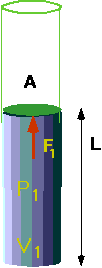
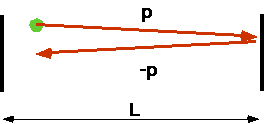
The atoms interact only as hard spheres with a rigid wall, all collisions are totally elastic.Collisions with
the wall will produce a force on the wall, which is the pressure of the gas.
Note that collisions increase as the molecules move faster.
Start with one atom in 1-D!
If we have heavy molecules or fast molecules, force will increase
This says that the heavier the molecules of the gas, the slower they move
Is this reasonable?
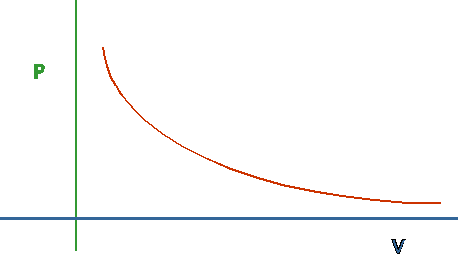
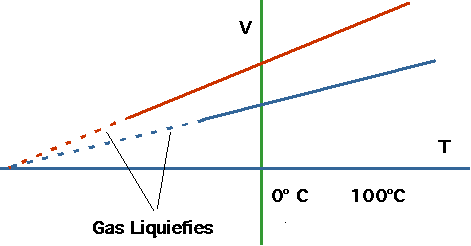
We can understand a number of things from the kinetic theory: e.g. how compressing a
gas makes it heat up (think of a bicycle pump!)
and how an expanding
gas can do work, and the gas cools down and this leads to .....
The First Law of Thermodynamics
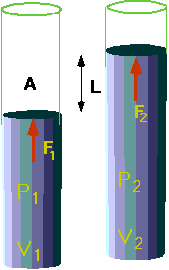
Effectively: energy is conserved. When a gas expands, its energy can change, and it can change the energy of its surroundings
If the piston is allowed to move,then the gas will
do heat or cool.
e.g suppose we paddle a canoe: mechanical energy in the paddle ⇒ motion in the water⇒ motion of the individual molecules ⇒ heat
e.g suppose we burn gasoline in a car: the heat energy in the hot gases ⇒ mechanical energy transmitted to the tires ⇒ mechanical energy (and the gas gets cold)
e.g suppose you eat food before running: the food energy is stored in ATP in your muscles, and ⇒ kinetic energy when you run
This is pretty obvious: it's essentially conservation of energy: what has it got to do with time?
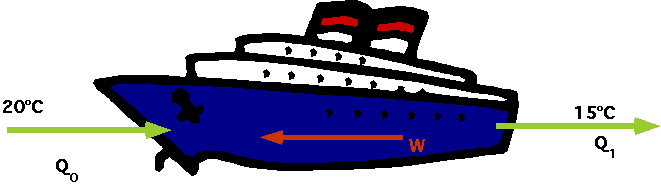
For example, why can't we have (e.g) a boat that takes in water at 20°C,
extracts some heat, turns it into energy and exhausts cold water
Doesn't violate first law
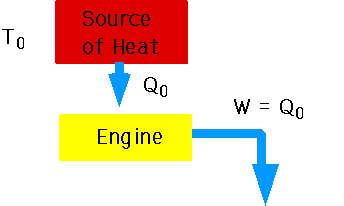
In symbolic terms, why can't we have
Shares for investment in the company will be available after the class.
Second Law of Thermodynamics
A good many times I have been present at gatherings of people who, by the standards of the traditional culture, are thought highly educated and who have with considerable gusto been expressing their incredulity at the illiteracy of scientists. Once or twice I have been provoked and have asked the company how many of them could describe the Second Law of Thermodynamics, the law of entropy. The response was cold: it was also negative. Yet I was asking something which is about the scientific equivalent of: 'Have you read a work of Shakespeare's?'
C. P. Snow
In order to get work out of a system, one must have a very asymmetrical system
e.g. High pressure one side of a piston, low pressure the other side. Can this arise by chance?
e.g. high temp. one side of a piston Can this arise by chance?
Given 6 atoms, what is probability of finding them all one side of a room? Can model this via coin tossing
Entropy
Essentially the relative probability of finding a particular arrangement by chance. If arrangement is improbable, we can always get work out of it.
Hot gas + cold gas <--> warm gas
Gas molecules will randomize themselves very fast
a system will always tend towards the most random arrangement
See Tom Stoppard, Arcadia
THOMASINA: When you stir your rice pudding, Septimus, the spoonful of jam spreads itself round making red trails like the picture of a meteor in my astronomical atlas. But if you need stir backward, the jam will not come together again. Indeed, the pudding does not notice and continues to turn pink just as before. Do you think this odd? Arcadia
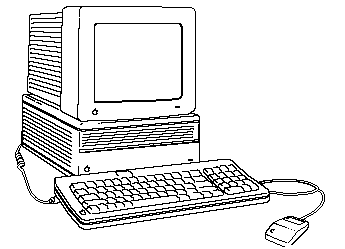
Low entropy Macintosh!
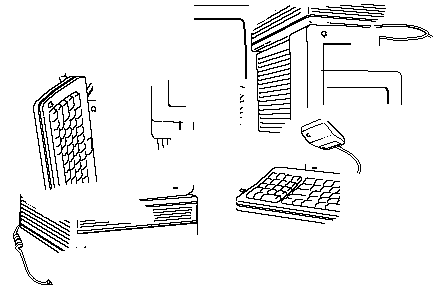
High Entropy Macintosh!
It is very probable that dropping a Mac will rearrange it in a more randomly
ordered form!
Dropping it again (once or one million times) is not likely to get it working
again!
Another version of the 2nd Law:
Entropy tends to increase in a closed system.
Of course we can decrease entropy locally:
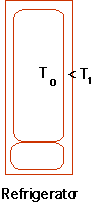
How about a fridge? Initially room & fridge at same temp., afterwards T0
< T1
Fridge is not a closed system: must include power station. How about hydro-power?
Where does the hydro power come from?
Degradation of energy: high temp. energy in sun <--> low temp. energy here
Note that the nomenclature complicates things unnecessarily: it would be easier
if heat was called energy (or maybe heat energy) and entropy was called heat.
Then paraphrase of 2nd Law would be
All forms of energy get converted into heat energy. Once all the heat is at the same temperature, can get no further work.
Murphy's versions of the laws of thermodynamics
1st: You can't win
2nd: You can't break even
3rd: You can't quit the game
No, don't put them on an exam!
2nd law and evolution
2nd law has profound philosophical consequences: e.g:
Clearly complexity of animals has increased over history of earth. We are more
ordered than amoebas (no moral judgments here!)
Therefore evolution contradicts 2nd law?
Not a closed system!
Time and Entropy..
how is tomorrow different from yesterday?
Or better, how do you know if a movie film is being run backwards?
The "arrow of time" is defined via an increase in entropy.
e.g "Time's Arrow" Martin Amis
What happens in the end? i.e how does the universe evolve, assuming that it
is expands for ever?
All processes increase entropy, hence end of universe will
come when entropy becomes a maximum
When temperature of everything is the same, then can do no work, hence .....nothing! Heat Death of the Universe
"This is the way Worlds end, not with a Bang, but a Whimper" T.S.
Eliot
THOMASINA: Well, it is odd. Heat goes to cold. It's a one-way street. Your tea will end up at room temperature. What's happening to your tea is happening to everything everywhere. The sun and the stars. It'll take a while but we're all going to end up at room temperature." Arcadia
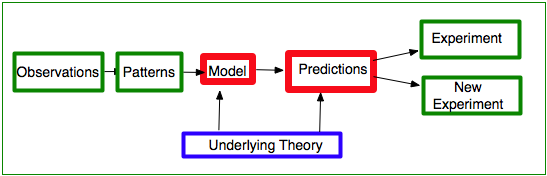
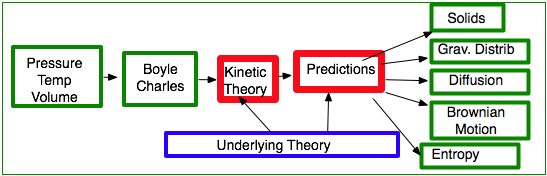
In terms of our scientific model
Chaotic Motion
She comes, she comes, the sable throne behold
Of Night Primeval and of Chaos old!
...
Physic of Metaphysic begs defence
and Metaphysic calls for aid on Sense
See Mystery to Mathematics fly
In vain! they gaze, turn giddy, rave and die
....
Lo! thy Dread Empire, Chaos is restored
Light dies before thy uncreating Word. Alexander Pope, The Dunciad
Up to know we have discussed two kinds of system:
Deterministic: i.e. systems whose future can be predicted exactly
e.g. planetary system, mass on a spring, pendulum.
Random systems: i.e. ones which are too complex to predict exactly
e.g. gas, society...Best we can do is to predict average values
However there are two other kinds of systems:
Chaotic: i.e. systems which are predictable over the short term but not over the long term.
Quantum: systems which are intrinsically unpredictable except in a special sense.
Chaotic systems:
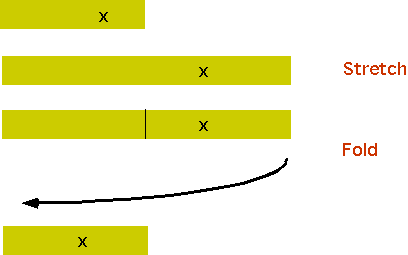
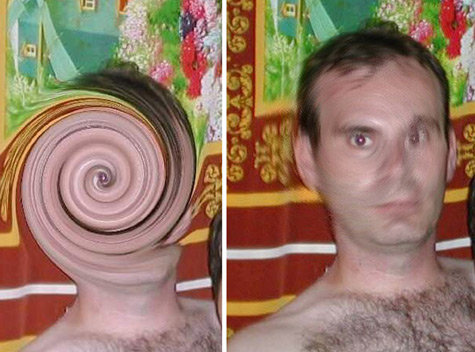
the easiest one to visualize, although technically it is not chaotic, is the "baker transform"
The formula is
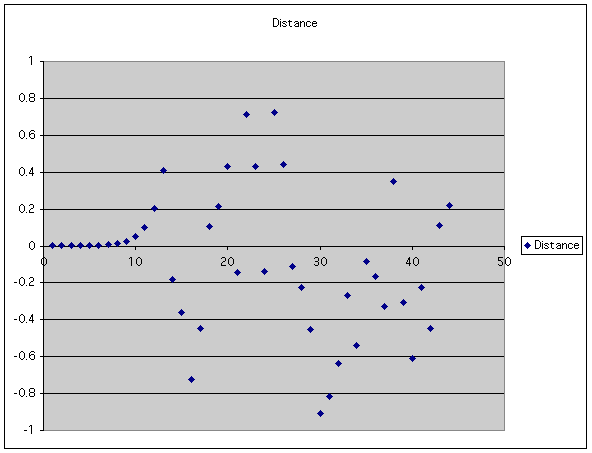
For example, we can start with two points very close together and see what happens:
Step
Particle 1
Particle 2
Distance
1
0.001
0.0011
0.0001
2
0.002
0.0022
0.0002
3
0.004
0.0044
0.0004
4
0.008
0.0088
0.0008
5
0.016
0.0176
0.0016
6
0.032
0.0352
0.0032
7
0.064
0.0704
0.0064
8
0.128
0.1408
0.0128
9
0.256
0.2816
0.0256
10
0.512
0.5632
0.0512
11
0.024
0.1264
0.1024
If you plot the , it looks nice and smooth to start with, but suddenly looks random.
The real physics applications relate to the Lorenz equation and similar.
The easiest to visualize is the "logistic map", which originally arose in modelling population growth. All chaotic systems have some common features
The equations must all be non-linear
There are regions of the parameters where the motion is predictable
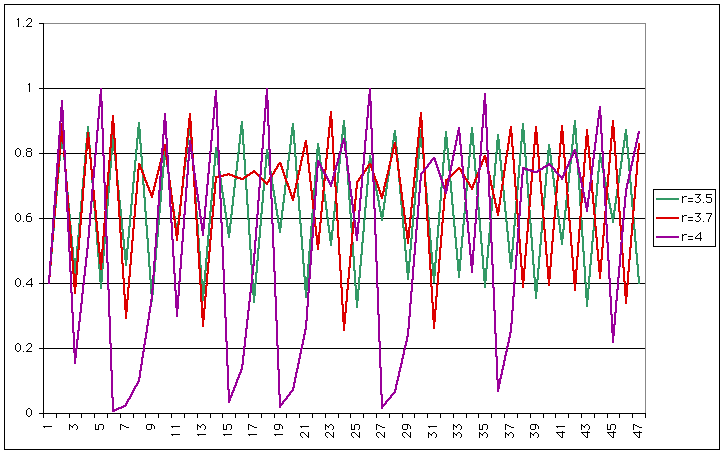
There are regions where it is chaotic
In the chaotic region, points that start off close together become wildly different as time goes on.
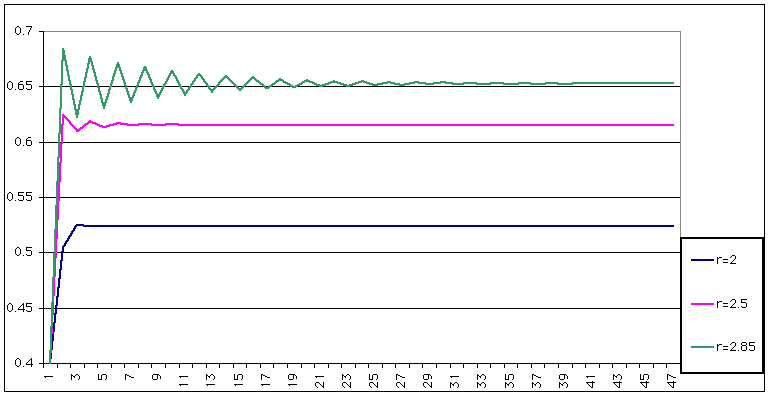
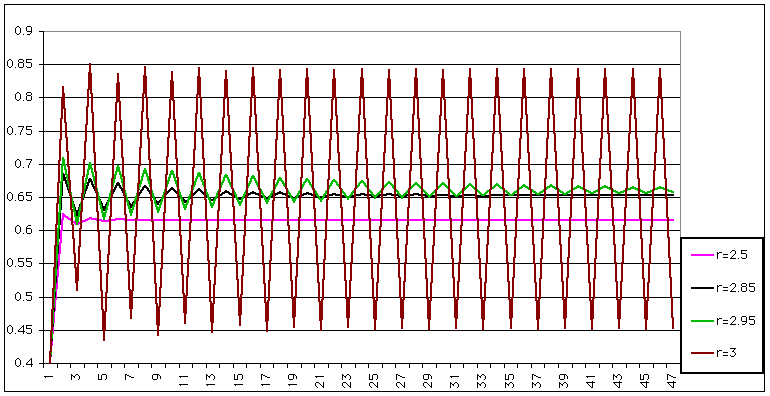
" Obviously " what will happen is that the population will grow until the population reaches an equilibrium value? Deaths = Births
This is what happens for r = 2 (say)
However, for r = , a curious effect arises: the number actually oscillates.
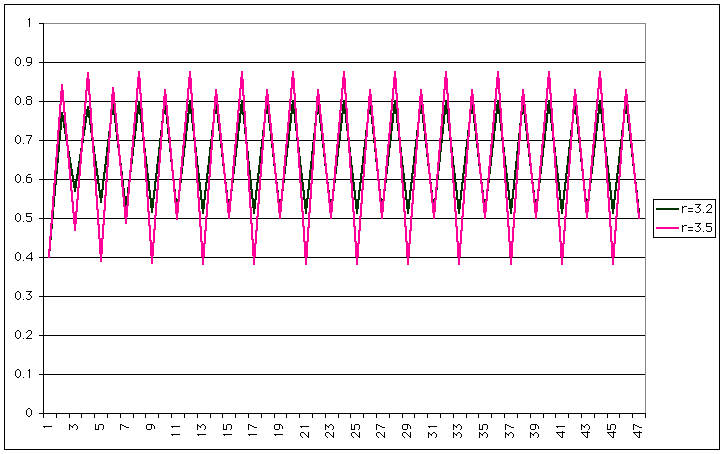
This doesn't seem too bad, until you increase r a bit more
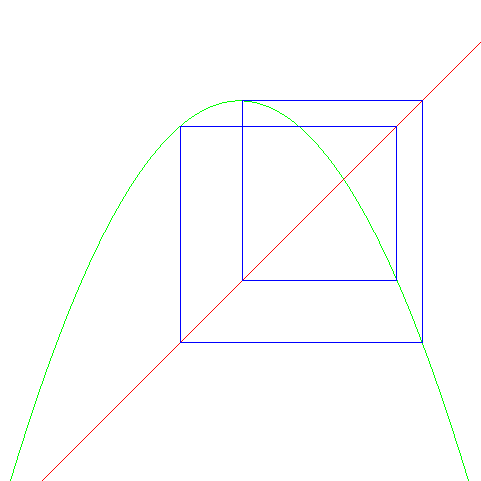
Now you have a period 4 (same period, but two different heights). If we increase r a little more, the behaviour becomes chaotic
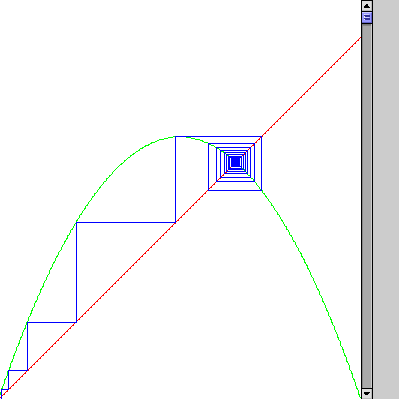
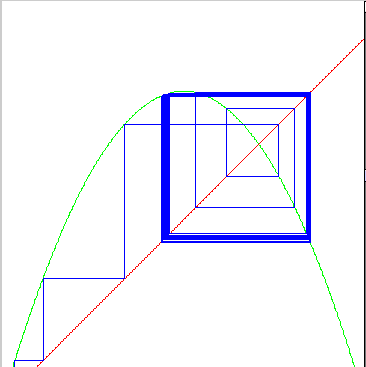
There is a nice way of seeing this: a "logistic map." (1Dmap) One can iterate between the curves
\color{red}{
\begin{array}{l}
y = x \\
y = rx\left( {1 - x} \right) \\
\end{array}}
VALENTINE "You have some x-and-y equations. Any value for x gives you a value for y. So you put a dot where it's right for both x aand y. Then you take the next value for x which gives you another value for y, and when you've done that a few times you join up the dots and that's your graph of whatever the equation is....every time she works out a value for y, she's using that as her next value of x. And so on." Arcadia
For small r = 2.9 we get iteration to the "stationary point"
Thomasina in Arcadia is bored with static geometry and wants to know how ferns grow.
A physical example the "chaotic pendulum". Small swings are predictable,
Medium ones are quasi-periodic
large are not.
The most famous example is weather. "Primitive Equations" written down by L F Richardson (1922). Can't be solved without computer
“After so much hard reasoning, may one play with a fantasy? Imagine a large hall like a theatre, except that the circles and galleries go right round through the space usually occupied by the stage. The walls of this chamber are painted to form a map of the globe. The ceiling represents the north polar regions, England is in the gallery, the tropics in the upper circle, Australia on the dress circle and the antarctic in the pit.
A myriad computers are at work upon the weather of the part of the map where each sits, but each computer attends only to one equation or part of an equation. The work of each region is coordinated by an official of higher rank. Numerous little "night signs" display the instantaneous values so that neighbouring computers can read them. Each number is thus displayed in three adjacent zones so as to maintain communication to the North and South on the map.
(computers in old fashioned sense of someone who computes!)
From the floor of the pit a tall pillar rises to half the height of the hall. It carries a large pulpit on its top. In this sits the man in charge of the whole theatre; he is surrounded by several assistants and messengers. One of his duties is to maintain a uniform speed of progress in all parts of the globe. In this respect he is like the conductor of an orchestra in which the instruments are slide-rules and calculating machines. But instead of waving a baton he turns a beam of rosy light upon any region that is running ahead of the rest, and a beam of blue light upon those who are behindhand.
Four senior clerks in the central pulpit are collecting the future weather as fast as it is being computed, and despatching it by pneumatic carrier to a quiet room. There it will be coded and telephoned to the radio transmitting station. Messengers carry piles of used computing forms down to a storehouse in the cellar.
In a neighbouring building there is a research department, where they invent improvements. But these is much experimenting on a small scale before any change is made in the complex routine of the computing theatre. In a basement an enthusiast is observing eddies in the liquid lining of a huge spinning bowl, but so far the arithmetic proves the better way. In another building are all the usual financial, correspondence and administrative offices. Outside are playing fields, houses, mountains and lakes, for it was thought that those who compute the weather should breathe of it freely.” (Richardson 1922)
The "Lorentz" equations: this is a very simplified version of the equations that describe weather.
These give rise to chaotic behaviour: hence it is plausible that weather itself is chaotic.
You cannot predict the future weather precisely.
However, buried in this are some predictable elements.
e.g. we cannot predict an "el Nino" event, but we can predict the consequences once it has happened.
Note "weather" prediction and "climate" prediction are (almost) unrelated
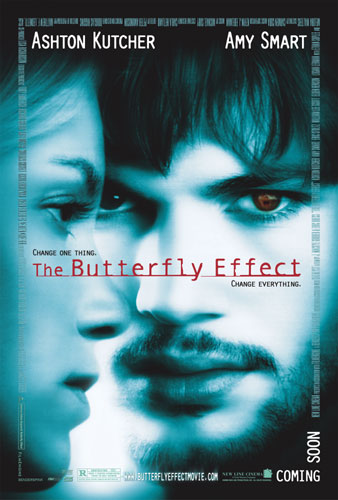
Butterfly effect: arbitrarily small perturbation of initial conditions have unpredictably large consequences
"The Butterfly Effect"
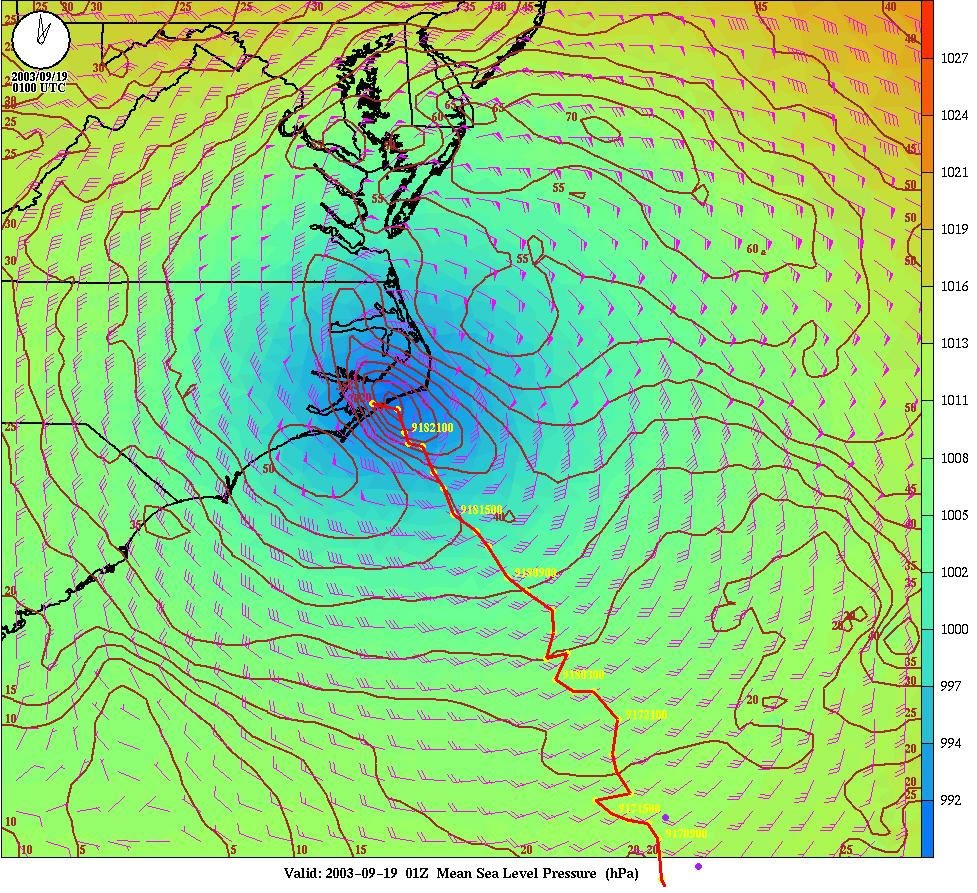
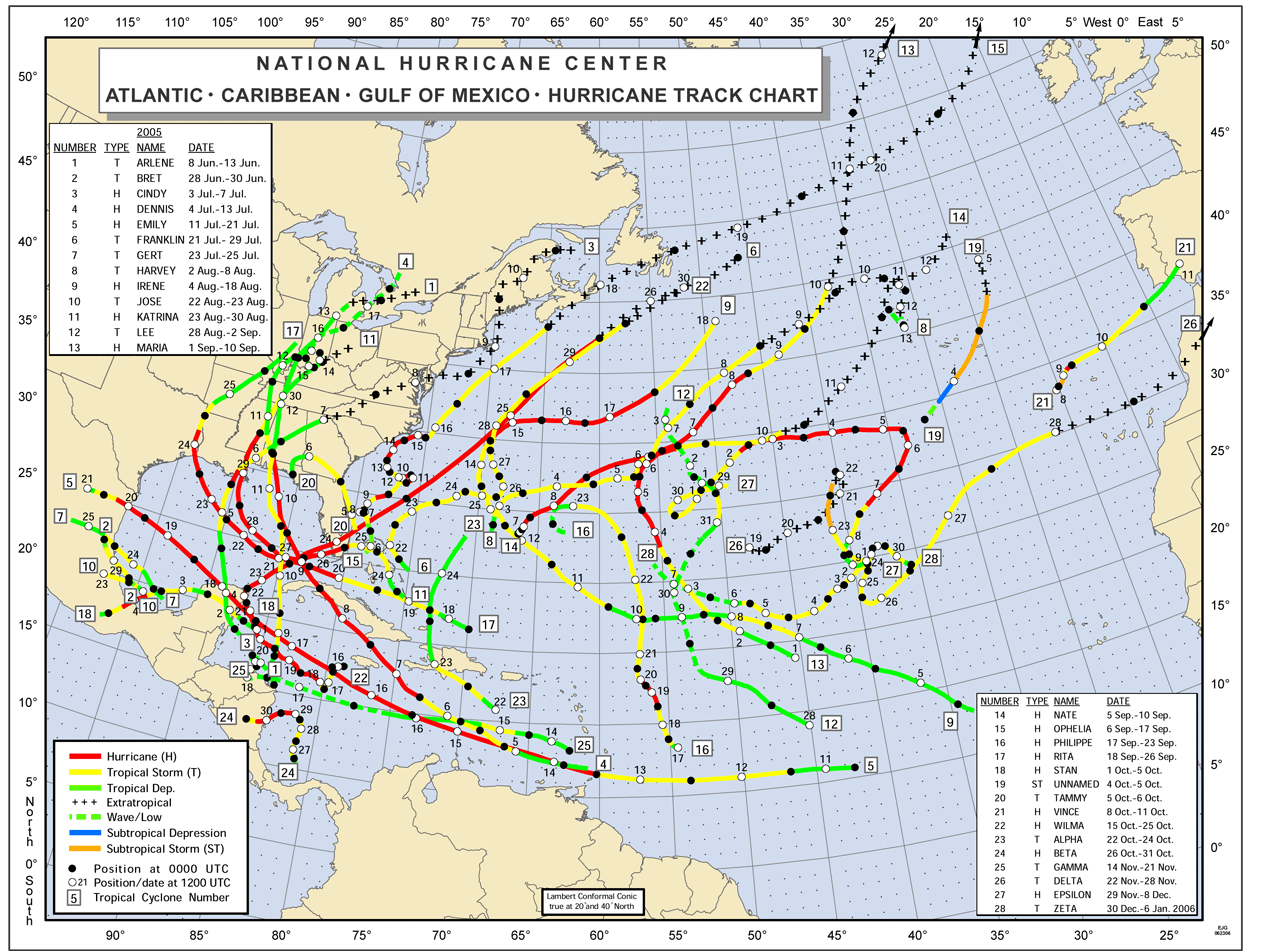
e.g hurricanes:
we'd really like to be able to predict them
What's the pattern?
Note almost identical initial tracks have widely divergent land-falls
contrast with
But we can still predict weather in the short term
George Mason U camp.gmu.edu/significant_ weather_prediction.html
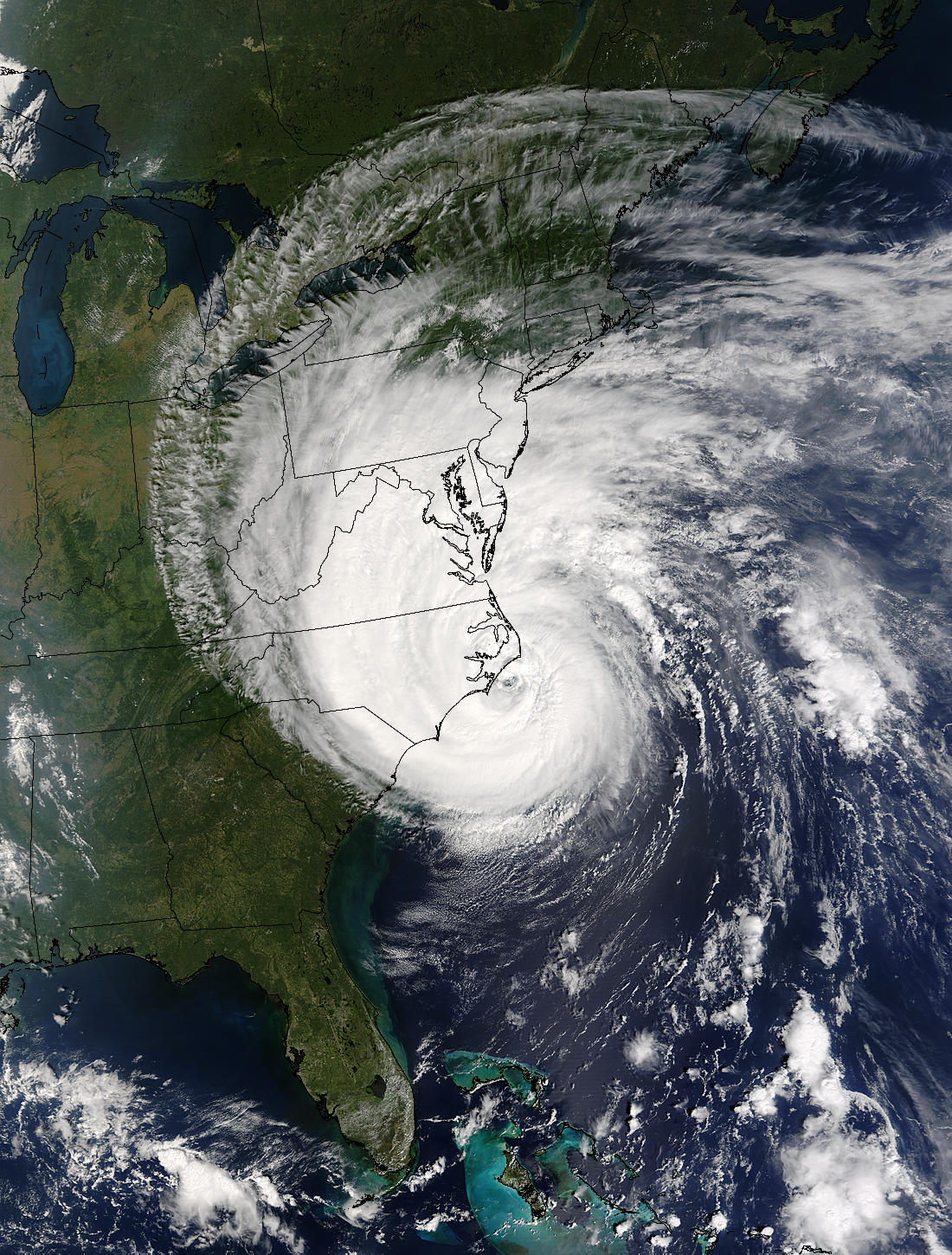
And this is what Hurricane Isabelle actually looked like!
An interesting chaotic system (provided your pension doesn't depend on it!)
So what have we learned about time in physics:
Newton/Galileo saw time as a parameter, the same for everyone in the universe
Causality tells us that causes must precede effects
Clocks tell us how to measure time
Special relativity links time and space.
General relativity tells us how space-time is distorted.
Entropy sets the direction of time.
Chaotic systems tell us that we cannot predict most systems in the long term
And now for something completely different: what does physics tell us about music



 What's the pattern?