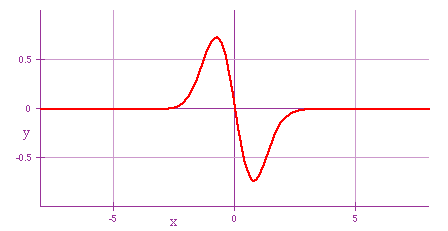
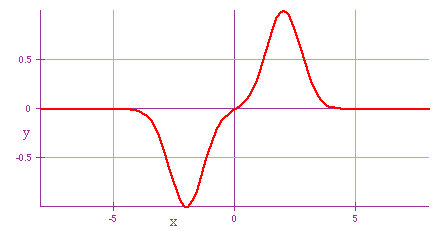
We are interested in waves, but it is usually easier to start with oscillations (one-D waves) There are many forms of oscillatory motion is nature: e.g.
Mass on Spring
Pendulum
Stringless pendulum
Ball in bowl
Fortunately, all can be simplified to very similar mathematics
First some nomenclature
Amplitude (A): size of swing
Cycle: a complete oscillation (back and forward)
Period (T): time for one cycle
Frequency f = number of turns (vibrations)/s = 1/T usually called Hertz (Hz)
Hertz also used for wave motion
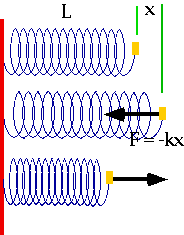
The Spring
Easiest mathematically is the spring. One more special force:
CEIIINSSSOTTUV
which you will immediately realise is
SIC VIS UT TENSIO
which in turn you will translate as ...
As the Force, thus the extension or as we say
Hooke's Law
extension ∝Force,
or
F = -kx
Note only the extension matters
Force is in opposite direction to extension
x is extension (not the original length)
- sign to get the direction right
k is the spring constant
\color{red}{
P = 2\pi \sqrt {\frac{m}{k}} }
stiff springs (large k) vibrate faster
large masses (large m) vibrate slower
Simple Waves
Easiest to visualize are water waves, or waves in slinky , but also
Waves in string
Sound waves
Light Waves
Guitar/violin string
Drum head
Usually medium is left undisturbed by passage of wave (can't tell if a water wave has been past)
Waves can be
Pulses
Continuous Waves
Standing Waves
Pulses
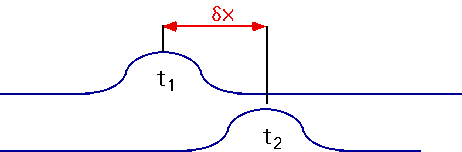
Easy to see what we mean by velocity/speed of wave
If wave travels a distance
δx in δt = t₂-t₁
then
v = δx/δt
Periodic Waves
Continuous waves which repeat are periodic waves
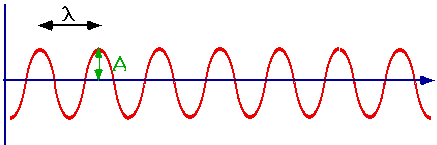
Because it is mathematically simple, we will often use harmonic waves: i.e. sine waves:
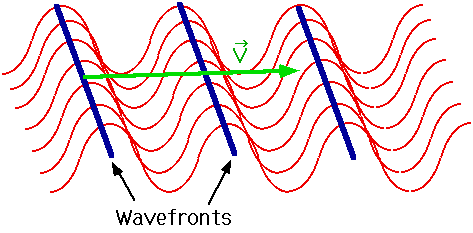
As before v is speed at which one crest (or trough) moves
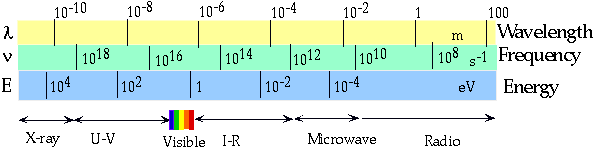
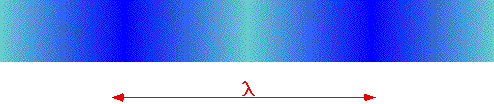
Wavelength: λ = distance between successive peaks (or the same point on each successive wave)
Amplitude (A): "height" of wave (need not be a physical height)
Period (T): time for one cycle to pass a given point.
Frequency f (or ν , pronounced nu): no. of crests/s = 1/T
Wave-function is "shape" of wave
Obviously
Speed = wavelength x frequency
v = λf
(why?)
Longitudinal Waves
Waves can be
Longitudinal
Transversei.e. particles move perpendicular to wave
Longitudinal: i.e. particles move in direction of wave
e.g. Slinky
Sound Waves
Molecules move backwards and forwards to create regions of higher or lower density. Note sound travels through a solid in exactly the same way
Transverse waves
where the movement is perpendicular to the velocity
e.g. String, light, water-waves.....
or slinky!!
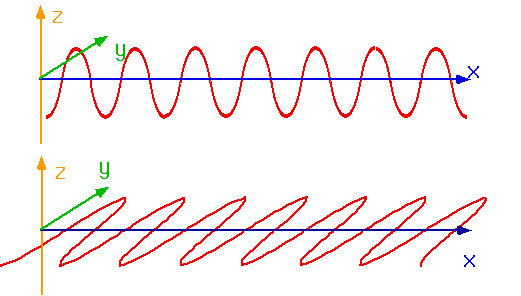
Tranverse waves can be polarized in the vertical plane, or the horizontal plane or anywhere in between
Damped S.H.M.
Reality rearing its ugly head again. If there is friction in the system,
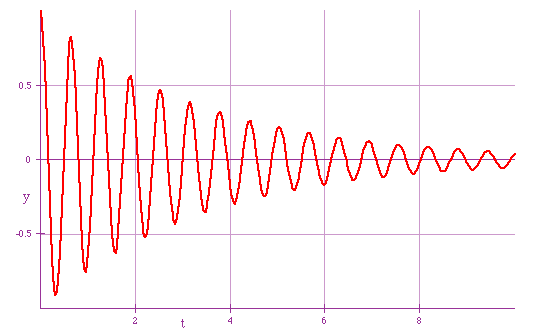
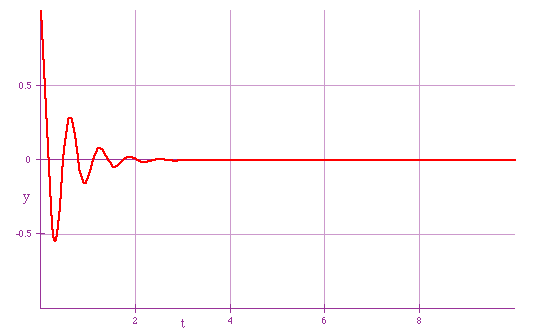
the frequency is almost the same, but the amplitude decreases exponentially with time. The extreme cases are
a pendulum swinging in vacuum: almost undamped
a pendulum swinging in syrup: will not complete one swing
Up to now, we have assumed that the system is started off at some time and allowed to oscillate. However, can arrange for the system to be driven, so that driving force varies in time. Watch the demo:
If driving frequency
ω0 matches natural frequency of system
ω, then size of oscillations grows
Usually some damping, so does not grow without limit. e.g.
Soldiers marching across bridge (did it ever happen?)
Status: RO
From: "MIDN Zamberlan" <m017107@usna.edu> To: <watson@physics.carleton.ca>
Subject: Answering a rhetorical question
Date: Fri, 17 Nov 2000 01:28:03 -0500
X-Priority: 3
I was reading your class on simple harmonic motion and you said "soldiers marching across bridge ,did it ever happen?" Well, actually I have seen it occur at the US Naval Academy. In '97 the freshmen, plebes, were out exercising and ran across a wooden footbridge in cadence. There was 50 of them. The bridge is about 200 ft long and once they reached the middle, two of the supports snapped and the bridge began to oscillate noticeably. The bridge was then condemned till a Naval Construction Battalion was able to repair it. I hope this answers your question.
Very respectfully,
RJ Zamberlan
MIDN, USN
Bay of Fundy,
hot air over beer bottles,
musical instruments (most)
wash-board roads,
resonances in nuclei,
electrons in an AC circuit and...............................
the Tacoma Narrows bridge
Speed of Waves
What governs the speed of a wave?
light = 3x10⁸ ms-1
water waves:
small λ(ripples) v ~1 cms-1
medium λ (waves on lake) v ~ 2 ms-1
large λ (tidal waves) v ~ 100 ms-1
Speed of sound in air= 330 ms-1
Sound is often produced by strings: speed of wave depends on
density of string ρ
thickness (better: X-sect area) of string A
tension T
\color{red}{
v = \sqrt {\frac{T}{{\rho A}}} }
Why is this plausible?
Interference
Back to waves in general
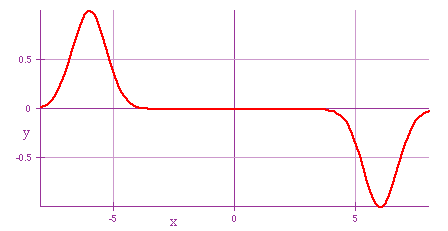
e.g pulses: Waves will pass through each other with no (permanent) effect on each other.
Note this means that we can "cancel out" a loud sound by radiating one of same frequency out of phase.
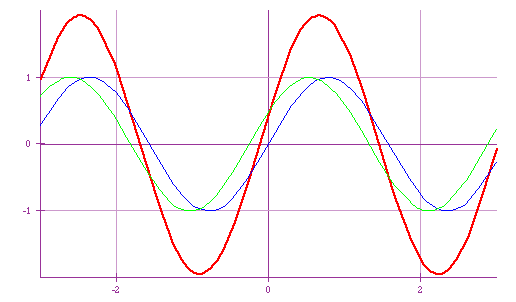
What if the frequencies of the waves are not exactly the same?
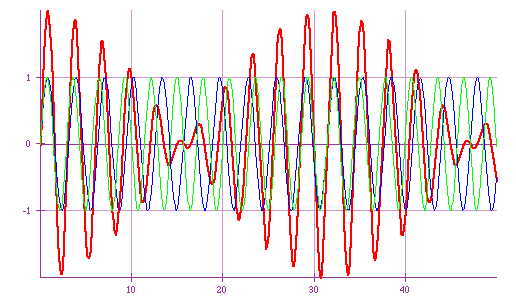
If k₁ and k₂ are different, then they will add up constructively at times and destructively at others. The result is a wave that is sometimes large and sometimes vanishes. See the animation.
If this is a sound wave, we hear it as "beats":
400 + 401 Hz
400 + 410 Hz
400 + 420 Hz
Note closer frequencies are the wider the separation
Practically: we are very interested in sound, since it forms such a large part of our communication. Most sound waves are set up by standing waves
In general:
f = v/λ
(write it this way since λ is defined by "shape" of object and v by mech. props)
Now we can start on sound and music:
Simplest is a guitar string
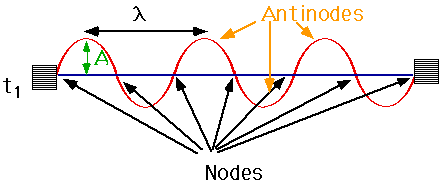
Ends don't move: can only fit a fixed number of half-waves into the string
L = (n/2) λ, n = 1,2,3,4,
These are known as "harmonics": n=1 is fundamental, n = 2 is "first harmonic" and so on.
e.g. guitar has all wavelengths that satisfy (n/2)λ = L so frequencies are
f0 = 1/2v/L   fundamental
f1 = 2/2v/L   1st harmonic
fM = M/2 v/L  (M-1)th harmonic
In principle, all of these can be excited, but in practice the amount of energy required for higher harmonics is larger, so that they are less easily excited.Hence actual note heard is superposition of many frequencies
Nodes are points where string does not move: points half way between with maximum motion are antinodes.
Wind Instruments
Most wind instruments have one open end e.g. flute, oboe, beer-bottle, organ...
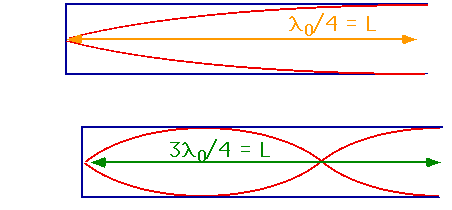
Note what is really happening is that the molecules move a lot at the antinodes but are stationary at the nodes.In particular,there is no motion at the closed end. The fundamental in this case has 1/4 wave
λ = 4 L
λ = 4L/3
This is 3/4 wave.
in general .
λ = 4 L/(2n+1)
Hence frequency
f = (2n+1) v/(4L)
Note harmonics are not one octave higher.
e.g. A beer bottle is about 25 cm high. What would you expect the fundamental note to be at? (speed of sound = 330 ms-1)
Historically, we have notes described in terms of octave:
C
Db
D
Eb
E
F
Gb
G
Ab
A
Bb
B
One octave = doubling of frequency
C
8.2
16.4
32.7
65.4
130.8
261.6
523.3
1046.5
2093.0
4186.0
8372.0
Db
8.7
17.3
34.6
69.3
138.6
277.2
554.4
1108.7
2217.5
4434.9
8869.8
D
9.2
18.4
36.7
73.4
146.8
293.7
587.3
1174.7
2349.3
4698.6
9397.3
Eb
9.7
19.4
38.9
77.8
155.6
311.1
622.3
1244.5
2489.0
4978.0
9956.1
E
10.3
20.6
41.2
82.4
164.8
329.6
659.3
1318.5
2637.0
5274.0
10548.1
F
10.9
21.8
43.7
87.3
174.6
349.2
698.5
1396.9
2793.8
5587.7
11175.3
Gb
11.6
23.1
46.2
92.5
185.0
370.0
740.0
1480.0
2960.0
5919.9
11839.8
G
12.2
24.5
49.0
98.0
196.0
392.0
784.0
1568.0
3136.0
6271.9
12543.9
Ab
13.0
26.0
51.9
103.8
207.7
415.3
830.6
1661.2
3322.4
6644.9
13289.8
A
13.8
27.5
55.0
110.0
220.0
440.0
880.0
1760.0
3520.0
7040.0
14080.0
Bb
14.6
29.1
58.3
116.5
233.1
466.2
932.3
1864.7
3729.3
7458.6
14917.2
B
15.4
30.9
61.7
123.5
246.9
493.9
987.8
1975.5
3951.1
7902.1
15804.3
Various aspects become obvious: In terms of this physics,
Why does increasing/decreasing the tension increase/decrease the pitch?
Why do thicker strings play lower notes?
What happens to the note if we halve the length of a string?
What happens if we touch a string at the midpoint?
Dynamic range: lowest available note to highest: what is it for guitar?
For recorder?
In general, each frequency will have a different amplitude, and the sound depends on this. Why does same fundamental on different instruments sound different?:
Violin (bowed)
Clarinet
Can analyse this:
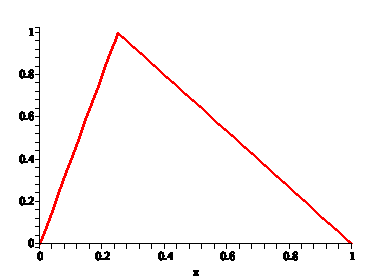
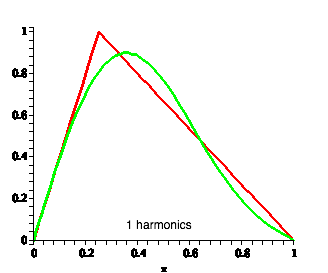
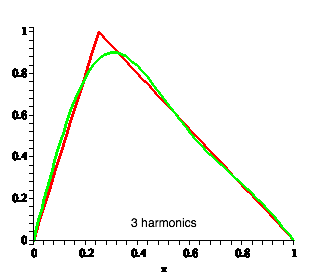
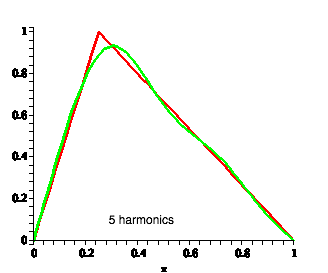
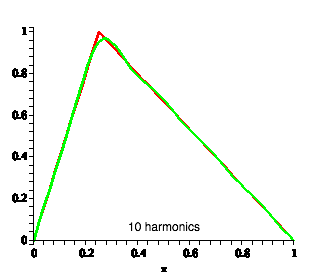
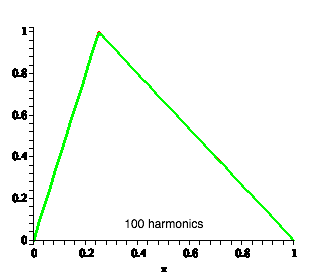
e.g. suppose a guitar string is plucked at the 1/4 distance point.
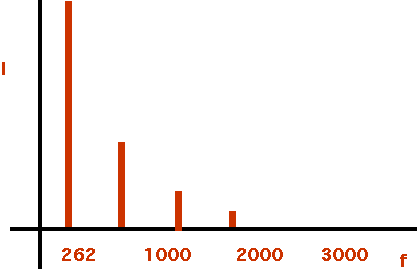
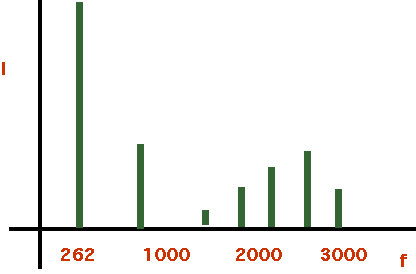
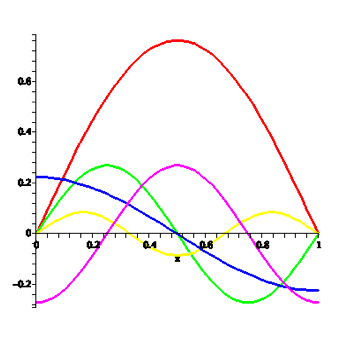
This will excite a fundamental and a set of harmonics.
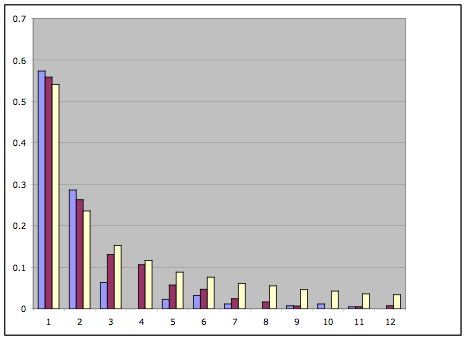
This shows the actual harmonics: note the fundamental is the largest
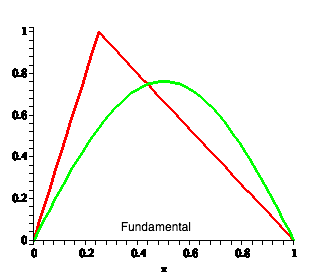
Not obvious that this gives us the original string shape, but we can add in successive harmonics to produce the original shape
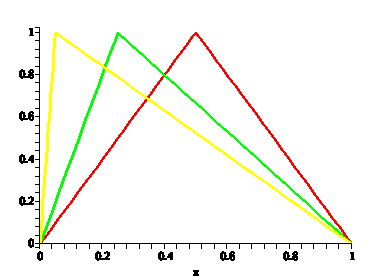
Means we can look at different shapes and find the harmonic content
Note that the simplest wave (plucked at half-way) has most fundamental, plucked at .05 gives us largest high harmonics
This technique (of adding wave to make complex shapes) is known as Fourier analysis.
Note that once we understand Fourier analysis, we can produce "impossible" sounds (see http://asa.aip.org/sound.html )
e.g. Shephard scale
e.g. Rissett scale
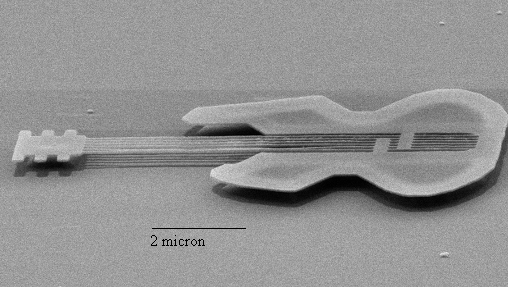
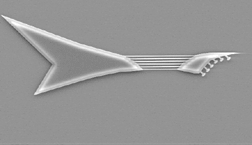
Nano-guitar.
To produce waves of 1m wavelength need instrumentent about 1m in size . If we have a much smaller intrument we produce much higher frequencies
e.g. nanoguitar. 10 μ long, trings are ∼ 50nm in diameter, played with laser beam.
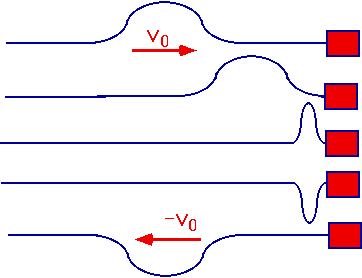
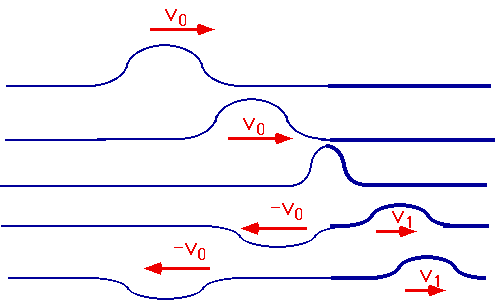
Wave is partially reflected and partially transmitted
Try the animation
Note: "refracted" wave propagates at a different speed.
What happens when a light wave hits glass?
Some is always reflected
Energy in waves:
Note how the string moves: Not only does the wave move forward, but each individual particle is displaced. This means a wave carries energy. Each particle would have
P.E. = 1/2 k x ²
where x is the maximum displacement. Also
K.E. = 1/2 m v ²
so more rapidly oscillating string means larger velocity so...
power in wave ∝ square of amp.
∝square of frequency
P∝ f²|A|²
i.e. double the amplitude, 4 times the energy: this means it is harder to excite large amplitudes and high frequencies. Generally true for any kind of wave.
Energy in sound waves:
We are sensitive to power/unit area: this is intensity I
\color{red}{
I = \frac{{\delta P^2 }}{{2\rho c}}}
δP = change in pressure ~amplitude of wave
ρ = density of air
c = velocity
e.g. maximum overpressure the ear can stand is ~ 30 Pa (atmos pressure ~105 P): this is only about .03%
At maximum allowable level, ear only absorbs about 1 μW (!)
We usually express this in logarithmic form (What we hear is log(I), not I, so 10 times the intensity can sound twice as loud)
β = 10 log(I/I0)
where I0 is the faintest sound we can hear (threshold of hearing ~10-12 watts/m2).
This implies an amplitude of ~10-11 m, (for f ~ 1kHz) which is less than size of an atom!
β is loudness in decibels
whisper β ~ 50 db
conversation β ~ 70 db
pain threshold β ~ 120 db
Dire Straits β~ 130 db
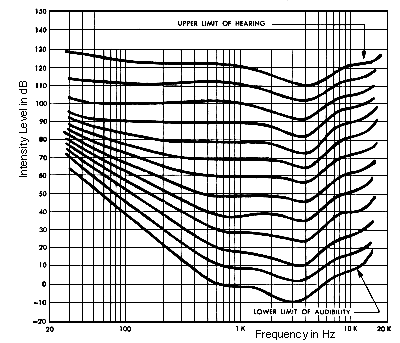
Note that our hearing response is not uniform at all frequencies:
Top curve is threshold of pain,
bottom is threshold of hearing
Children have wider dynamic range 10 Hz-20kHz
Repetive exposure to intense sounds of one f will destroy ability to hear that.
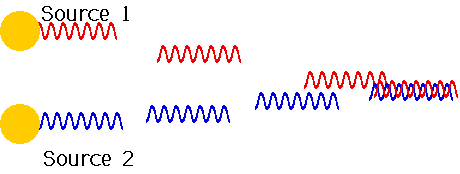
For light, there is an extra problem: sources don't stay in phase...
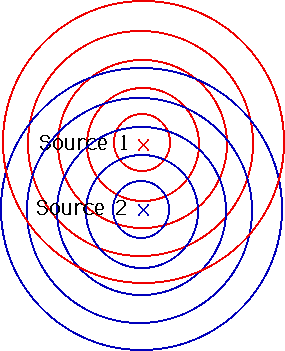
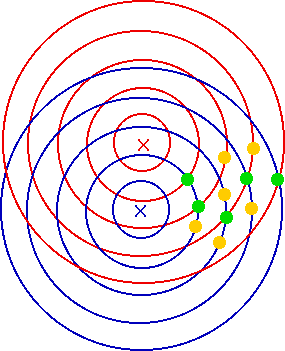
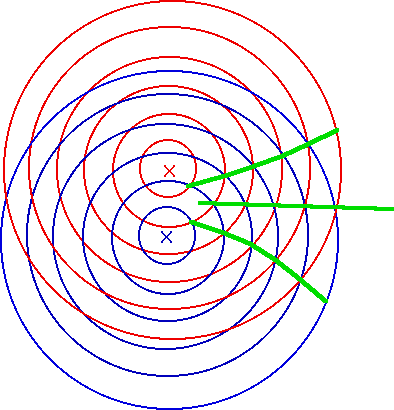
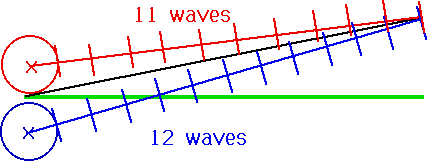
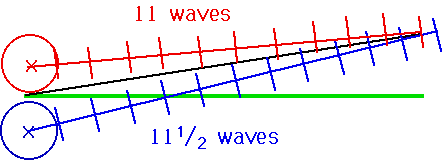
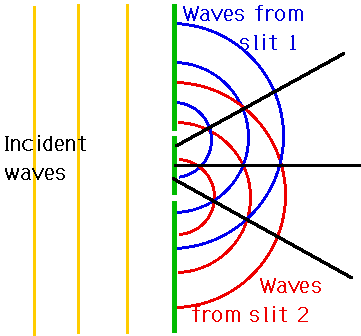
We can overcome this by using the same wave twice! Make two bits of the wave go through separate slits
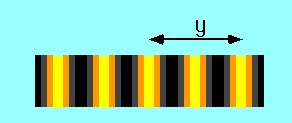
e.g. a light produces Na (sodium) light (λ = 589 nm) and it passes through two slits separated by 5μ (5x10⁻⁶ m). How will it appear on a screen at a distance of 1 m?
It is this experiment that proved conclusively that light is a wave, not a particle as Descartes and Newton thought.
Gravitational Waves
A final consequence of General relativity
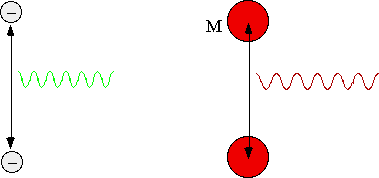
Vibrating charge radiates E.M. waves (i.e. light)
Vibrating mass radiates grav. waves
Differences:
Gravitational force between 2 electrons ~ 10-42 electric force Radiation is quadrupole, not dipole, which also means it is still weaker
Can only be produced by assymetric system
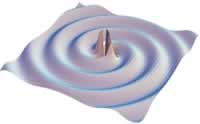
Hence (well, more or less hence!) it requires a large amount of mass to produce a grav. wave, and a large amount to see one: e.g. coalescing binary stars
Note what is happening here is that space-time is stretching (!)
History:
Joseph Weber claimed to have seen grav waves in 1970.
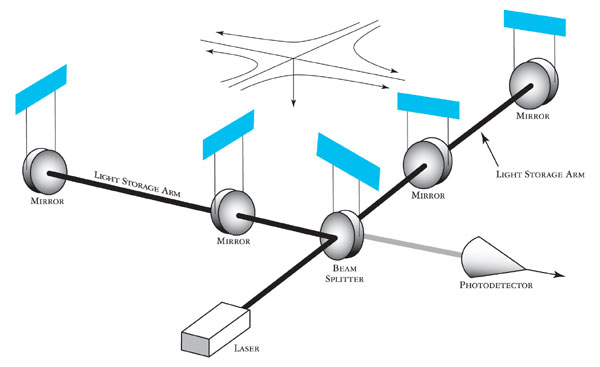
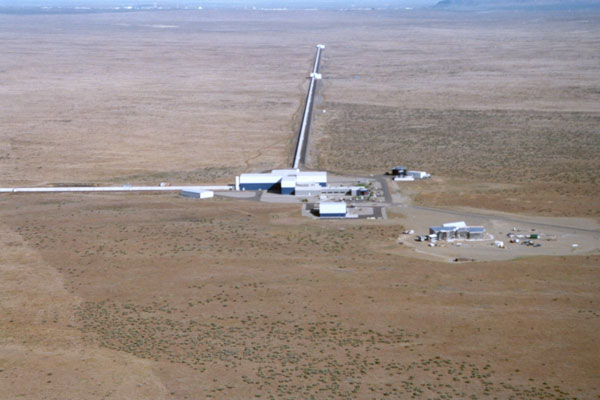
LIGO (Laser interferometer Gravitational Wave Observatory) detectes GW's by interfering 2 beams of laser light after sending them along 4 km arms
LIGO turned on in 2004: will see coalescing binary systems
LISA (space interferometer) will detect grav. radiation from anything within 106 light years
Hulse and Taylor: Binary Pulsar
PSR1913+16 discovered 1974. Like all pulsars, emits very regular radio pulse every 59 ms. (Frequency is 16.940 539 184 253 Hz: i.e. is better known than atomic clocks)
This consists of two neutron stars, in orbit 106 km in radius, with period of hours. Change in frequency allows orbit to be calculated exactly, and can measure..
Rate of precession = 4.22662 0/yr (i.e. 30,000x that of Mercury)
and that pulsar is losing energy, by gravitational radiation (mass~1.4 M0, and accns are large)
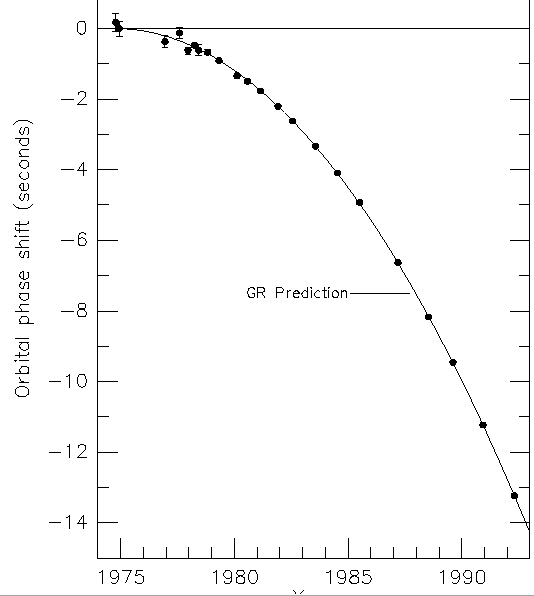
Decrease of the orbital period P (about 7h 45 min) of the binary pulsar PSR B1913+16, measured by the successive shifts T(t) of the crossing times at periastron; the continuous curve corresponds to $$
\color{red}{
T(t) = \frac{{t^2 }}{{2P}}\frac{{dP}}{{dt}}}
$$
given by the general relativity (reaction to the gravitational waves emission).
Reference:
Taylor J.H. 1993, General Relativity and Gravitation 1992, eds. R.J. Gleiser, C.N. Kozameh, O.M. Moreschi. Institute of Physics Publishing (Bristol).






 .
.