
Pat McCracken, NASA
Why does the shadow point at the moon |
Pat McCracken, NASA Why does the shadow point at the moon |
Note that the effect of manned (or wommanned) exploration has been miniscule (the Moon is a very dull place!)
| A prominence erupts from the surface of the sun (7 light-minutes) | 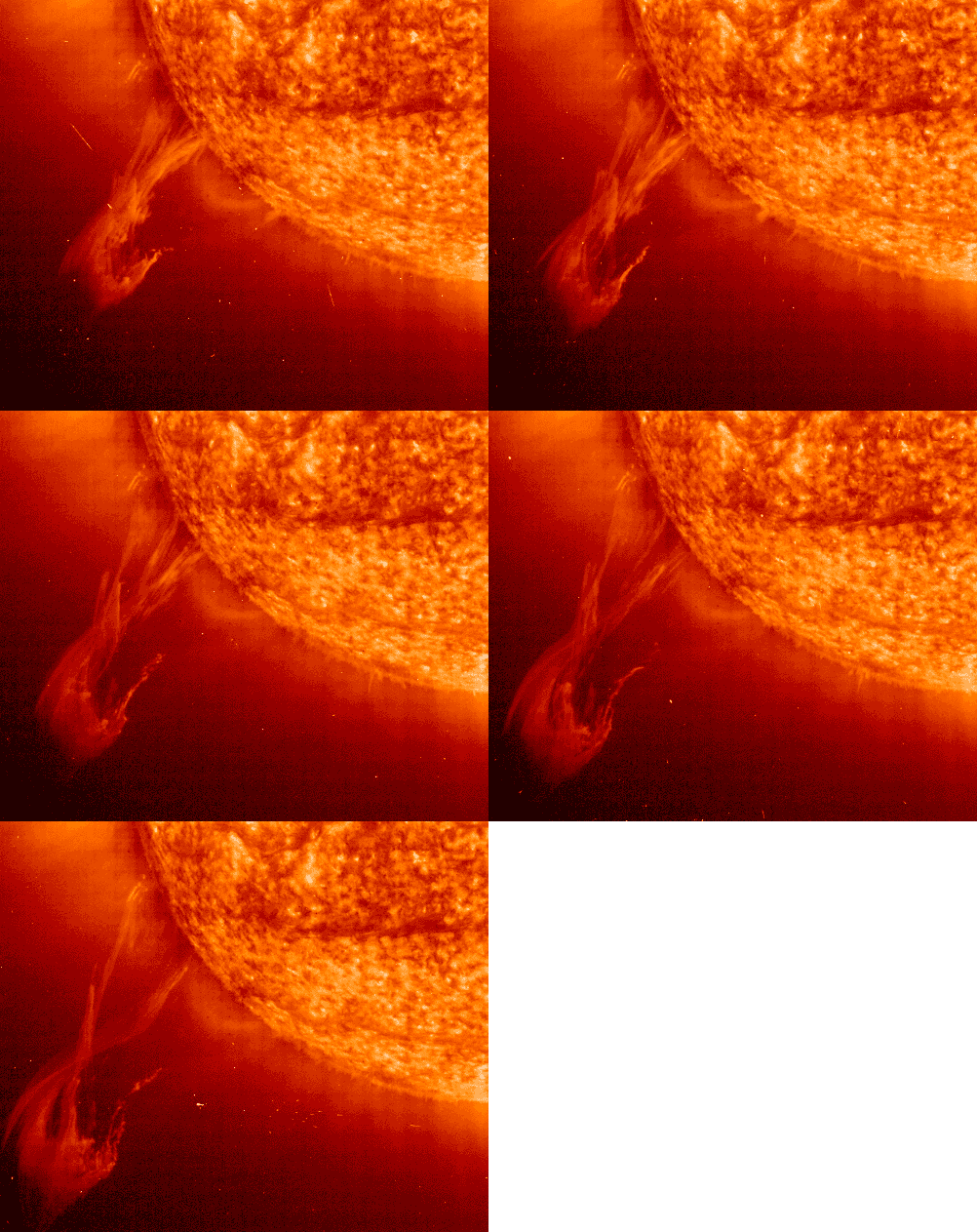 |
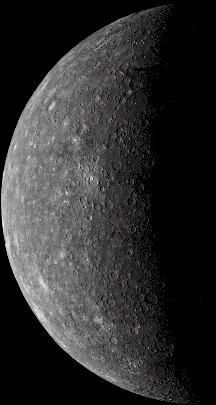
The surface of mercury
|
 |
| Degas crater | 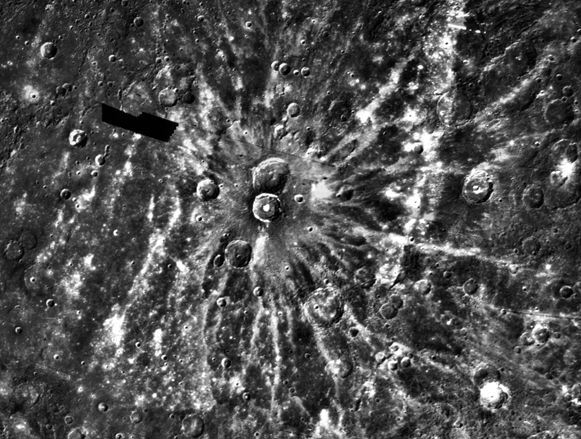 |
|
Orbital period of 88 days.
Rotational period ∼ 56 days (Long thought to be ∼ 88 days: In fact, it is 2/3 of the orbital period). |
 |
| Popular with writers: e.g C. S Lewis So does it look like this? |  |
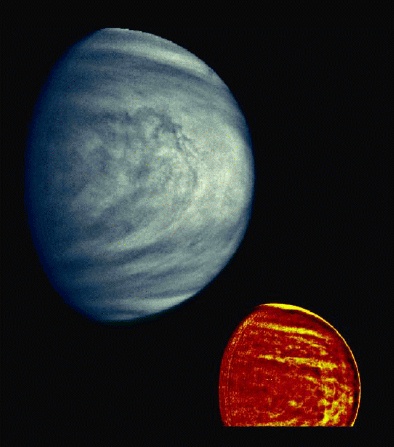
| Almost featureless in optical. Usual picture is UV (upper) or infrared (lower) and only shows cloudtops.
Venera, pioneer and radar showed surface for first time Year = 225 days. |
 |
Upper clouds rotate in 4 days (∼360 km hr-1) Surface rocks basaltic, appear to be young |
 from Jim Imamura: http://zebu.uoregon.edu/~imamura/121/lecture-11/lecture-11.html |
| Radar maps show rough terrain as bright | 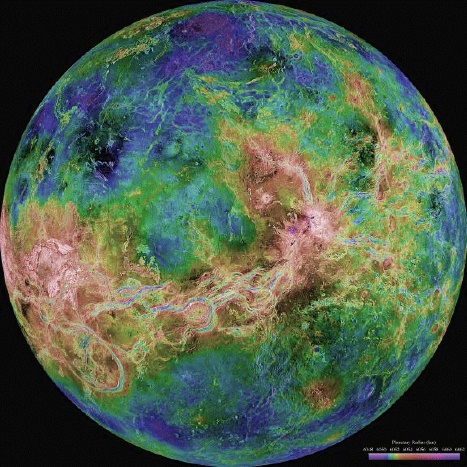 |
| Sapas Mons, a volcano 400 km across and 1.5 km high is on the western edge of Alto Regio. Note the lava flows extend for hundreds of km. | 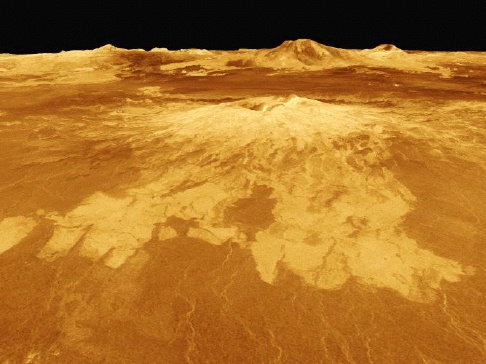 |
| Very poular with writers: Bradbury did it best ("Sands of Mars")
Lowell observed canals |
 |
| Atmosphere: pressure ∼ 0.005 bar 95% CO2, rest O2, N2, Ar + very little H2O
Temperature range 210 K->310 K |
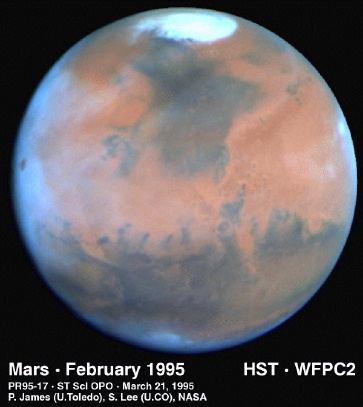 |
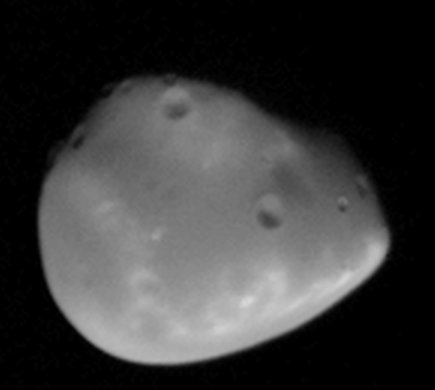
| Two small, close, irregularly shaped moons. Phobos has very large impact crater. |
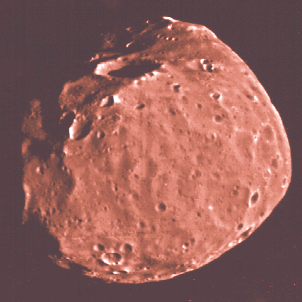 |
| Deimos Moons are probably captured asteroids. |
 |
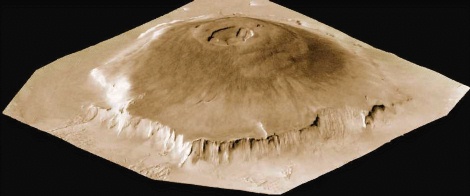
| VOLCANOES: Olympus mons: 25 km high, evidence of lava flows. Much larger than equivalent ones on earth (why?) |
 |
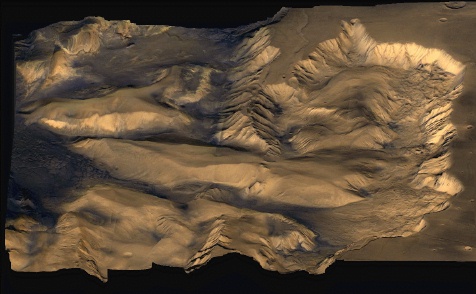
Candor Chasma |
 |
| Many craters, at various stages of newness | 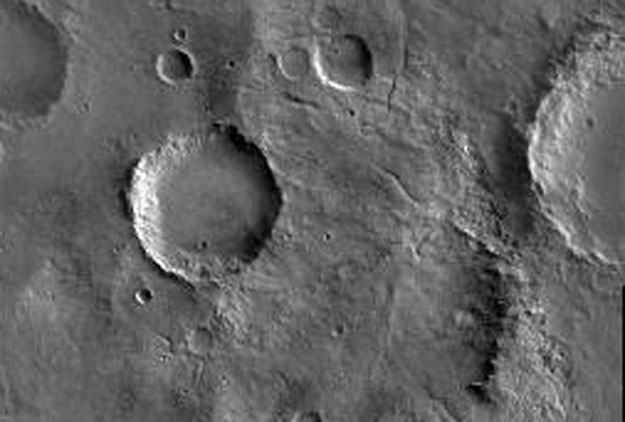 |
| The interesting problem: Does Mars have water? Sometimes it looks just as though it once did | 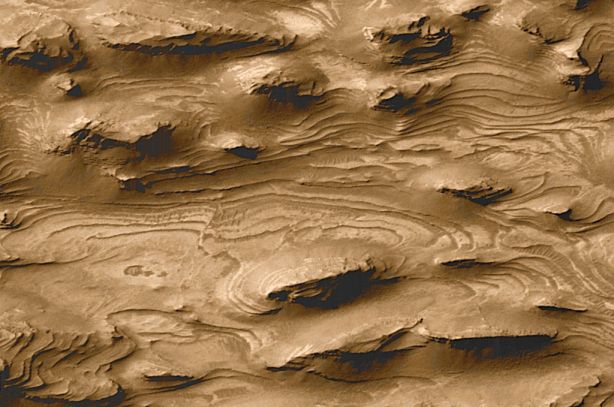 |
| This is the Newton crater | 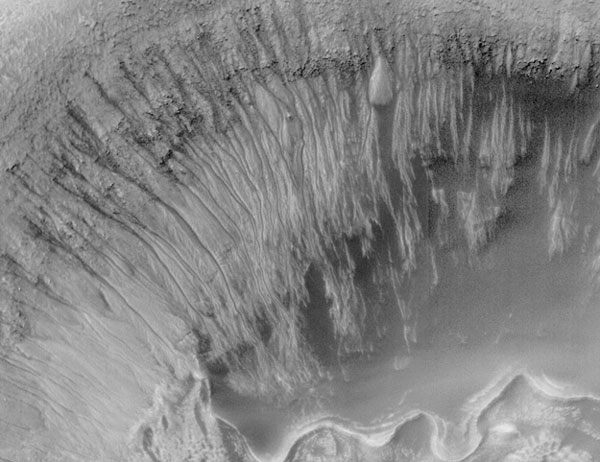 |
| and what really look like arroyos in New Mexico | 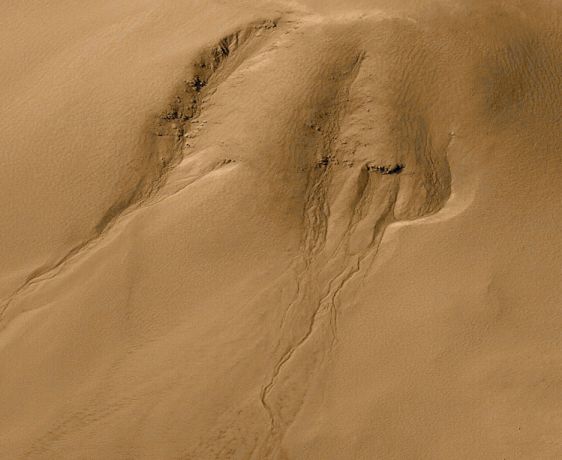 |
| and "holes":deep caves where water could still exist. SO probably there was a lot of water, coiuld still be some underground |  |

| Methane: tends to be created by living things (e.g. microbes ....) |  NASA |
| Largest planet by far.
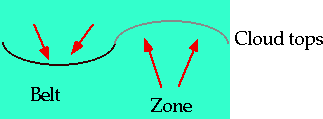
Strongly banded appearance, corresponding to convective regions in atmosphere. Dark areas (bands) lie lower in atmosphere than light areas (zones). |
 |
Colours probably due to complex organic molecules: detected so far are:
|

 |
| : noted since 1600's ∼ 20,000 km × 50,000 km. Top of spot extends well above surrounding cloud tops. Note downstream eddies. Colour probably from organic molecules stirred up from below. |
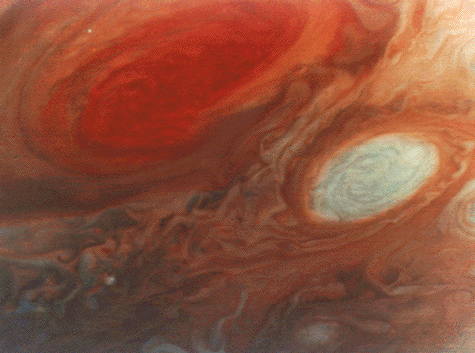 |
| Speeds of rotation ∼ 500 km/hr Now clearly seen to be "hurricane" (lifetime not too surprising: 1000 × bigger than terrestial hurricanes, so lifetime could well be 1000 × longer!) |
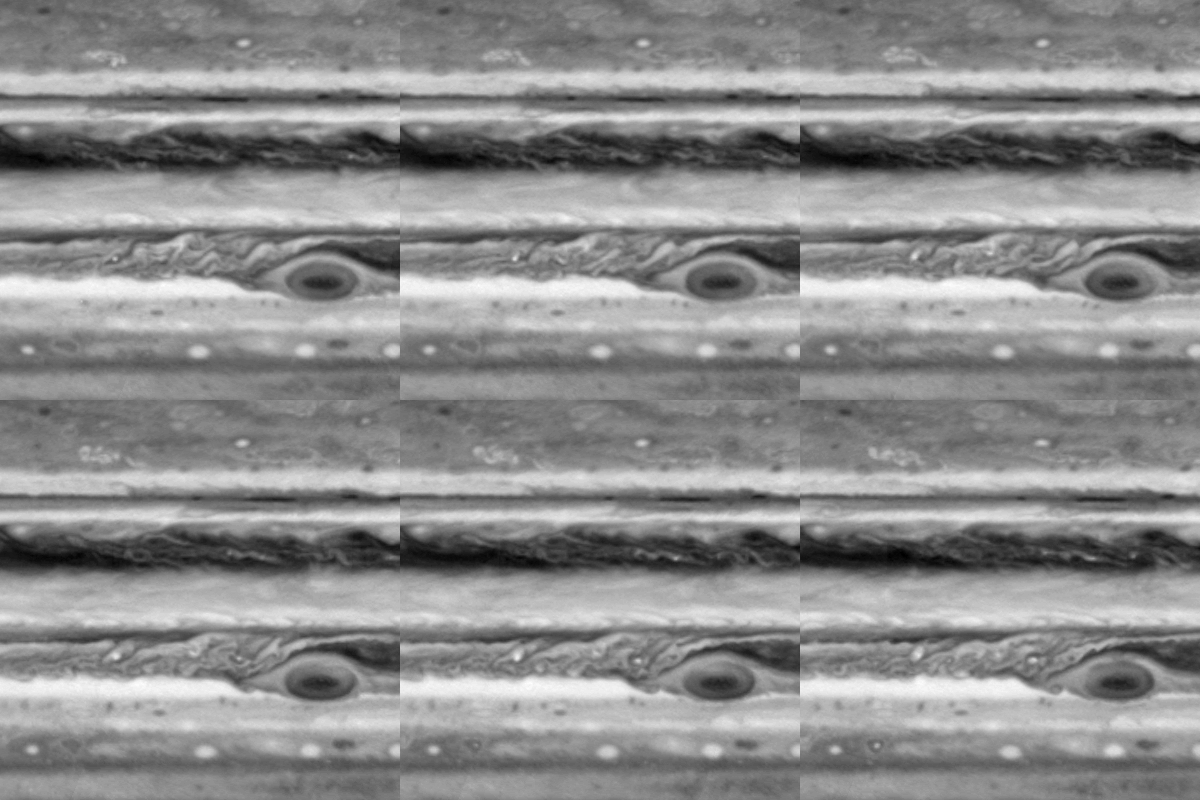 Cassini At Jupiter: Red Spot Movie Credit: CICLOPS, NASA, JPL, University of Arizona |
| Jupiter has some of the oddest moons in the solar system. Four large easily visible with binoculars Can watch Io rotating |
|
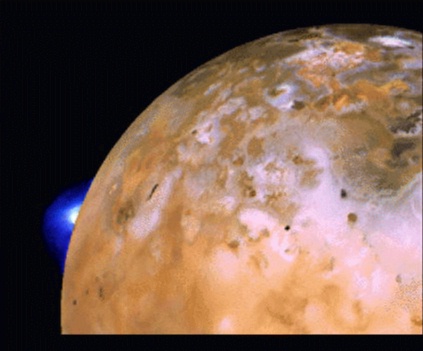
| Io is in a state of continuous volcanic eruption: Volcanoes:Plumes to 250 km Vulcanism caused by "tidal pumping" by other moons. |
 |
|
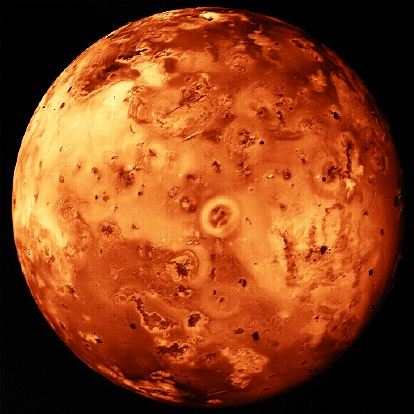
Note surface is very unstable: no craters (age ∼ 106 yrs). "pimple" in centre is volcano seen frolm above |
 |
| Rock covered with ice, probably slushy since no impact craters. |
 |
| Close-ups show odd crustal structures | 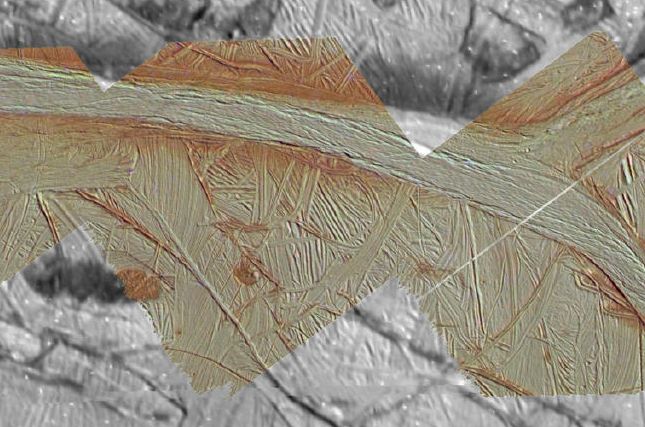 |
| Largest moon in the solar system: Ice on rock. Many craters, but with central pits, not peaks. Huge transverse faults | 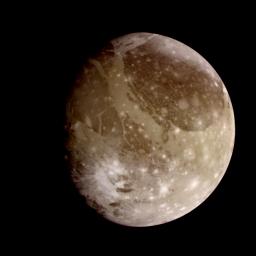 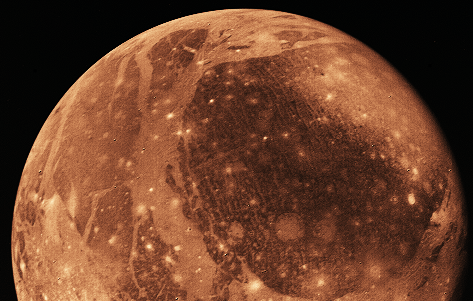 |
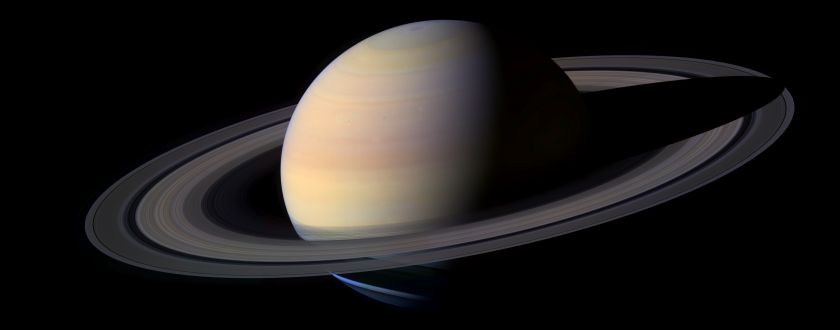
| Day 10 hr 14 mins.
ATMOSPHERE similar to Jupiter, but less heating (internal &sun) so weather better |
|
| First seen by Galileo as "Handles"
Assumed to be solid, but Maxwell showed that tidal forces would have destroyed them... Spectrum consistent with small ice pellets and dust (moonlets).Voyager showed
| 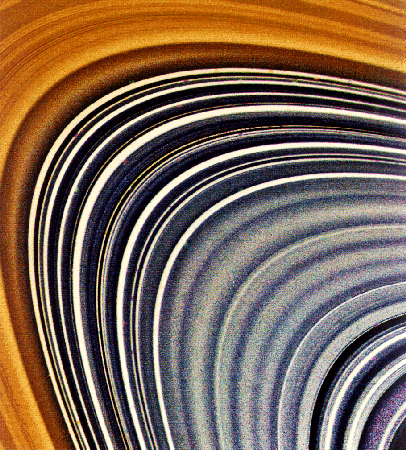 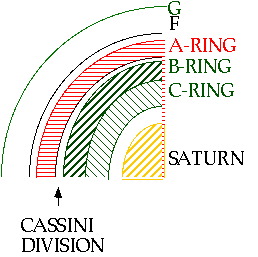 |
| Many Moons: Titan, Mimas, Tethys, Janus, and Enceladus. | 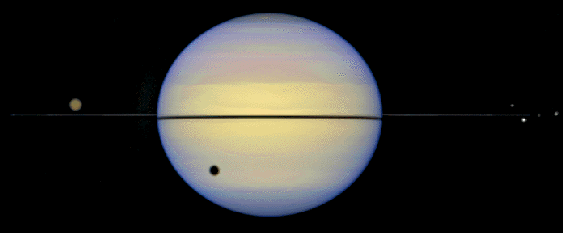 Credit: Erich Karkoschka (University of Arizona Lunar & Planetary Lab) and NASA |
| JANUS is two moons in orbit round each other. |  |
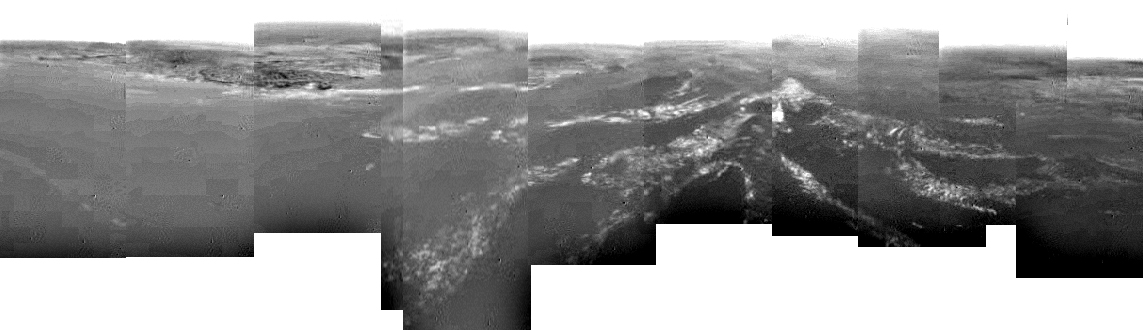
Credits: ESA/NASA/JPL/University of Arizona
| Touch down at 4.5 m/s, the saucer-shaped probe penetrated 15 cm. Surface consistency of wet sand or clay. | 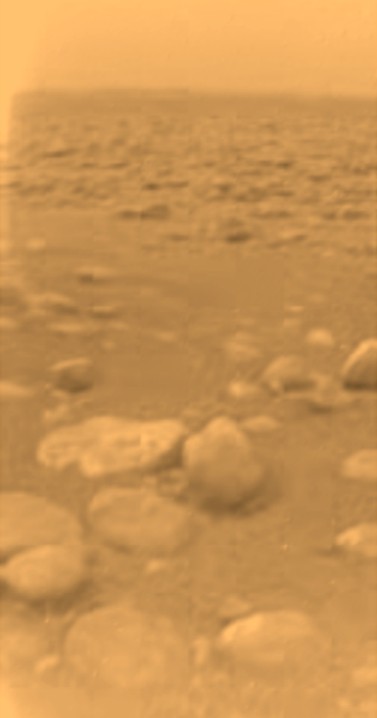 Titan Landscape Titan Landscape
Credit: ESA, NASA, Descent Imager/Spectral Radiometer Team (LPL) |
| Density about 1/2 water (!) suggests spongy texture! |  Credit: Cassini Imaging Team, SSI, JPL, ESA, NASA |
| Half of moon is covered in material as black as coal |  |
| Giant striped snowball? |  |
|
Pale green. |
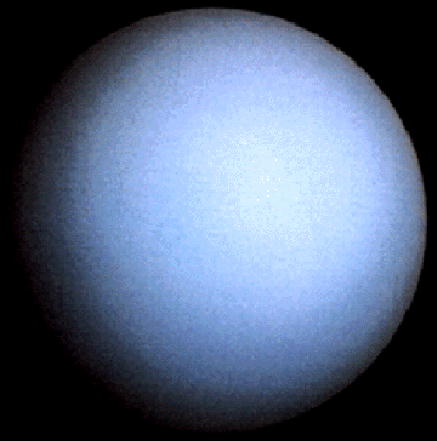 |
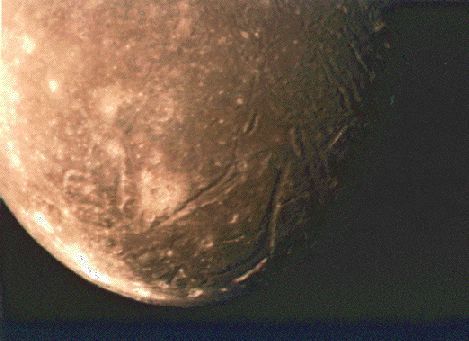
| Ariel from a distance of 170,000 kilometers. |
 |
|
Miranda from 42,000 kilometers. |
 |
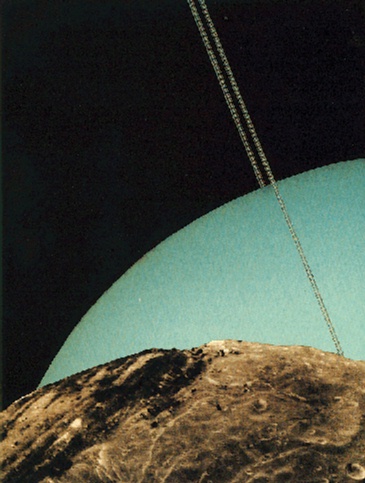
| Ring system, probably 9 narrow dark rings (seen by occulting star) | 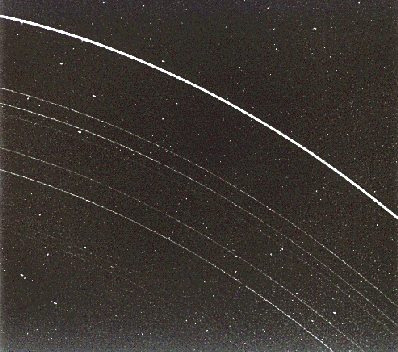 |
| THis is how it might look from Ariel |
 |
|
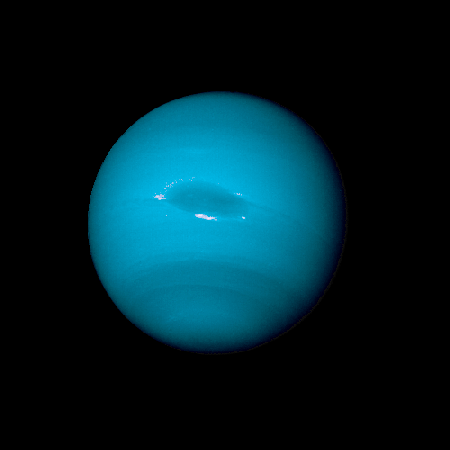
Pale blue-green Large dark spot |
 |
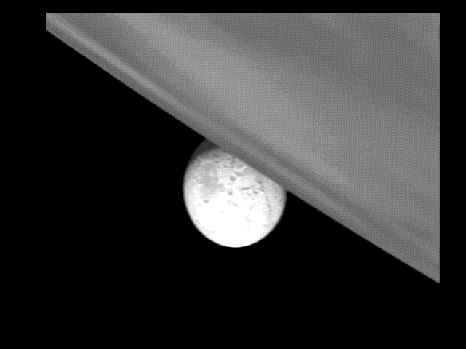
| 1 major moon, Triton has an atmosphere, and a retrograde orbit (captured asteroid?). Other smaller moons. Appearance similar to outer moons of Jupiter: i.e. ice-covered rock. |
 |
| Pluto Originally found in a search for 9th planet, based on prediction due to the perturbations of Neptune's orbit. Sometimes closer than Neptune (till 1999!) | 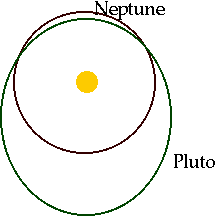 |
| > Seen to be double planet: Pluto-Charon |   |
Paths of the
|
 |
| Most asteroid orbits lie in plane of solar system, a few are very tilted. Most lie between Mars and Jupiter, maybe more beyond Jupiter (Centaur asteroids). two Centaur Asteroids (outer Chiron and 1991DA). Orbits clearly imply that they were never part of a single object which exploded |  |
| Have now had close-up look at several asteroids. This is Gaspara | 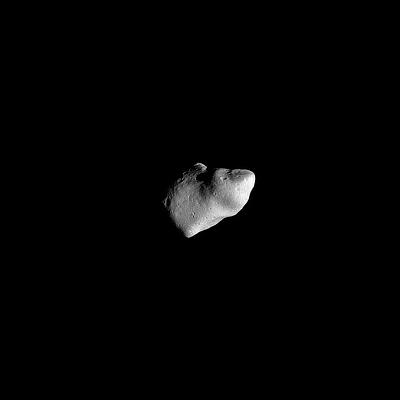 |
| Ida and its moon, Dactyl. | 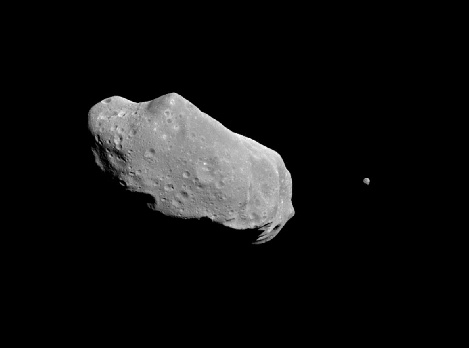 |
| Eros is a lump of rock | 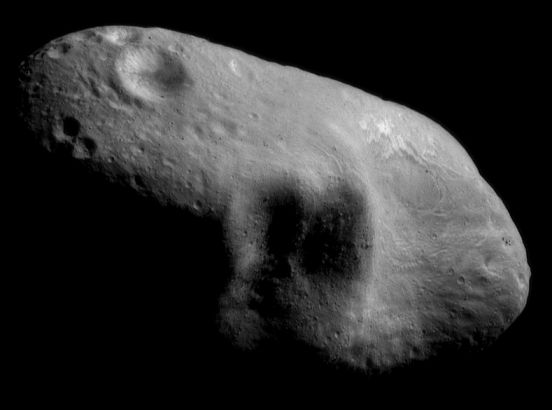 |
| We can even watch it rotate |
| We have managed to land on it | 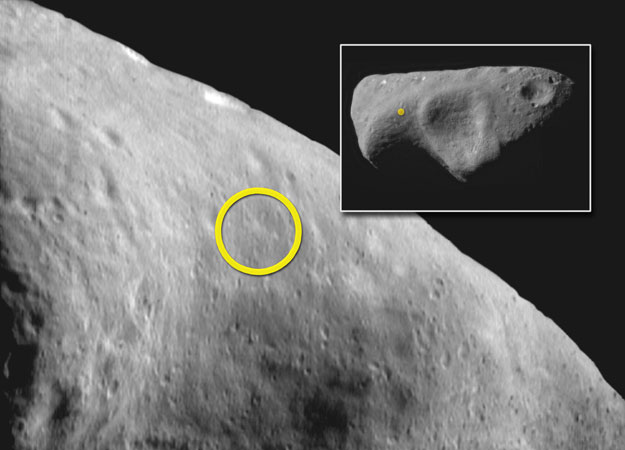 |
| the fourth object (after the Moon, Mars and Venus) in the Universe! (but a bit too hard!) | 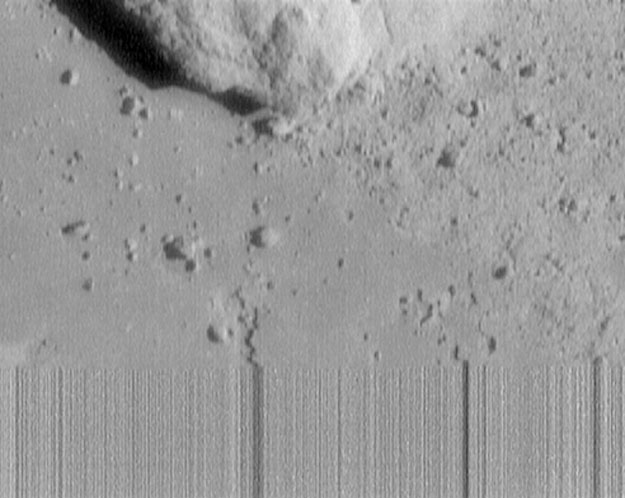 |
| Sedna is almost at its closest; 10,000-year orbit takes it into the Oort cloud. Probably not a planet in the usual sense. Sedna is the Inuit goddess of the sea. |
No easy answer: conventionally we take original 8 as planets, and say everything else is not (i.e. Pluto isn't).
| and above all, the Hubble which sees in the ultra-violet and infra-redand is above everything! |

The Orbiting Hubble Space Telscope Credit: STS-103, STScI, ESA, NASA |
i.e. it takes light 7 minutes to make the journey
| This shows a region in Andromeda: each star is about size of the sun. u And. first star found to have 3 planets. Note M31, M33 and a small cluster of stars: everything else are just Milky Way stars. |
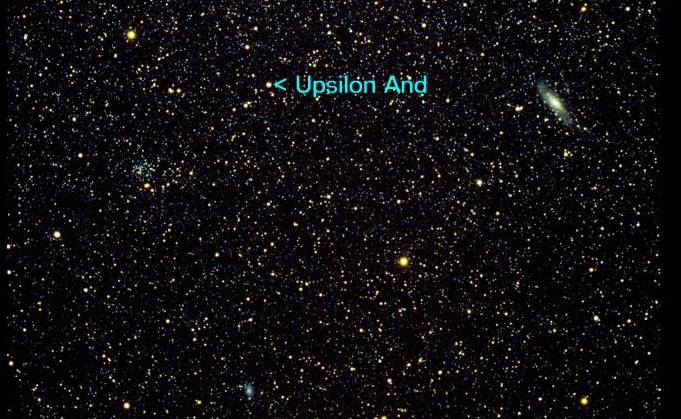 |
| The best known cluster is the Pleiades: (Seven Sisters except we can only see 6 now) | 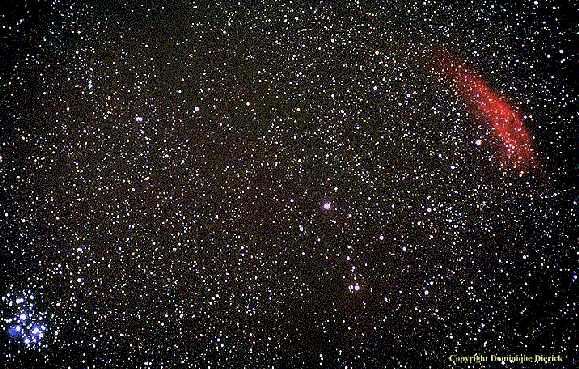 |
| A closer look: the Pleiades are a very young group of stars, about 107 years old, and very close: about 10 pc, so light takes 40 years to travel from them. | 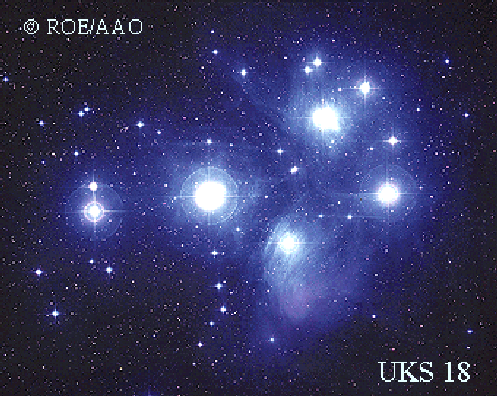 |
| The milky-way is "our" galaxy: roughly 109 stars | 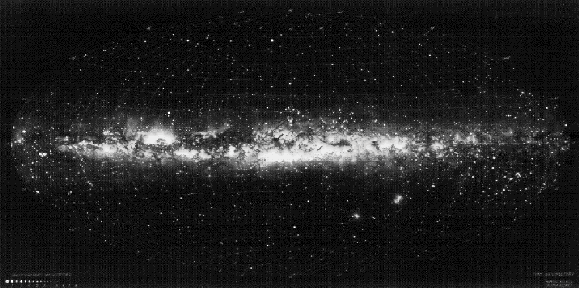 |
| M31 is a massive spiral
galaxy, rather like the Milky Way with about
1010 stars at 1.5 Mpc.
About 20 kpc in radius |
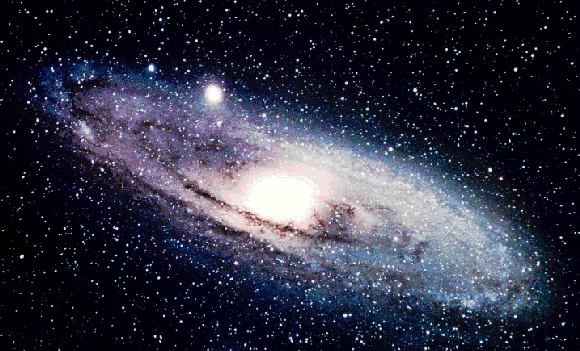 |
| M33 is a slightly smaller galaxy, rather further away |
| M74 is another spiral | 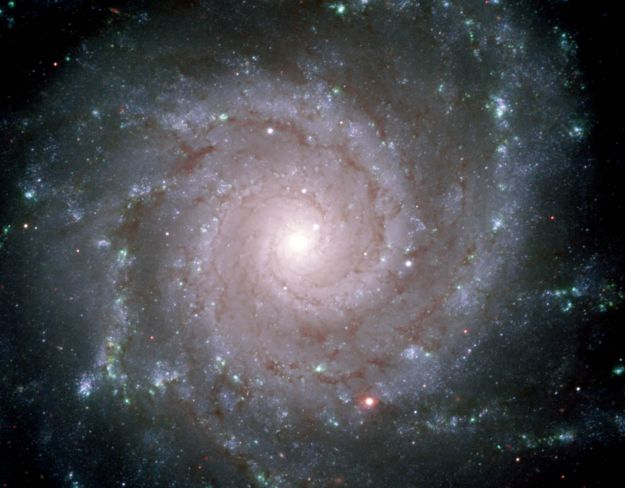 |
| This is M87 (a giant elliptical galaxy) in Virgo. Almost perfectly spherical: about 1011 stars | 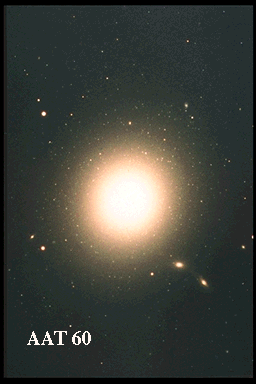 |
A very pretty spiral (ESO 269), and note the very distant galaxies in the background.
|
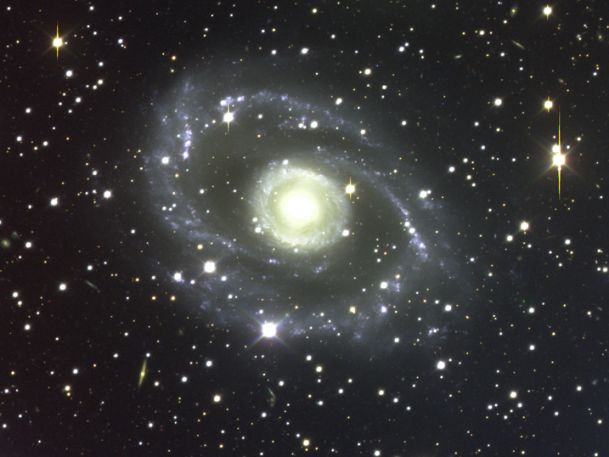 |
| We have found about 108 galaxies.
Galaxies form clusters:
This is the VIrgo cluster: over 1000 galaxies: 3 big ellipticals, including M87 at the bottom. Closest big cluster |
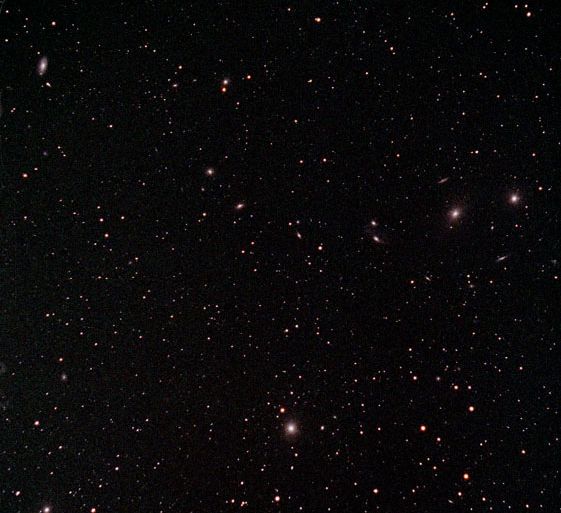 Galaxies Of The Virgo Cluster Credit & Copyright: Matt BenDaniel |
| This is the core of the Virgo cluster: M 84 and M 86 are the big ellipticals: also some small ellipticals and spirals |  Credit & Copyright: Jean-Charles Cuillandre (CFHT), Hawaiian Starlight, CFHT |
| Coma cluster contains at least 104 galaxies | 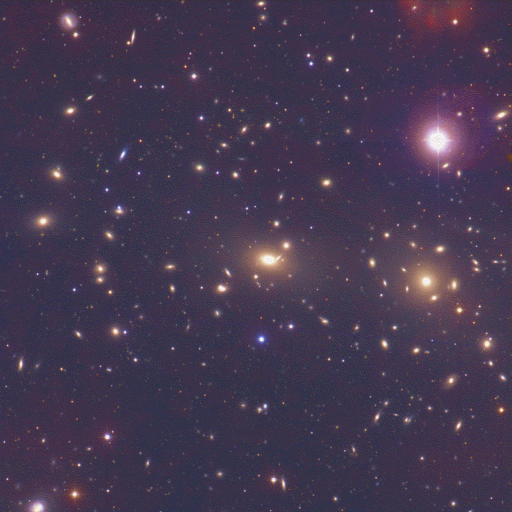 |
But this is only the beginning: We have measured the position of at least 10 million galaxies.......
| and we can go deeper | 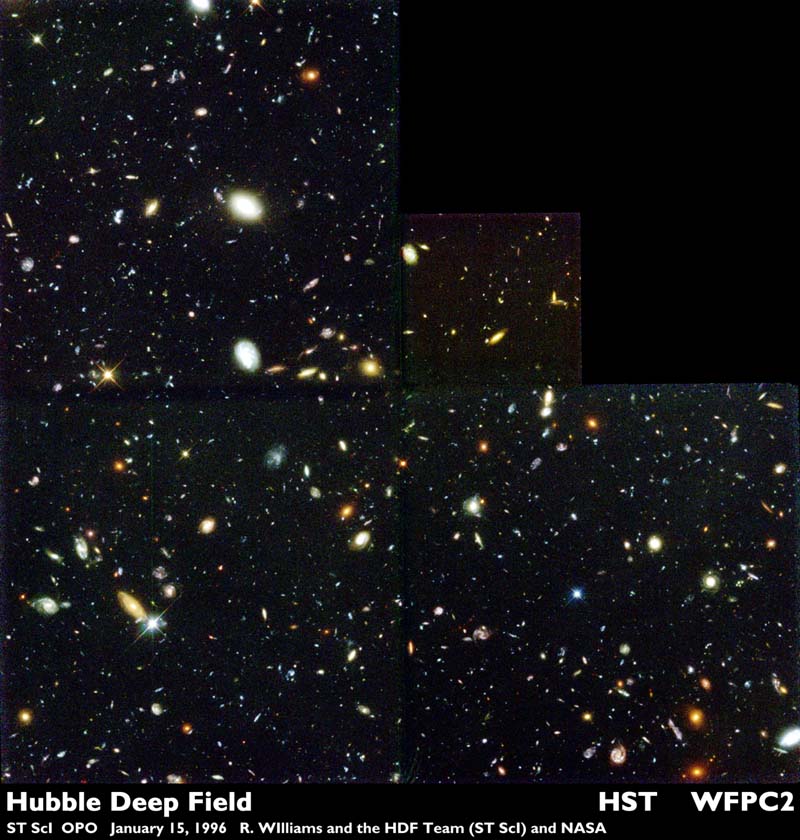 |
| And further: this is a cluster of galaxies | 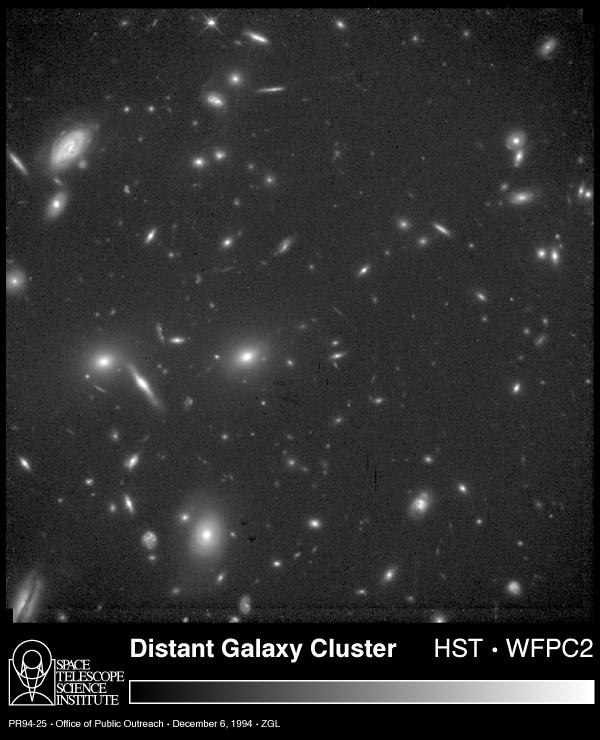 |
| and further: this is a cluster of galaxies which is fairly close, but the most distant (for a week!) galaxy known is gravitationally lensed in the picture | 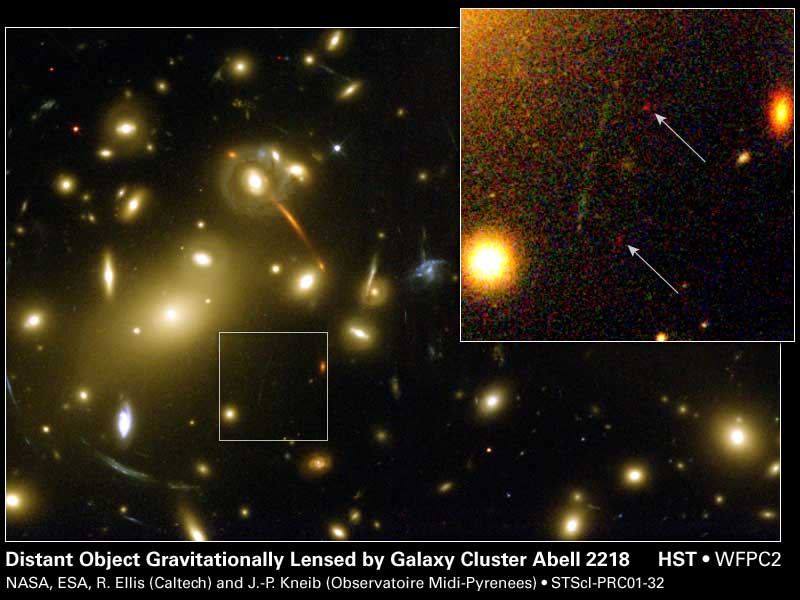 |
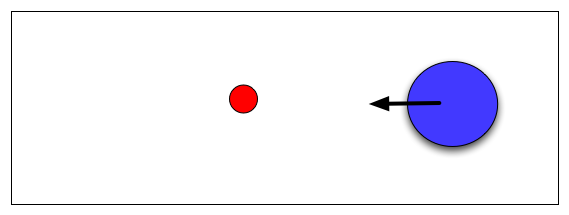

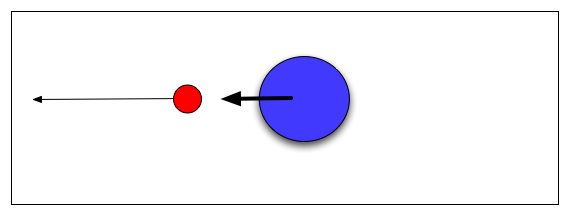
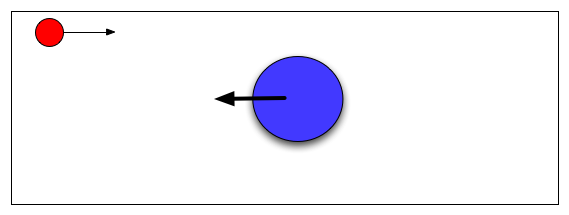
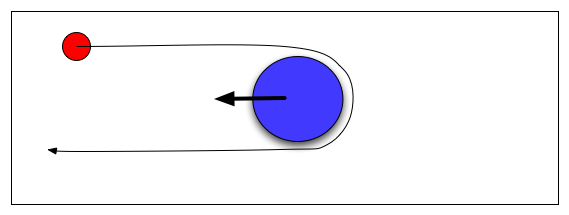
Radiation has pressure
|
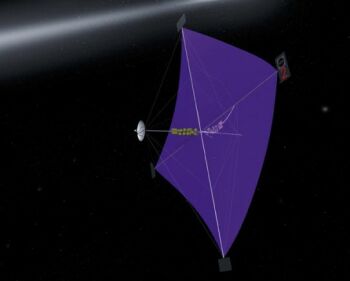 |
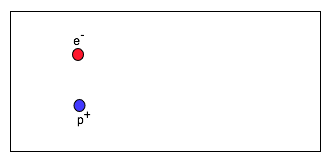
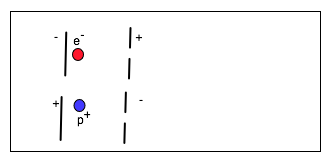
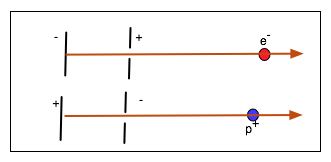
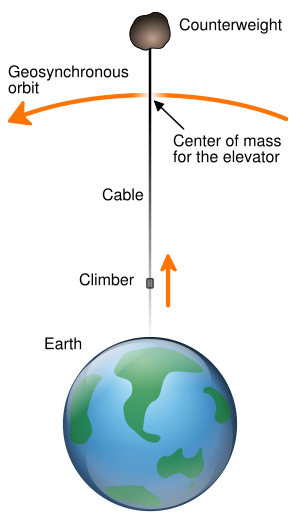
A neat idea but needs materials with huge tensile strength and low density, and we still have energyy problems (doesn't matter how we get something into orbit, energy is a constant). Need to be at geostationary orbit ~ 36000 km
e.g.
|
 Wikipedia |
|
Can accelerate metal object in varying mag. field (technology of (mag. lev. trains). Could build very long tunnel (50 km) to top of mountain, maybe speed of 3000 m/s at a height of 8000 m.,⇒ acceleration ~9g |
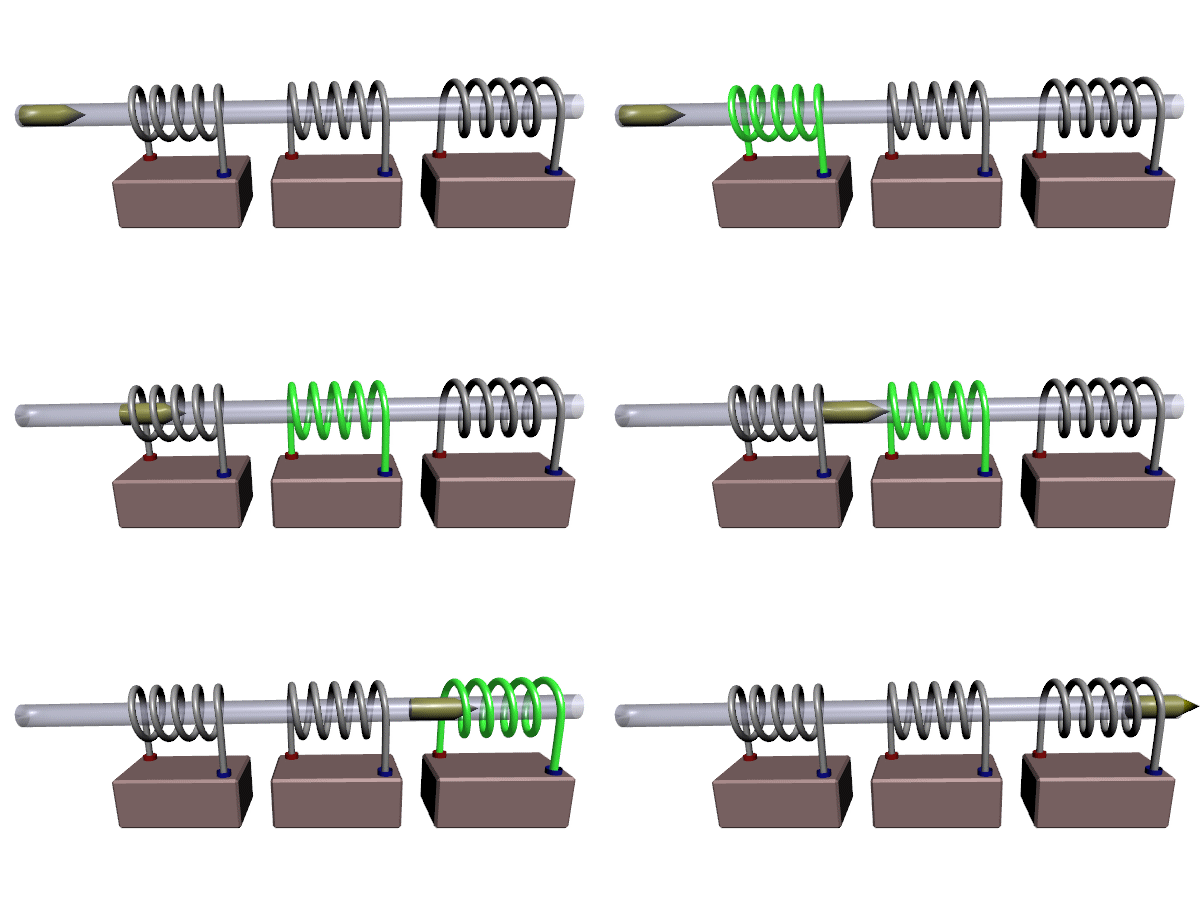 |
| We know how to screen electric forces, because + and - charges attract each other, and can cancel out: however grav. forces just add and always attract. So can't manufacture cavorite. | 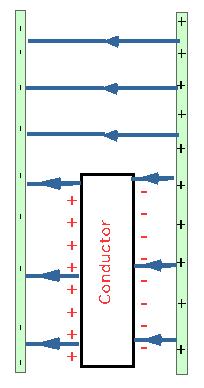 Wikipedia |