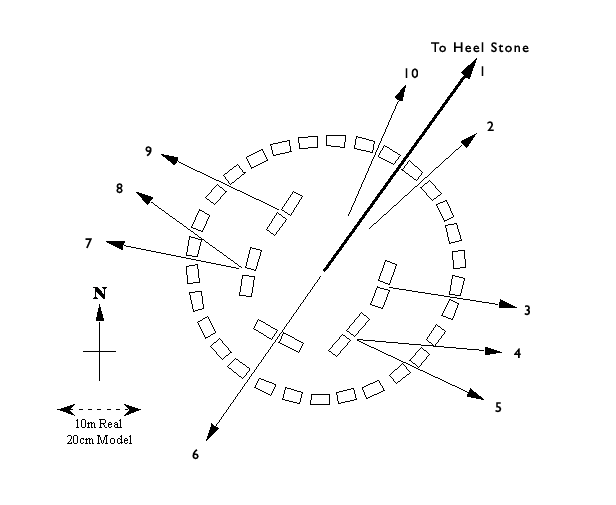
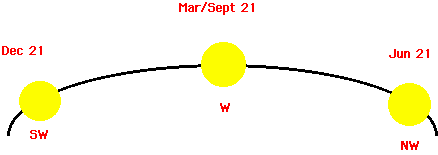
It moves against the fixed stars because
- the earth orbits the sun
- the earths axis is tilted
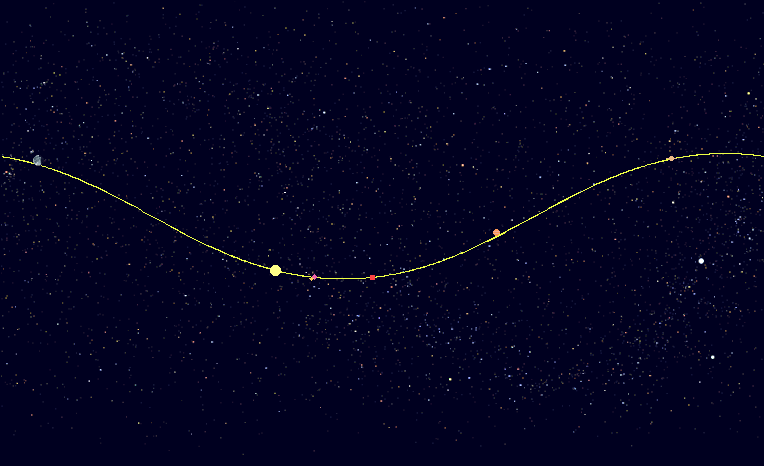
| it also moves in the sky at a given time of day: (i.e. the time of noon varies) because the earth moves at varying speeds in its orbit, so we actually need a better clock than the sun to measure this |
 |
Eclipses
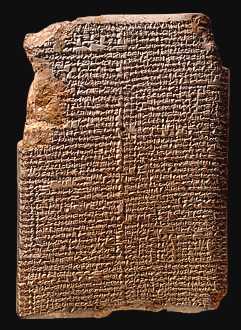
| Tablet with a list of eclipses between 518 and 465, mentioning the death of king Xerxes. British Museum, London |
 |
- Why do these matter?
-
CALPURNIA: When beggars die, there are no comets seen;
The heavens themselves blaze forth the death of princes.
Julius Caesar
- (Chinese astronomers Hi and Ho executed for failing to predict eclipse in 300BC).

Saros:
- Eclipses repeat after 18 years and 11.3 days.
- The .3 days shifts the eclipse about 110º degrees west.
- Also some saros sequences start at the south and drift North, others at the North and drift South.
- This means that the cycle is very complex: can only see it after many years.
- Why is it so complicated? Need to combine
-
- Earths rotation
- Moons orbit (not quite circular)
- Earth's orbit (ditto)
- and the plane of the moons orbit precesses
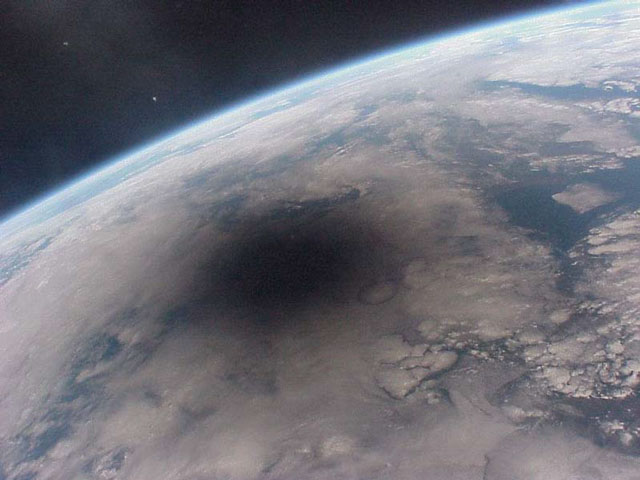
| Fascination with eclipses remains: e.g. An eclipse seen from Mir.
e.g. FEC story |
 |
Babylonian Astronomy?
- What was wrong with Babylonian Astronomy?
- They had no model (but they were very good at arithmetic!)
-
e.g. the month
Kidinnu arrived at 29.530594 days, which is only 0.432 seconds more than the modern estimate of 29.530589 days.
Dates For Early Astronomy: Chinese
Records from 2000 BC.
- Eclipses predicted
- Comets (Halley's comet in 467BC).
- Measured year to be 365 1/4 days, lunar month to be 28 days.
Dates For Early Astronomy: Hindu
| Not very systematic observations, and cosmology mixed in with mythology! |
 |
- Fortunately now revived:
Great A'tuin the turtle comes, swimming through the interstellar gulf, hydrogen frost on his ponderous limbs, his huge and ancient shell pocked with meteor craters. He thinks only of the weight. Most of the weight is accounted for by Berilia, Tubul, Great T'phon and Jerakeen, the four great elephants upon whose shoulders the world rests.
.......The Colour of Magic, Terry Pratchett
Dates For Early Astronomy: Greek
Pythagoras:
First Cosmos Model: Motions of the Spheres.
Motion of Venus and Mercury.
| Hisperus appears as an evening star (very bright) for about 8 months. |
 |
| Followed by Phosphorus (morning star) by a similar period in the Eastern sky at dawn |
 |
| become Venus, -497 BC.
Note that this is much more difficult to study than it sounds, because the orbit is tilted to the horizon, and the orbit is distorted: |
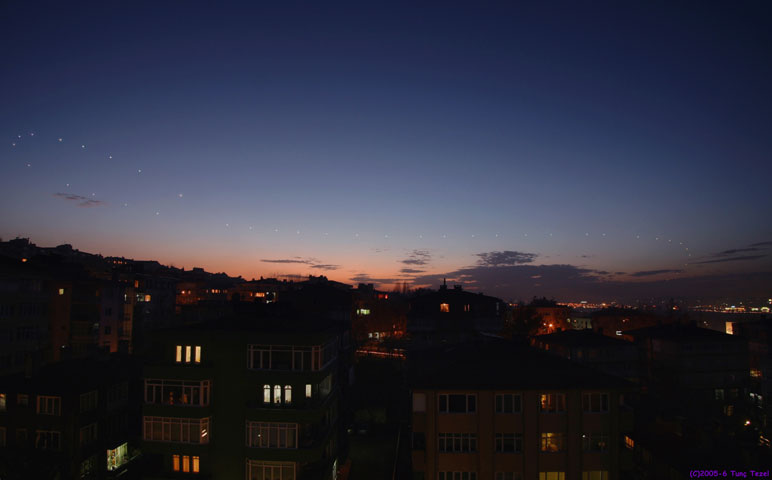 |
| Conclusion: One is seeing a "side on" circle. |
 |
-
Eudoxus: 408-355 BC.
- First Mechanical Model,
Rotating spheres pivoted on each other.
Aristotle: , 384-322 BC.
Parallax, Phases of the moon
- Geocentric Model: Why the earth must be stationary:
|
Suppose that the earth revolved around the sun. In observing two distant stars, α > β
Since the separation between the stars doesn't change, the earth must be stationary. |
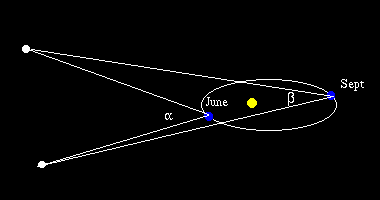
|
- What is wrong with this argument?
Aristarchus: 310-230 BC.
Heliocentric Model, (1700 years before Copernicus!)
Eratosthenes: 276-195 BC
: Radius of Earth
| Sun is vertically above Syene (Aswan) whereas it is 7° of the vertical at Alexandria, 700 km North. Gives ∼ 5800 km instead of 6400. |
 |
Hipparchus: 160-127 BC.
Precession of the Equinoxes
Earth's axis is tilted, but doesn't always point to the same place (i.e. the North Star isn't always!)
March 21st & Sept 21st are special days: Sun is on the equator (now), but where on the equator? In 2000 BC
- Aries 2000 BC
- Pisces 100 BC (which is why the Christians chose the fish as their symbol)
-
-
Except it isn't!
Why the Earth is not flat: the earth's shadow on the moon is always curved
|
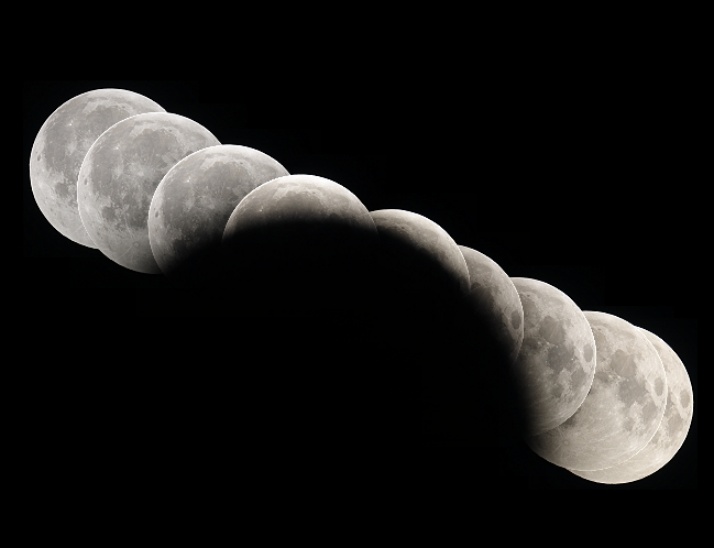 Anthony Ayiomamitis
|
| But maybe the earth is a disc...
Even so..! |
 |
Earth-Moon Distance:
|
¸
|
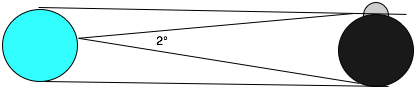 |
-
Radius of the earth ~6500 km (4000 mi).
- This gives d ~ 375,000 km
- d = 384,400 km by modern methods.
¸
Distance to the sun.
Much Cleverer
| If the sun was infinitely far away, then half-moon would occur exactly half way through month. |
 |
| If the sun is closer, half-moon will occur earlier.
But half moon is difficult to estimate: This yielded an earth-sun distance ~20 times Earth-Moon distance.
Hence ~7,500,000 km.
We now know the distance ~150,000,000 km
|
 |
Antikythera Mechanism
| An extraodiinary discovery from 1901: probably from late second century BC |
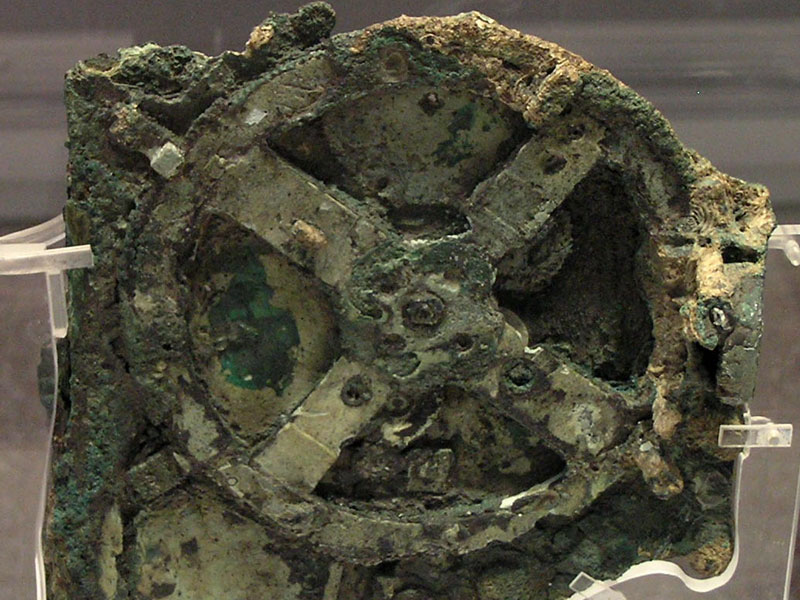 National Archaeological Museum in Athens: wikipedia |
| X-rays show very complex structure |
 |
Appears to be a very sophisticated astronomical computer: includes Hipparchos' discovery of irregularities in Moon's orbit

T. Freeth et al, Nature 444, 587-591 (30 November 2006), wikipedia
- The front dial has two concentric scales. The inner scale shows the Greek zodiac with 360 divisions.
- The Parapegma is a star almanac showing rising and settings at dawn or evening of particular stars or constellations
- Consistent with Egyptian calendar of 365 days, with twelve 30-day months and 5 extra
- The effect of the extra quarter day in a year could be corrected by turning the scale one day every four years
- The spiral upper back dial displays the luni-solar Metonic sequence of 235 lunar months with a subsidiary dial showing the Callippic cycl
- spiral lower back dial displays the 223-lunar-month Saros eclipse cycle with a subsidiary dial showing the Exeligmos cycle.
|
 |
Ptolemy:
Almagest (13 Volumes on Astronomy), Ptolemaic model, ~140 AD.
| The simplest model is Geocentric, that is with the earth at the centre of the circular orbits of the Moon, Venus, Mercury, the Sun, Mars, Jupiter, and Saturn in ascending order. Orbits of Mercury and Venus are locked to that of the sun. As well, all planets are given epicyclic orbits, that is they orbit about a point, which revolves about the deferent - or orbital path about the earth. Finally, the earth is removed slightly to one side of the centre of all of these orbital paths. |
 |
BUT:
- Mercury & Venus never get far from sun.
- Retrograde Motion.
- Changing brightness during year.
In the Ptolemaic model, the orbits of Mercury and Venus are locked to that of the sun. As well, all planets are given epicyclic orbits, that is they orbit about a point, which revolves about the deferent - or orbital path about the earth. Finally, the earth is removed slightly to one side of the centre of all of these orbital paths.
Retrograde Motion
| Apparent path against the fixed stars, viewed from within the orbit:
|
 |
so need to introduce epicycles
|
 |
200 B.C. -1400 AD:
And now....Nothing....
In Europe, nothing....
Ptolemy's model by now required 40 epicycles to explain the increasingly accurate observations. Copernicus proposed a Heliocentric solar system model as a device to explain the motions. His model used circular orbits (thus still needing epicycles to achieve good agreement with observations). |
 |
Motion of Mercury & Venus "unlocked" from sun.
Lack of parallax because fixed stars are very far away
So why did people at the time believe in Copernicus?
Reasons for asserting the earth is motionless:
- David in Psalm 89: God has founded the earth and it shall not be moved.
- Joshua bade the sun stand still-which would not be notable were it already at rest.
- The earth is the heaviest element, therefore it more probably needs rest.
- Everything loose on the earth seeks its rest on the earth, why should not the whole earth itself be at rest?
- We always see half of the heavens and the fixed stars also in a great half circle, which we could not see if the earth moved, and especially if it declined to the north and south...
- A stone or an arrow shot straight up falls straight down. But if the earth turned under it, from west to east, it must fall west of its starting point.
- In such revolutions houses and towers would fall in heaps.
- High and low tide could not exist; the flying of birds and the swimming of fish would be hindered and all would be in a state of dizziness.
Reasons for the belief that the earth is moved:
Tycho Brahe 1546-1601
| Tycho Brahe: Note the tin nose ...
|
 |
| Ruler of island of Hveen (of coast of Denmark). Constructed Uraniborg (first observatory) to measure position of planets and stars |

|
Now it is quite clear to me that there are no solid sphere's in the heavens, and those devised by the authors to save the appearances exist only in the imaginations for the purpose of permitting the mind to conceive the motion which the heavenly bodies trace in their courses. Brahe
Kepler 1571-1627
| Corresponded with Brahe and acquired records after his death. (i.e. refused to give them up to his heirs) |
 |
Keplers laws :
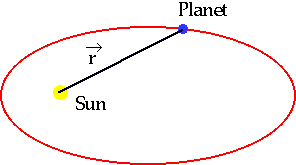
| Planets move in ellipses, with one focus at the sun |
 |
Keplers laws :
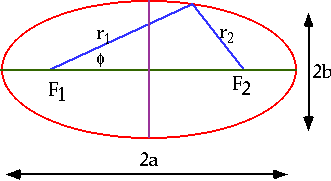
| Ellipses: a circle is a point moving so that its distance from one point is constant. An ellipse is a point which moves so that the sum of its distance from two points is constant |
|
Relations for ellipse
Keplers laws :
Second Law
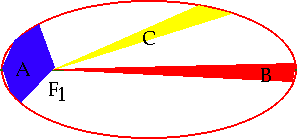
A vector drawn from the planet to the sun will sweep out equal areas in equal times
A = B = C Means "Planet moves faster closer to sun" |
|
Third Law
The period (P) and the semi-major axis (a) are related by
P2 = constant
a3
Note that these are empirical laws: there is no indication of where they come from...
GALILEO
GALILEO (1564-1642) |

|
Developed telescope
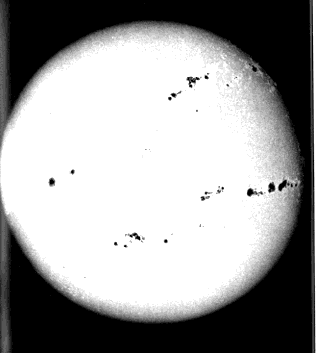
| Sunspots showed sun "imperfect" (and allowed him to measure rotation rate) |
 |
| Phases of Venus.Probably most important, since it showed planets shone by reflected light: phases did not agree with
Ptolemy |
  |
| Moons of Jupiter. This is his original notebook: showed conclusively that objects other than earth could act as centre of orbit |
 |
and this is a translation.
|
 |
- The moons were simultaneously discovered by a German astronomer Marius (or Mayr). These moons are usually known as the Galilean Moons, although Marius gave them their names Io, Europa, Ganymede and Callisto.
- The probe to Jupiter which arrived Dec 7th 1995 was known as "Galileo".
| Mountains of Moon. Showed heavenly bodies "Imperfect": can see shadows changing on edge of crates |
 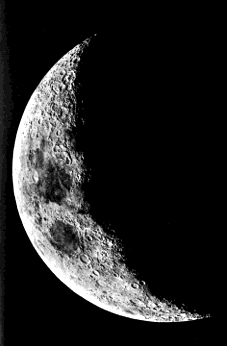 |
| Rings of Saturn: He also saw these, but he could never figure out what they were! He thought that the planet had "handles". |
 |
The greatest discovery Galileo never made!
For a week in 1612, Neptune was in the field of his telescope when he was
observing Jupiter, and he even notes that it seemed to be a moving star
A final note: the most famous quote
Epur si muove (And yet it does move)
was almost certainly made by Giardano Bruno before he was burnt at the stake in 1600
Newton
1642-1727 (born the day of Galileo's death)
Newton (in Principia) showed that the motion of the planets can be undestood in terms of the gravitational force at the earth's surface.
And now we will go to 1960
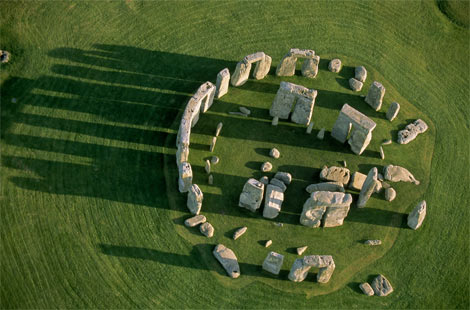 >Photograph by Joe McNally/Sygma: http://www.nationalgeographic.com/history/ancient/photo/stonehenge-from-above.
html
>Photograph by Joe McNally/Sygma: http://www.nationalgeographic.com/history/ancient/photo/stonehenge-from-above.
html