Up to now we have just described motion (kinematics). We now want to explain it
(dynamics)
A Body continues at rest or in a state of uniform motion unless acted on by
a force.
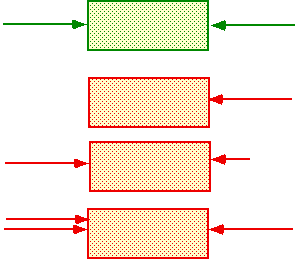
Uniform motion means no acceleration. Note forces can balance: "a force" means
"a net force"
Inertial/Non-inertial frames
Inertial/Non-inertial frames: A body continues at rest.....
At rest with respect to what? Watch the animation!!
Inertial frames: moves at a uniform velocity w.r.t "fixed stars"
Non-inertial frames: body accelerates w.r.t. frame without forces being applied
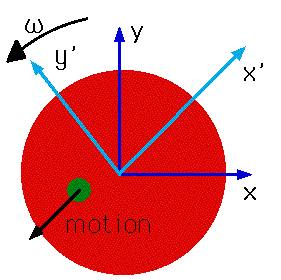
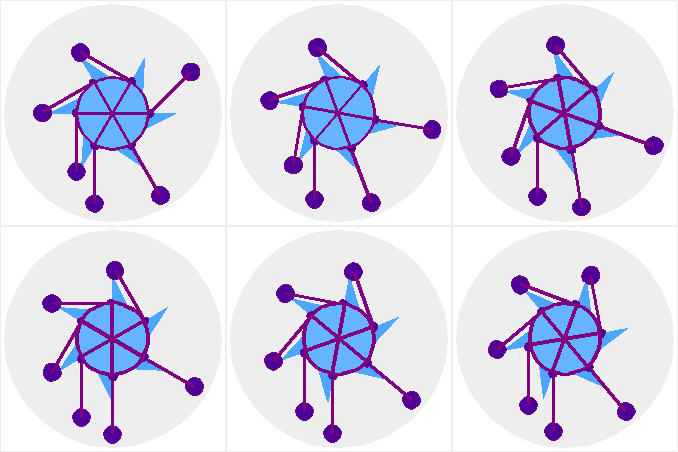
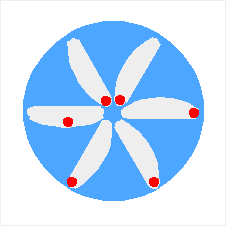
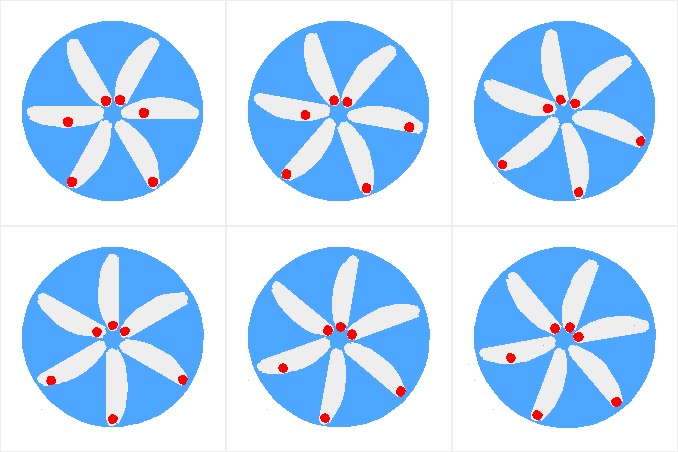
A very common non-inertial frame is a rotating one: e.g. a record player turntable.
There are two frames of reference an inertial one (well almost) attached to
the earth (x,y) a non-inertial one (x',y') The earth rotates, but is inertial
to about 1/2 %. The only truly inertial frame is one defined by the distant
stars.
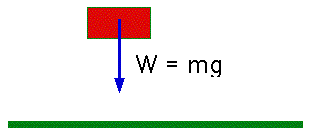
Most important is gravitational force, which gives rise to weight
m a = W = -mg
so that
a = -g
Hence Newton's 2nd. law shows that everything has the same acceleration in
a gravitational field. This is unique to gravitation, and suggests
that there are two kinds of mass: inertial mass and gravitational mass.
Gravitational force depends on position:
F = mg
is a good approx. only at surface of earth.
On moon, weight ~ 1/6 that on earth
Other Forces
Elastic Forces: Response of object to being stretched or compressed (we'll need these later)
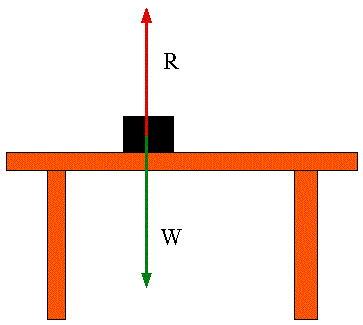
Contact Forces Forces which stop one object penetrating into another. Perp to interface.
Electrostatic Forces
Magnetic Forces
Nuclear Forces
Frictional Forces
Air Resistance
Momentum and Collisions
There is a second (and better) way to state the second law
First define
momentum= mass x velocity
\color{red}{
\vec p = m\vec v}
Impulse
Second law can be written
Force x time for which it acts = change in momentum
This quantity
\color{red}{\vec F\delta t}
is known as impulse, and is useful in collisions.
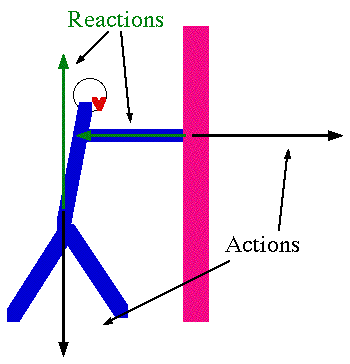
However momentum also has a very important role in connection with the 3rd Law (Action and Reaction.............)
e.g a bouncing ball. Note that the force only occurs for a very short period of time.
If a 300 gm ball is dropped from 2 m, what is the force during the bounce if it takes 1/50 s?
Circular Motion I
Circular Motion: Body moving in circle at constant speed will
accelerate towards the centre
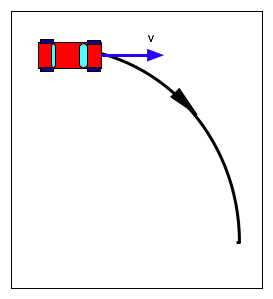
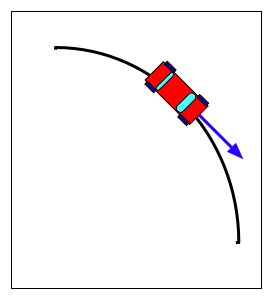
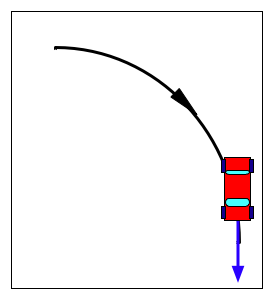
Note constant speed does not mean constant velocity. e.g. consider
a car travelling round a quarter circle, radius R, speed v
Car on a curve
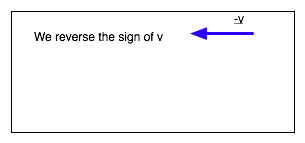
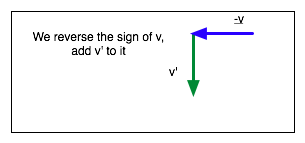
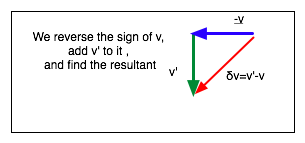
To find the change in velocity,
Dimensionally: must be combination of v and r that gives dimension
of accn.
[r] = L
[v] = LT-1
[a] = LT-2
so that only possibility is
a = v2 = (LT-1)2
    r     L
= L2T-2 = LT-2
   L
Centripetal Acceleration
This is called centripetal accn. It is NOTcentrifugal accn. (which is the apparent
accn. that a body feels in a rotating frame of reference)
Centripetal force is force required for centrip. accn. It does not exist as a force in its own right:
it has to be supplied by another force: e.g.
String
Tension
Friction
Gravitation
Magnetism
Simplest example
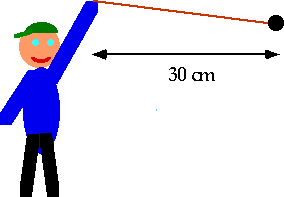
A kid whirls a stone around which is tied to a piece of string of length 50
cm. The string has a breaking strain of 20 N, and the stone weighs 400 gm. How
fast is the stone going when it the string breaks? Ignore the fact that the rope gets pulled down by the mass.
This was the first time that laws deduced on the Earth were seen to apply outside!
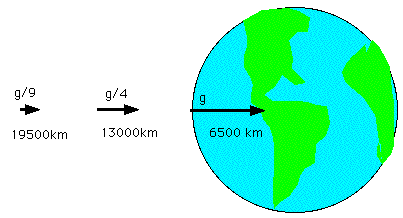
Gravitational force between any two bodies, masses M1 and M2
separated by distance R is given by Newton's Law of universal gravitation
\color{red}{
F = \frac{{Gm_1 m_2 }}{{R^2 }}}
Note that this imples that grav. force gets weaker as we move away from the earth
G=6.67x10⁻¹¹ N m2 kg-2 is a universal constant
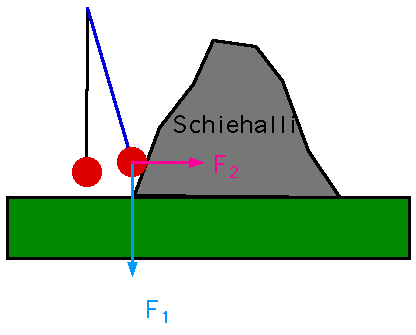
The first direct test of this was by measuring the deflection of a plumb-bob near a mountain in Scotland (Schiehallion)
Note that action and reaction apply: normally the reaction force will not cause a large acceleration.
The inverse square law is fundamental: there is an interesting and wrong way to get it.
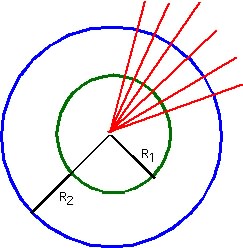
Suppose gravity is something that spreads out like sound or light. If you are twice as far away, it will be spread out over 22 = 4 times the area. Hence
F ~ 1/R2
What's wrong with this?
Why should gravity behave like this?
We know of other forces that don't.
In fact the argument is half right.
The real derivation of Kepler's laws is much more complicated: if you are interested look at Celestial Mechanics
Energy
Newton's second law gives us a relation between velocity and force, via
F = m a = m δv
            δt
If the force is complicated (e.g. F = -kv2, or F = sin(r) ), then solving for the velocity can be very difficult.
Fortunately there is a better way: a new idea called Energy.
Kinetic Energy
defined to be
T = 1/2 m v2
for a particle with mass m, vel v.
Potential Energy
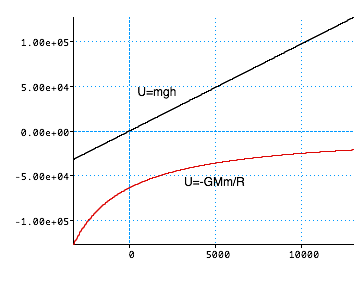
If you drop something, kinetic energy increases. This energy is originally in the form of potential energy (P.E.).
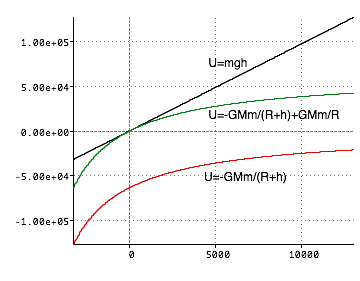
Gain in P.E. by raising an object a height = mgh, when it is close to the earth.
Total energy = P.E.+ K.E.= constant
Note that the force would be very complicated in this case, so one couldn't actually solve via F = ma
Need a new unit for energy
1 Joule= 1 kg m2s-2
(Joule originated study of heat energy --> mechanical energy)
Conservation of Energy
A very important idea that we will return to again and again:
If the forces are conservative, then total (mechanical) energy will be conserved: it can be transformed from one form to another.
(P.E. ⇔K.E.)
Later will see that energy is always conserved, but we need to introduce more kinds:
Heat⇔chemical ⇔ potential ⇔ nuclear ⇔kinetic
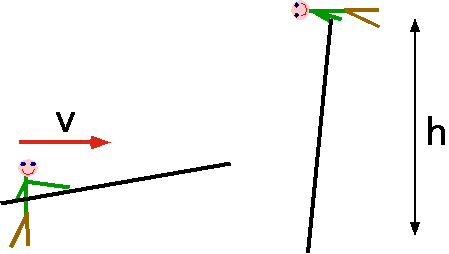
e.g. An example to show how general this idea is: What should the world pole vault record be? (5.8 m at present).
Assume that the vaulter runs at 10 ms-1, and his c.o.m. is 1 m. above the ground
Note only differences in P.E. are meaningful
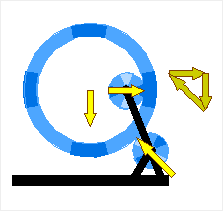
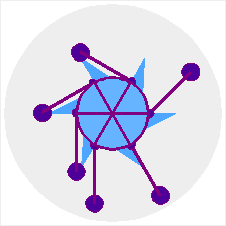
Perpetual Motion Machines
An interesting consequence....
We would be able to arrange for a complicated system of forces to keep things moving forever.
which turns for ever
Or another variety
which also turns for ever
and here is a modern version of the
overbalancing wheel
Conservation of energy tells you not even to try! (and the US patent office requires a working model of a perpetual motion machine...!).
This is quite general: a system of two or more particles bound together will have negative energy. Also
K.E. = - 1/2 P.E.
Escape Velocity
How hard would you need to throw something so that it never came back?
At the earth's surface, \color{red}{\frac{1}{2}mv^2 - \frac{{GMm}}{r} = E}
At ∞, P.E. = 0, so want K.E. = 0 as well
Remember T.E. = P.E. + K.E. = constant
\color{red}{
\frac{1}{2}mv^2 = \frac{{GMm}}{r}
\rightarrow v = \sqrt {\frac{{2GM}{r}} }
e.g. for the earth: R = 6500 km g = 9.8 ms-2
vescape~11 km/s
=???
Angular Momentum
When an object is rotating, it has some angular momentum associated We will use a simplified form:
L= mvr
Just as Force changes momentum \color{red}{
F\delta t = \delta p
}
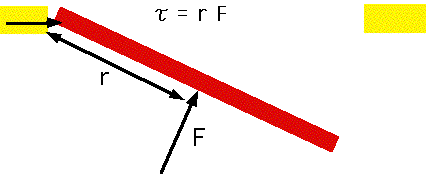
"angular force" or torque changes angular momentum. e.g. consider pushing on a door (new symbol is tau τ)
Torque about a given axis = Force x lever arm
= Force x distance from axis x sin(θ)
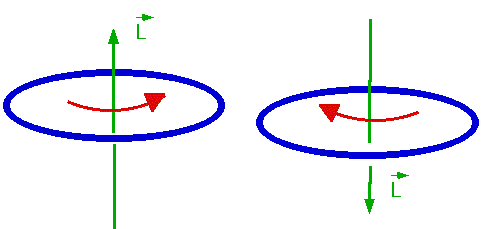
Conventionally: Right hand rule gives direction of vector
The vector nature of this leads to some very non-intuitive results
e.g. Bicycle wheel demo
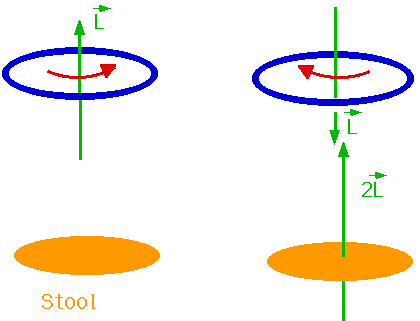
Total ang mom must be conserved, hence changing one (large) component will affect the other.
Also, unlike linear momentum where the mass is fixed, it is easy to change moment of inertia on the fly
e.g. spinning chair demo
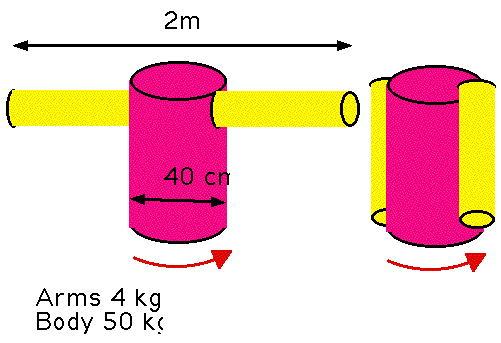
e.g skater in spin
consider an idealized skater
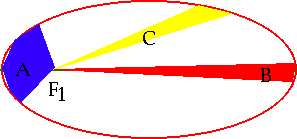
Keplers 2nd law
(the equal area law) is in fact just conservation of ang. mom.
Since
L = mvr or vr = L/m
is a constant, so area of triangle
δA = r vδt = L/m δt
is also a constant
Tops
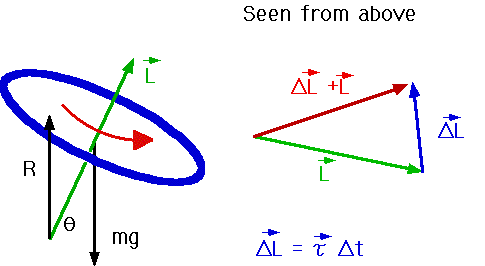
The most baffling example of ang momentum conservation is a spinning top/gyroscope
Watch the demo. How do we understand this?
Note that the torque
τ ⊥ L , so δL ⊥ L as well.
Precession occurs when a top is has an external torque acting on it. Paradoxicallly, the precession speed is greater the slower the top is spinning
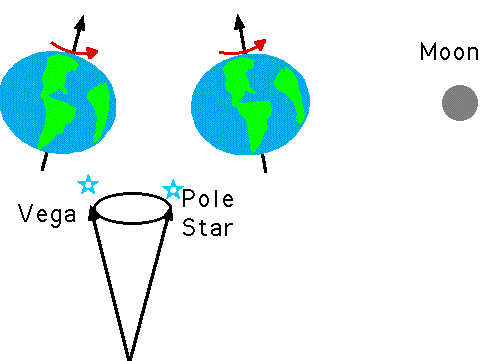
This same precession happens on a totally different scale. Since the Earth is not perfectly spherical, the Moon exerts a torque on the equatorial bulge, => Precession,
Period = 26000 yrs: Now N pole points towards Pole star, 13000 yrs will point at Vega
Means Sun is in a different zodiac sign every 26000/12 ~ 2000 yrs
Hence
This is the Dawning of the Age of Aquarius....
Also this gives saros cycle: plane of Moon's orbit precesses once every 18 years
The varous effects combine in often unexpected ways: e.g. we have seen that the earth is slowing down due to the tides of the moon
Hence angular momentum of the earth LE is decreasing
Angular momentum
LEM = LE + LM
of earth-moon system is conserved
so
LM = mMvR
must increase
⇒ distance of moon must be increasing (about 20 cm/year, so don't hold your breath!)
Conservation Laws
Although we derive energy conservation from 2nd law, it turns out to be far more fundamental. If the laws of nature are the same in all parts of the universe, then energy must be conserved.
In a similar way, one can prove from 2nd and 3rd law that momentum is conserved.
However, momentum conservation is also more fundamental: it follows from the invariance of the laws of physics under time.
Angular momentum conservation follows from the invariance of the laws under rotation.
Also note that although our starting point was forces and N's 2nd law, the conservation laws apply even when we cannot easily define or measure forces.
A lot of material: what do we really need?
Constant Acceleration Equations
\color{red}{
\begin{array}{l}
v = v_0 + at \\
s = v_0 t + \frac{1}{2}at^2 \\
v^2 = v_0 ^2 + 2as \\
\end{array}}
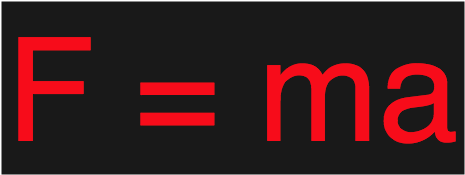
2nd Law of Motion \color{red}{{\vec F = m\vec a}} (note this contains first law)
3rd law (Action and reaction are equal and opp.)
Centripetal acceleration (for body moving in circle)
\color{red}{a = \frac{{v^2 }}{r}}
Gravitational Force close to Earth's surface \color{red}{F = - mgh}