
- Comet Mcnaught from Herzberg building
- Date: January 10, 2007
- Author: Etienne Rollin
|
The Description of Motion |
F = ma
F = mv2
     r
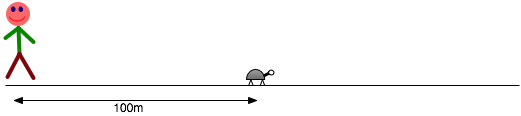
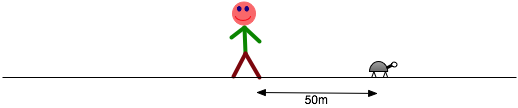
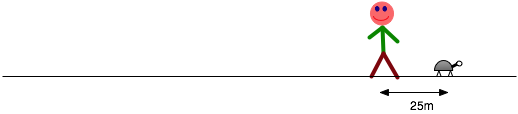
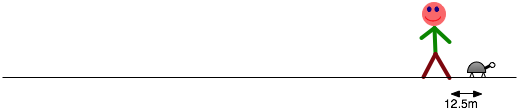
Infinite series can have a finite sum!
Speed =  d
       (t1-t0)
e.g. if Achilles runs d=100m starting at 4.00.00 p.m. and ending at 4.00.20 p.m., then
speed = 100  = 5 ms-1
      (20-0)
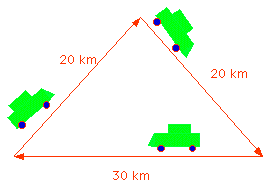
Displacement is the distance that you end up away from the starting point (Not the total distance travelled)
Velocity is Displacement/time
| e.g. A car travels in a triangular loop as shown: What is its speed and velocity if it takes one hour? |
 |
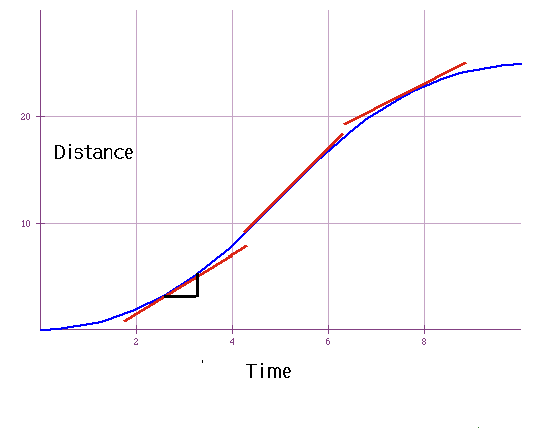
| e.g. A car travelling between traffic lights |
| Note that car starts slowly: position plot draws out a smooth curve |
Av. Vel. (0-10 s) = Tot. Dist.  = 25  = 2.5 ms-1
                    Tot. Time     10

Av. Vel. (4-8 s) = Tot. Dist.  = 14  = 3.5 ms-1
                   Tot. Time     4

Av. Vel. (4-6 s) = Tot. Dist.  = 9  = 4.5 ms-1
                   Tot. Time     2

Av. Vel. over short time => Instantaneous vel. = slope of dist/time curve
| By measuring the slope at each point, we can get the velocity time curve. |
x2-x1 = δx --> dx  = v
t2-t1   δt     dt
t2-t1 = δt = dtbecomes very short
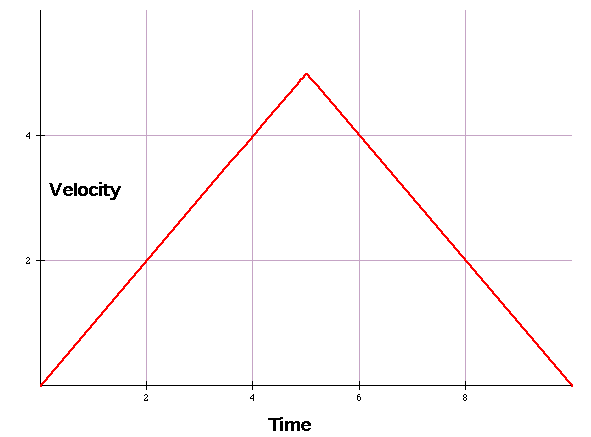
This is in fact an example of constant accn. Instantaneous vel. = slope of dist/time curve
= 5 ms-1 at t = 5 s
By measuring the slope at each point, we can get the velocity time curve.
a = change in velocity
             Time
a = (v1-v0)  = δv   = dv
    (t1-t0)    δt     dt
| This is easy for the case we are considering... |
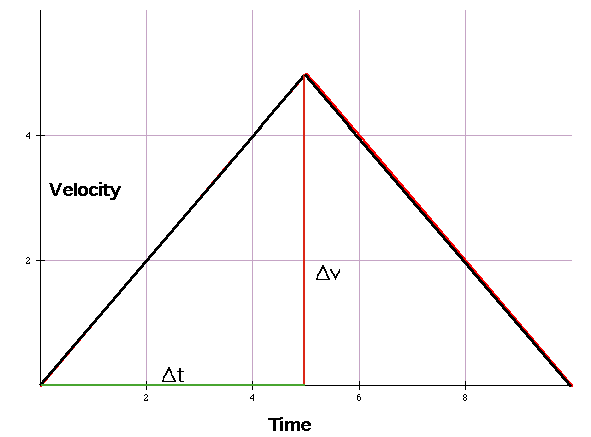
a = (v1-v0)  = 5  =1
    (t1-t0)    5
For 0<t<5
a = 5/5 = 1 ms-1 i.e. or any time t < 5s, the accn is the same:
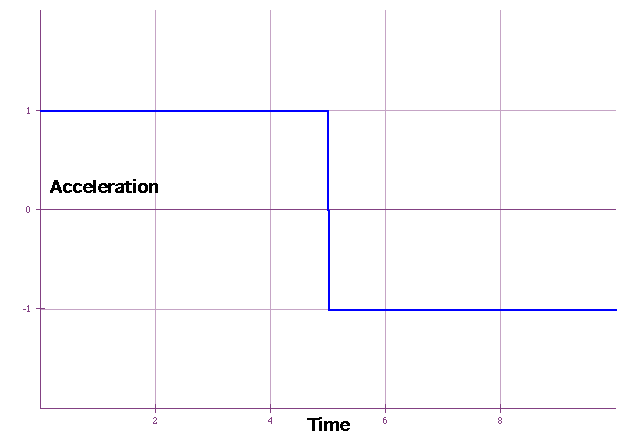
(note the Greeks had no concept of accn.)
Often a very good approximation $$ \color{red}{ a = \frac{{{\text{change in velocity}}}}{{{\text{change in time}}}} = \frac{{v_1 - v_0 }}{{t_1 - t_0 }}} $$
If we start the clock at t0=0, when the velocity is v0, then this can be written
$$ \color{red}{ a = \frac{{v - v_0 }}{t}} $$ or $$ \color{red}{ v = v_0 + at} $$
i.e. vel at time t = starting vel + accn*time Similarly, we get the average velocity
$$ \color{red}{ \bar v = \frac{{v + v_0 }}{2}} $$
but this is also total distance/time = s/t Hence
$$ \color{red}{ s = \bar vt = \left( {\frac{{v_0 + at + v_0 }}{2}} \right)t = v_0 t + \frac{1}{2}at^2 } $$
After tidying $$ \color{red}{ v^2 = v_0 ^2 + 2as} $$
These only apply if the Acceleration is constant: do not use otherwise!
Note that we define directions so that upwards is positive.
s = -1/2 g t2so time is given by
t = (-2s/g)1/2note s is negative, since we are measuring upwards as positive
s = (m/(m/s2)1/2 = sFormally
T = (L/LT-2)1/2