75.223 Astronomy: The Solar System: Other Objects
ASTEROIDS
Mainly lie in belt between Jupiter & Mars
⇒
Ceres (∼ 900 km radius) larger than rest
⇒
Total mass << Mercury

This image, drawn by the Voyager II Planetarium Software, shows the paths of the earth (green), Mars (the red square nearest the earth's orbit), Jupiter (yellow), and the twelve brightest asteroids, during the period Sept 1997 through Aug 1998.
Various special groups,
⇒
also gaps which are due to various tidal resonance positions (e.g. 1:2 with Jupiter)
⇒
Trojans in 600 δ with sun & Jupiter (old solution of 3-body problem: Lagrangian points L4 and L5!)
⇒
Hilda asteroids in 2:3 resonance with Jupiter (∼ 7.8 yr period)

This image, drawn by the Voyager II Planetarium Software, shows the major Hilda Asteroids and their orbits relative to the orbits of Jupiter (yellow), Mars (red), Earth (green), Venus (purple) and Mercury (orange).
Apollo asteroids: cross earth's orbit (and may collide occasionally!)
⇒
Eros used to measure Earth-Sun distance very accurately
⇒
All small < 30 km radius

This image, drawn by the Voyager II Planetarium Software, shows many of the Apollo Asteroids in relation to the orbits of the earth (green), Venus (purple), and Mercury (orange).
Most asteroid orbits lie in plane of solar system, a few are very tilted
⇒
Most lie between Mars and Jupiter, maybe more beyond Jupiter (Centaur asteroids)
⇒
Orbits clearly imply that they were never part of a single object which exploded

This image, drawn by the Voyager II Planetarium Software, shows the orbits of two Centaur Asteroids (outer Chiron and 1991DA) in relation to the orbits of Jupiter (yellow), earth (green), and Mars (red).
Have now had close-up look at two asteroids, via Galileo
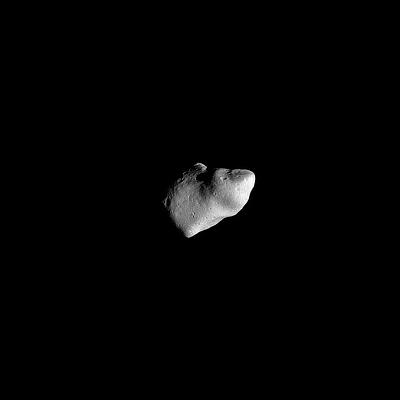
Asteroid Gaspara, photographed by the Galileo satellite.
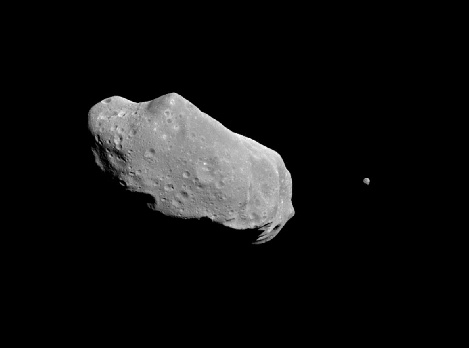
Asteroid Ida and its moon, Dactyl.
METEORITES
Most occur in well-defined groups (Andromedids, Perseids, Geminids)
⇒
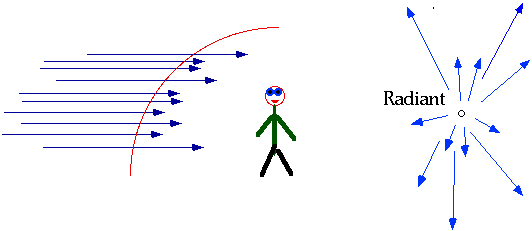
Arrive from definite point in sky (radiant)
 ⇒
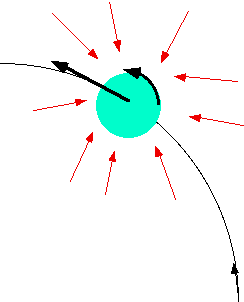
Escape speed from solar system at position of earth = 42 km s-1 Earth's speed ∼ 30 km/s Hence arrival speed of meteors 12 < v < 42 km s-1
⇒
More arrive after midnight
⇒
Escape speed from solar system at position of earth = 42 km s-1 Earth's speed ∼ 30 km/s Hence arrival speed of meteors 12 < v < 42 km s-1
⇒
More arrive after midnight
 ⇒
Occur in 3 varieties
Stoney chondrites
Stoney-iron
Iron-nickel
⇒
Some chondrites contain carbonaceons material (organic molecules) dextro-or laevo-rotatory? or neither?
COMETS
⇒
Occur in 3 varieties
Stoney chondrites
Stoney-iron
Iron-nickel
⇒
Some chondrites contain carbonaceons material (organic molecules) dextro-or laevo-rotatory? or neither?
COMETS
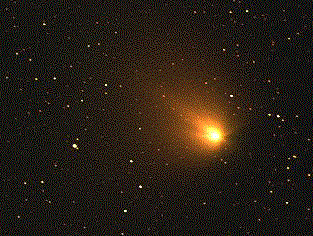
Hairy Star
⇒
Mostly very eccentric orbits, long periods, not in plane of ecliptic only visible near the sun.
⇒
Some short period ones (eg. Encke's) slowly disintegrating. Probably long period originally, perturbed by planets
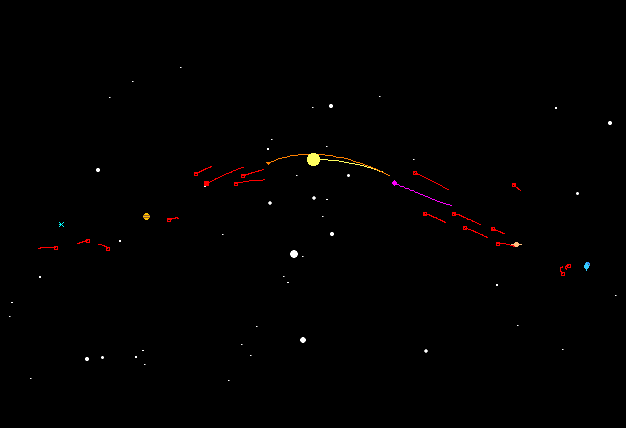
This image, drawn by the Voyager II Planetarium Software, shows the paths of several comets over a period of about three months in 1993, in relation to the sun, as seen from earth. Also shown are several planets.
⇒
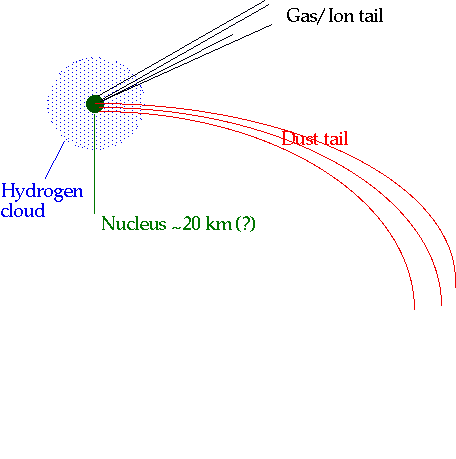
"Dirty Snowballs" H2O + dust + CO2
⇒
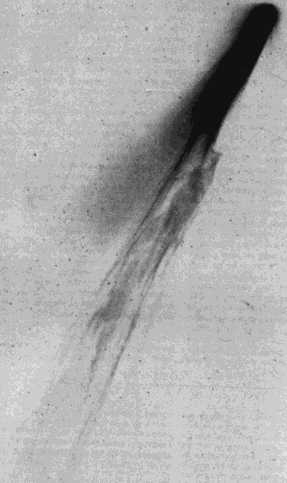
Water boiling causes breakup? Some comets observed to have jets, which can alter orbits
⇒
Low mass, cannot retain gas
 ⇒
Breakup need not be just material being blown out behind: previous encounter can give rise to material in same orbit: e.g. Arend-Roland
⇒
Breakup need not be just material being blown out behind: previous encounter can give rise to material in same orbit: e.g. Arend-Roland
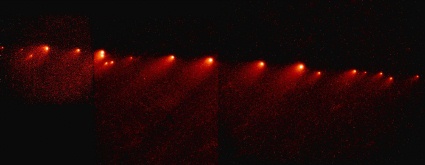
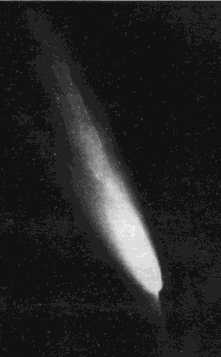 ⇒
Contents of comet are shown by spectra:
⇒
Contents of comet are shown by spectra:
 ⇒
Where from?
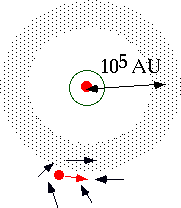
Oort cloud 105 A.U. from sun
Perturbations by passing stars can start comets falling towards sun.
⇒
No angular momentum, so must start from rest.
⇒
Where from?
Oort cloud 105 A.U. from sun
Perturbations by passing stars can start comets falling towards sun.
⇒
No angular momentum, so must start from rest.
On to the Origin of The Solar System

paterson@physics.carleton.ca