
Cosmogony (origin of solar system)
Age ∼ 4.5 x 10⁹ years
Executive Summary of Observations
| Close encounter of a star with the sun pulls out a tongue of material | |
| Companion star explodes, material captured by sun condenses into planets | 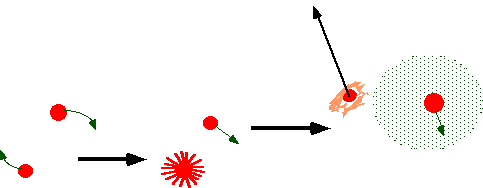 |
Both dynamically impossible. No angular momentum!
| Nebular Hypothesis. A rotating gas cloud, probably compressed by a nearby supernova shock wave, starts to collapse. The central part collapses to the sun. |
 |
| Conservation of angular momentum causes the outer part to speed up. | 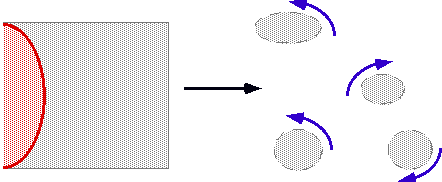 |
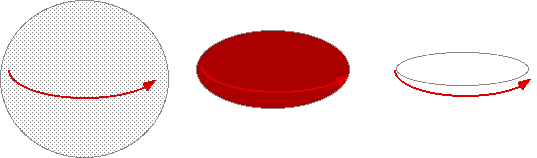
| The outer planets condense first. Gas and dust particles moving at an angle to ecliptic are more likely to interact and hence collapse into the plane normal to the rotation axis. Majority rule (less effective at the limits, hence Mercury & Pluto orbit further out of the plane.) |
 |
Intense solar winds remove hydrogen and helium from the inner part of the solar system. Terrestrial planets form from the left over refractory materials. |
 |
| The orbits are circularized by collisions and tidal effects. |  |
| e.g. υ (say Upsilon) Andromeda | 
Where is Upsilon Andromedae? Credit and Copyright: Till Credner & Sven Kohle |
| has 3 planets, one very close | 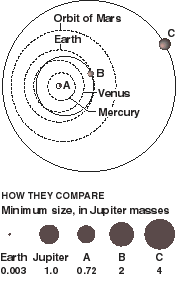 (New York Times) |
| so it might look like this | 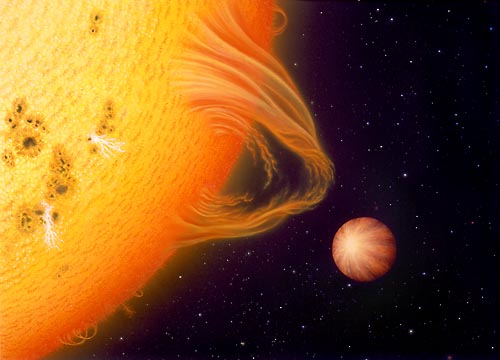 Drawing Credit & Copyright: Lynette Cook |
(as of today!). Special conditions required for the discoveries (can only see large planets, fairly close and orbit must lie close to our line of sight) suggest they are very common: probably 50% of stars have them.