(most easily seen with binaries, since then lines from star can be unambiguously identified)
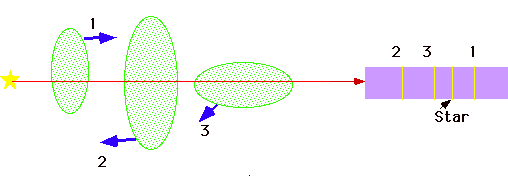
and for H via 21 cm line: can often see several differently Doppler shifted lines in any given direction.
About half of the mass of the galaxy is not in the form of stars: what is it?
| Interstellar gas seen via anomalous absorption lines (most easily seen with binaries, since then lines from star can be unambiguously identified) and for H via 21 cm line: can often see several differently Doppler shifted lines in any given direction. |
|
Lines are
Weak (since gas is very diffuse ∼ 10⁴ atoms m-3)
Sharp (since gas is cold)
Size of clouds ∼ kpc
Lines include H (obviously!) Ti, Na, CaI, CaII
(note ions are present: means that gas must be so diffuse that they have never recombined with e-.)
| Structure of galaxy can be seen via H lines: clouds of H show spiral structure | 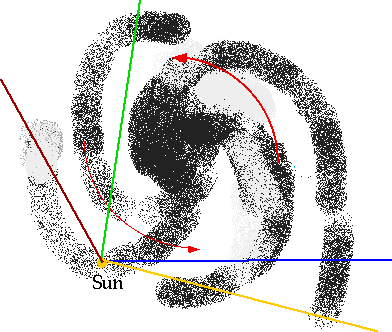 |
| (Since we can only measure velocities, not distances, interpretation is tricky) | 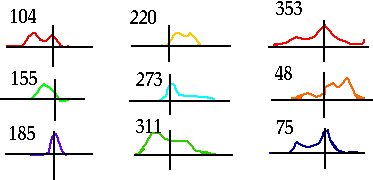 |
| Also at high densities, H2 is formed, which doesn't show 21 cm line |  |
| Presumably a typical spiral galaxy c/f M51 |
 |
| Horsehead in Orion: region of Milky Way "apparently" completely empty of stars | 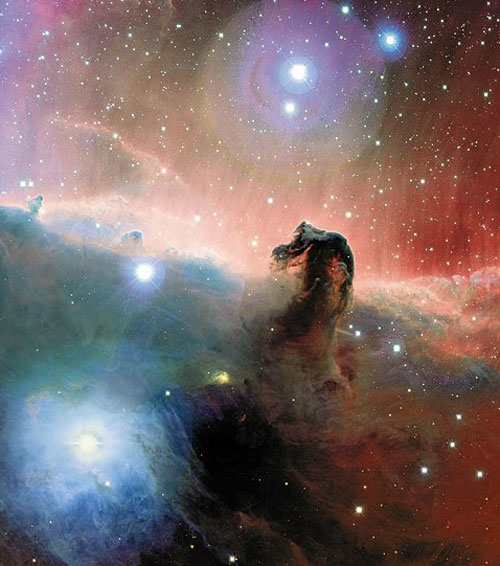 Credit & Copyright: Canada-France-Hawaii Telescope, J.-C. Cuillandre (CFHT), Coelum |
Also seen in external galaxies
| Also star counts (number of stars of given magnitude) show anomalies. We can see clouds (as sudden changes) but there is also a general obscuration |  |
Means apparent magnitude of distant stars is almost certainly wrong:
m - M = 5(log(d)-1) + Awhere A is a fudge factor!
Also is different at different wavelengths: B-type stars (known to be hot from spectral lines) appear to have redder (and hence cooler) BB spectrum
| Reflection nebulae e.g. Pleiades, | 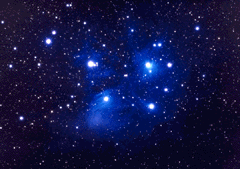 |
| and M42 in Orion | 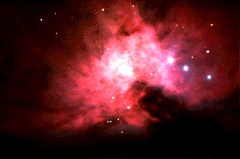 |
| shine blue by reflected starlight |  |
| Note same effect on earth: sunsets are red, the sky is blue! |  |
Also interstellar polarisation:
Light from distant stars about 5% polarised, poln α reddening, so whatever absorbs light must polarise it.
Clues to dust: must be small, elongated, aligned
spherical grains,random grains, ice won't polarise light
a) Dirty ice (ice at v. low temp forms needle-shaped crystals
b) Carbon (known to be present in atmospheres of C stars, in form of graphite, diamond and fullerenes
c) complex organics (see later)
d) silicates
or most likely, all of the above.
| Alignment produced by galactic magnetic field (∼ 10-6 G) | 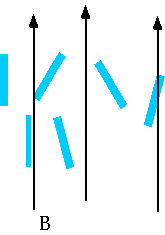 |
In fact over 100, many complex ones, many free radicals
Presumably many more, but spectra aren't known or can't be observed
OH (hydroxyl)
CO
CN (cyanogen)
CS
SiO
H2O
NH3
H2S
HCN
HCHO (formaldehyde)
HCHS
CH3OH (methanol)
CH3CN
HCOOH (Formic acid)
NHCO
...
HC5N, HC9N, HC11N, HC13N
These show pecularities of cosmic chemistry: they are very reactive, but have easily calculated spectra, and can be easily observed
H-C≅C-C C-CC-CN
How and why?
Molecules always occur in dust clouds
| >Often seen in emission, with crazy temperatures: e.g NH3 Maser action: molecule gets excited by collision and de-excited by another photon | 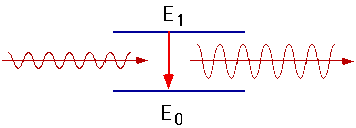 |
How and why?
| Outer layer of cloud protects molecules from UV, molecule formation is catalysed by dust particles |  |
Note: Hoyle and Wickwramasinghe have suggested that maybe life originated in space and it subsequently infected earth....
| Some nebulae actually produce light (rather than reflect it) | 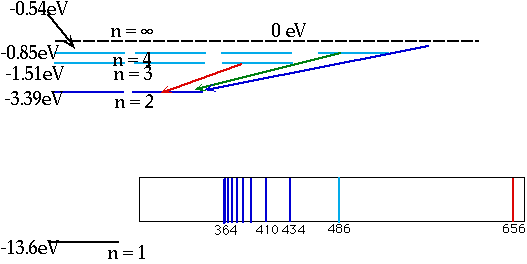 |
| H11 spectrum UV from O or B star kicks off electron then e- + p ⇒ H + γ (called a free-bound transition for obvious reasons) |
 |
| e.g. η Carinae | 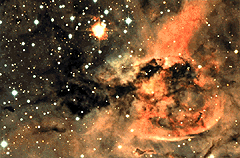 |
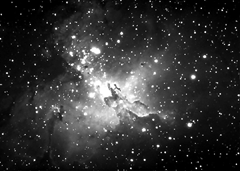
Often all of these different kinds of nebulae (emission, dark, absorption) will occur in same place. Invariably associated with H gas (hence red) and star formation
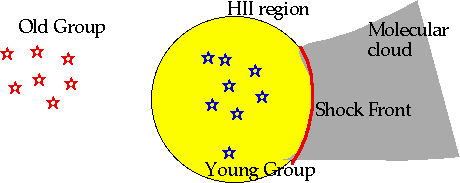
| Hot, young stars ionise gas ⇒ H11 region. Further out, gas is heated but not ionised Eagle nebula (M16) |
 |
| Trifid Nebula (M20) | 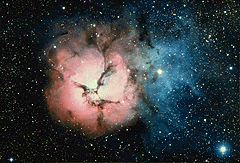 |
| These nebulae are usually associated with hot, young stars (which produce the emission)
Supergiants have lifetime of "only" 106 years: hence clouds will not have time to disperse much. |
 |
Cosmic Rays
Don't fit in very conveniently anywhere. High energy particles bombard upper atmosphere continuously:
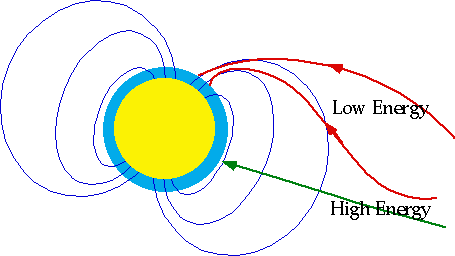
Low energy from sun (keV...100MeV); electrons, protons, α-particles produced (mainly) by flares in sun
| Mag field bends charged particles: F = q v x B ⇒ radii of curvature r = mv/qB Low energy ones are bent towards magnetic poles of earth....⇒ aurora when they hit upper atmosphere |
 |
High energy ones can have energies up to 1020 eV (most powerful accelarator on earth delivers 1 TeV = 1015 eV)
No electrons in H.E. They lose energy too fast
Nuclei up to 235U, in rough proportion to cosmic concentration
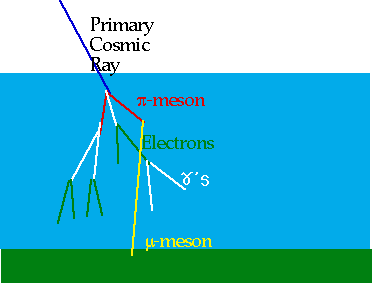
| High energies are not bent: they interact in upper atmosphere and cause showers of particles which can be observed at earth's surface
∼ 1 muon/m²/min |
|
| Learn very little astrophysics, unfortunately, since no directional info! R = p/Bq (p = momentum) galactic mag field ∼ 10-6 G = 10-10 T ⇒ R ∼ 10 kpc for 1 TeV cosmic ray |
 |
| Where do they come from? Not well understood, but one mechanism is pulsar mag fields: rotating mag field can accelerate particles (and we know the Crab is made of high-speed electrons) | 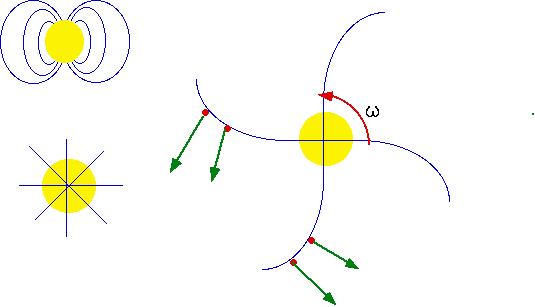 |
| Most convenient to start by defining galactic coordinate system
If we are observing objects with respect to earth, obviously use R.A. & dec. With respect to galaxy, choose galactic equator to lie along axis of Milky Way |
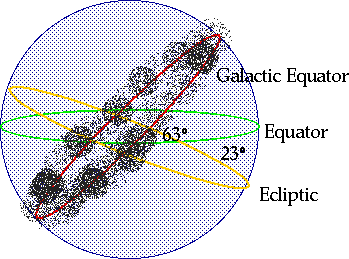 |
Choose O° of galactic longitude ( ) to corres. to centre of galaxy
(presumably) radio source Sagittarius A (α = 17h42m, δ = -28.55°) visible in summer as dense portion of Milky Way
Note: Dust clouds lie along galactic equator: similar effects seen in other galaxies general picture is that sun lies on a spiral arm of galaxy, ∼12kpc from centre
Star Clusters: two kinds
Open Clusters e.g. Pleiades
Hyades
M34 (H&χ persei)
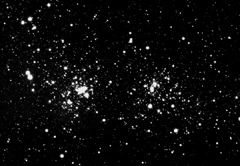
these are ∼100-1000 stars
a) young ∼ 106 years
b) contain many O-B-A stars
c) often not gravitationally bound
Forces all directed towards barycentre.
Kinetic energy = 1/2m v²
Potential energy = -GMm/r
M = mass of cluster,
m = mass of star,
r = distance of star from centre.
If K.E. > P.E. then star will eventually escape
...d) shortlived: stars will either escape or supernova
e) lie in galaxy
A lot of the Messier objects are globular clusters of stars: relatively bright and close, mostly old stars.
|
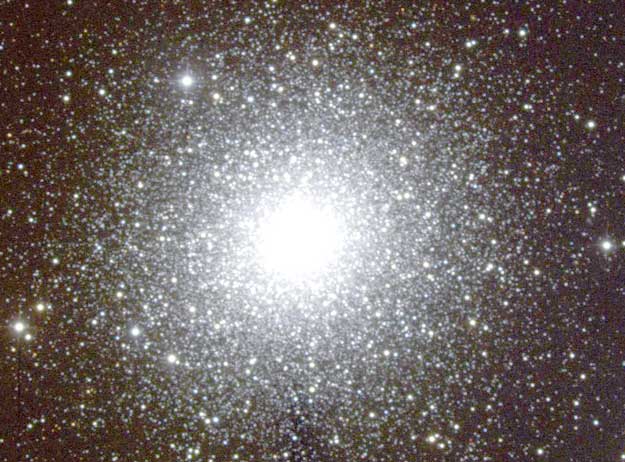 Globular Cluster M2
Credit & Copyright: D. Williams, N. A. Sharp, AURA, NOAO, NSF |
| e.g. M3 (note lots of red giants) | 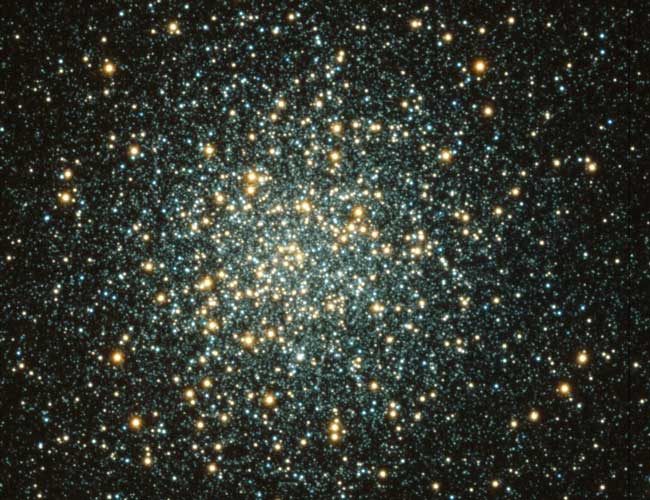 Credit & Copyright: S. Kafka & K. Honeycutt (Indiana University), WIYN, NOAO, NSF |
| There are about 200 round our galaxy: all galaxies seem to have them. THis is M87 (more about it later). It has about 1000 globulars. | 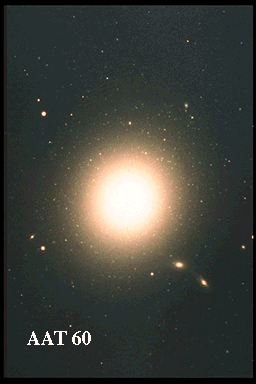
Credit: Anglo-Australian Telescope photograph by David Malin Copyright: Anglo-Australian Telescope Board |
| THese are quite easy to understand: stars swing in and out of centre. | 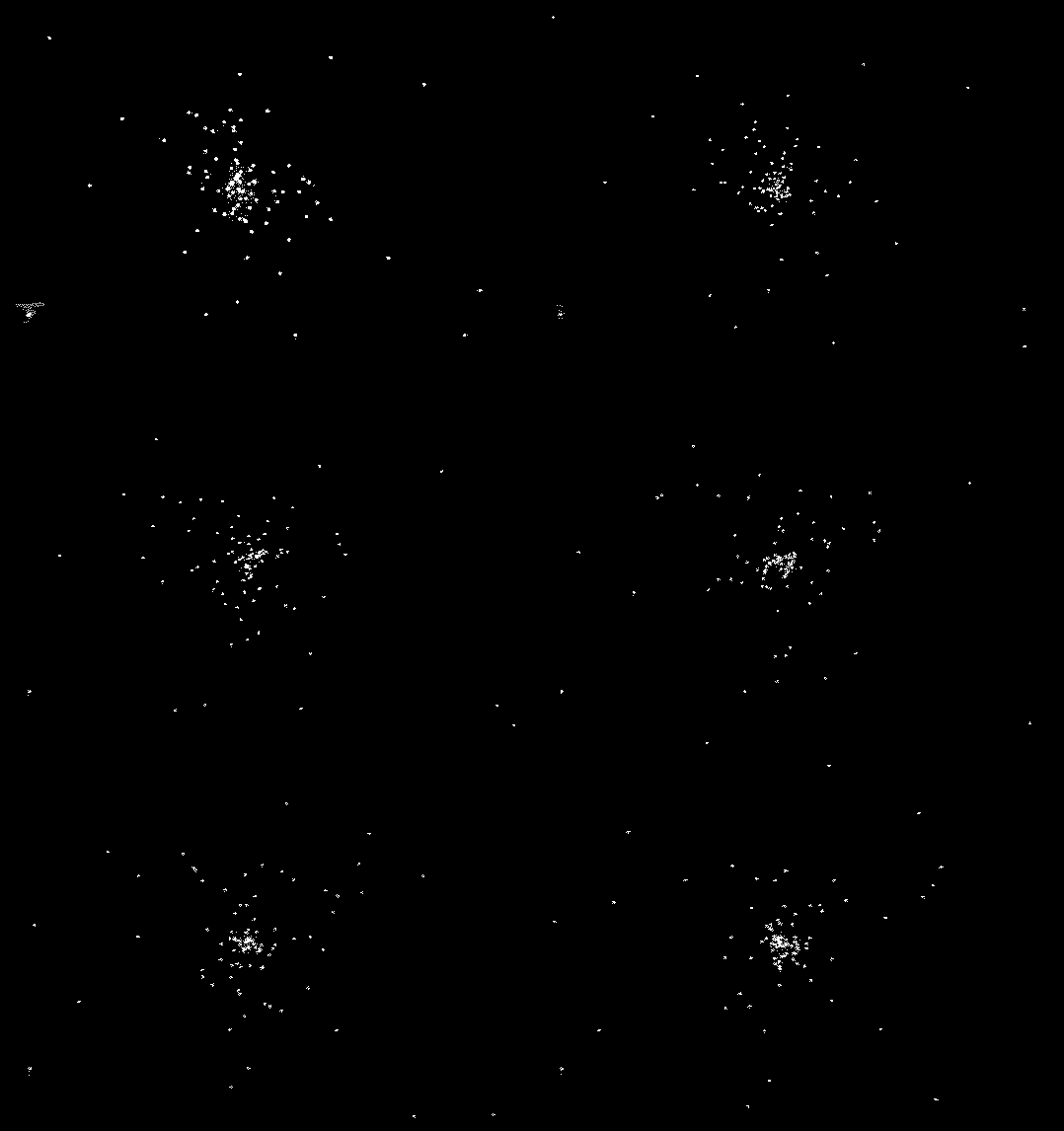 |
| A lot of the Messier objects are globular clusters of stars: relatively bright and close, mostly old stars e.g. M2 in Aquarius: about 100000 stars |
Globular Cluster M2
Credit & Copyright: D. Williams, N. A. Sharp, AURA, NOAO, NSF |
| e.g. M3 (note lots of red giants) | Credit & Copyright: S. Kafka & K. Honeycutt (Indiana University), WIYN, NOAO, NSF |
| There are about 200 round our galaxy: all galaxies seem to have them. THis is M87 (more about it later). It has about 1000 globulars. |
Credit: Anglo-Australian Telescope photograph by David Malin Copyright: Anglo-Australian Telescope Board |
| THese are quite easy to understand: stars swing in and out of centre. | |
Where is the sun relative to the rest of the galaxy?
Star Counts:
If general picture is correct , should see fewer stars as we move away from centre of galaxy. Assume we look only at stars of same absolute magnitude
Observer looks at an region of sky of angular area (i.e. solid angle) dΩ (area dA in the sky at a distance r)
dA = r²dΩ
(NOTE: full solid angle is 4π: area of sphere is 4πR²)
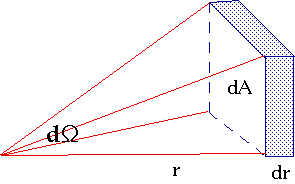
Going out a further distance dr will give a volume
dV= r² dr dΩ
The number of stars in this volume will be
N(r) = ρ(r) r² dr dΩ
ρ(R) is the number of stars/unit volume at this distance
Now m - M = 5 log r - 5 and assume all the stars have a fixed M, so ...
So that if two stars have same M and apparent magnitudes differing by 1
m + 1 - M = 5 log r'-5
Subtracting these gives log (r'/r) = 1/5
r'/r ∼ 1.58
i.e. apparent mag will drop by 1 for an increase of 1.6 in distance or
r = Cx100.2m
Hence if we count N(m), the number of magnitude m stars
N(m) = ∫ ρ(r) r² dr dΩ = 4πr³ ρ₀<br> Hence
N(m+1)/N(m) = 100.6 ∼ 4
Deviations would show a non-uniform stellar distribution.
BUT
1) Interstellar absorption fouls things up
2) Have to compensate for different intrinsic brightness
Failure to allow for this led to erroneous conclusion that sun was near centre of galaxy (e.g we see very few stars in direction of Sag A)
| Further evidence for position of sun comes from looking at globular clusters (125 known). These are gravitationally bound to galaxy, so will tend to accumulate around centre |  |
To learn more about the Milky Way, we need to look at external galaxies