
Credit & Copyright: Robert Gendler
Approx. 109 (one billion) observed (!!!).
Approx. 105 well studied
Messier list contains about 100 galaxies.
New Galactic Catalog ∼ 10,000
When in doubt, classify!
Galaxies classified under Hubble Classification
Different shapes
Different Sizes 105 -> 1012 L₀
Different Luminosities 105 -> 1010 L₀
Spirals & Barred Spirals show much smaller range of size, 109 -> 1011 stars.
Pop. I in arms and dust.
Pop II in core and plane
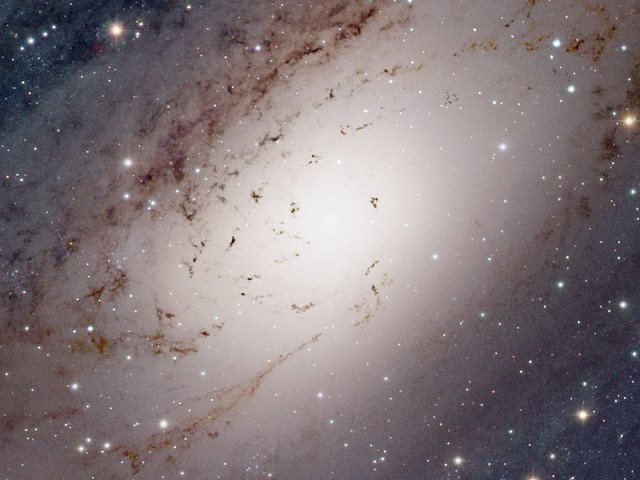
| The classic is M31 (Andromeda): tightly wound spiral with 2 satellites, a bit bigger than the Milky Way | |
| Core maybe has two black holes and billions of stars: superimposed are knots of dust |
Credit & Copyright: Robert Gendler |
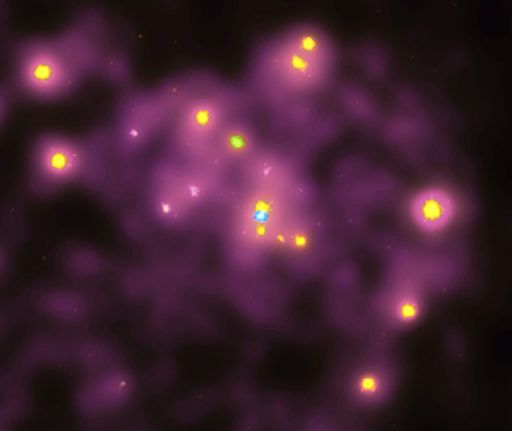
| Very bright in X-ryas, with an intense course at the centre | |
| This shows M51 along with Hurricane Julia: | 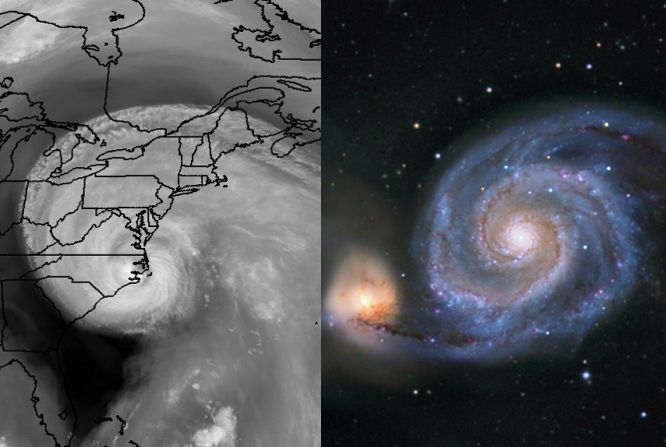 |
| NGC 1512 is an unusual spiral: tightly wound at the centre, with "star-burst" proceeding in a narrow ring | 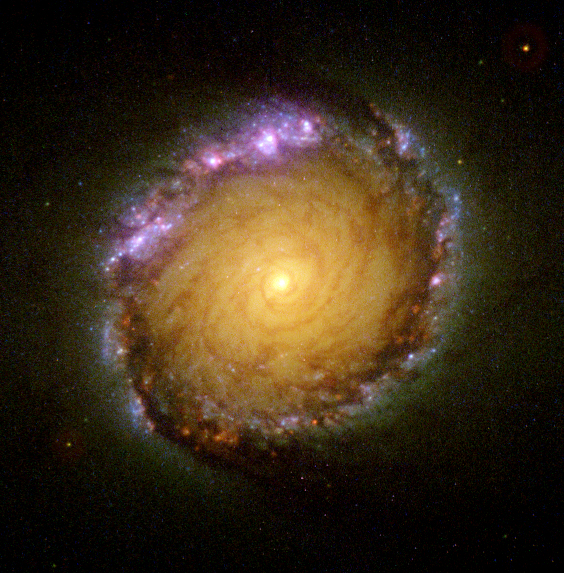 |
| NGC 6946: The Fireworks Galaxy. SHows the spiral structure for what it is: in this case, lots of new stars, (blue) and huge hydrogen clouds (red), and very bright small nucleus | 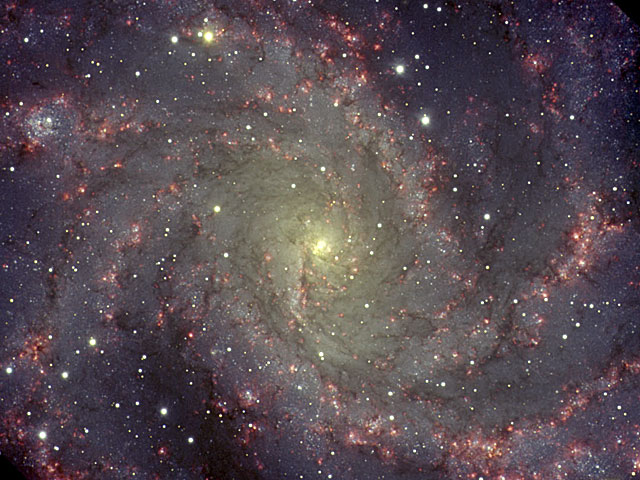 Credit & Copyright: T. Rector (U. Alaska Anchorage), Gemini Obs., AURA |
| M81 and M82 in Ursa Major make an intriguing pair: M81 seems to be destroying M82 via collisions | GALEX Full Field Credit: GALEX Team, Caltech, NASA 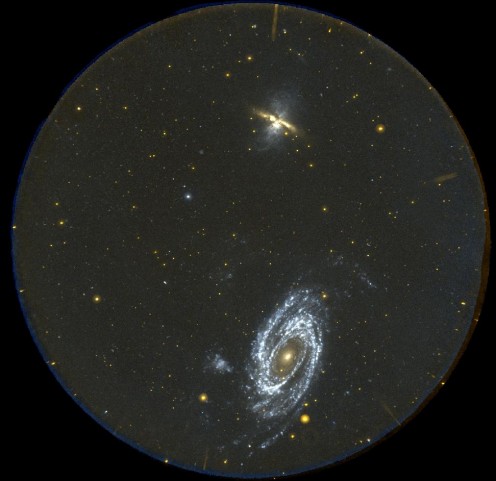 |
| Closeup of centre of M82 shows massive wind blowing out of centre of galaxy | 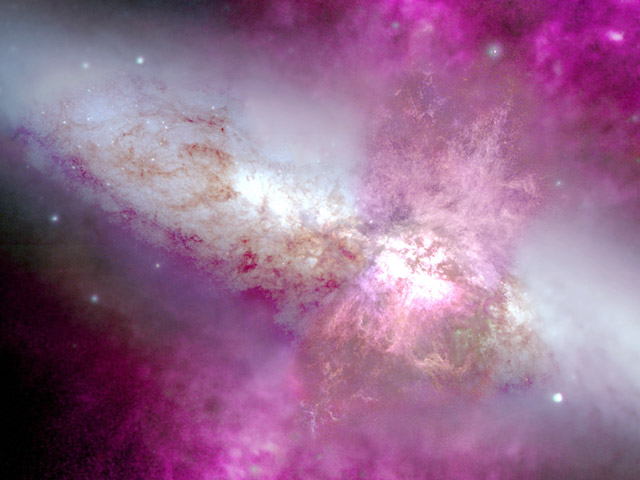
Credit: M. Westmoquette (UCL), J. Gallagher (U. Wisconsin-Madison), L. Smith (UCL), WIYN/NSF, HST, NASA/ESA |
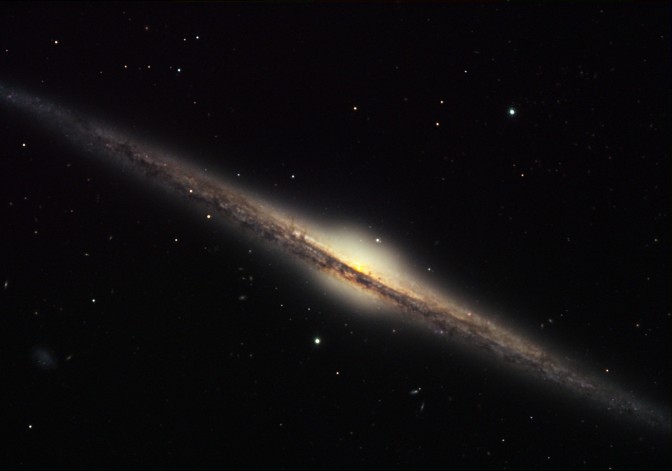
| >Some are seen side-on, which shows the X-sect
NGC 4565 |
 |
| Barred spirals: instead of a spherical nucleus, many have a bar across the centre:
NGC 1300 |
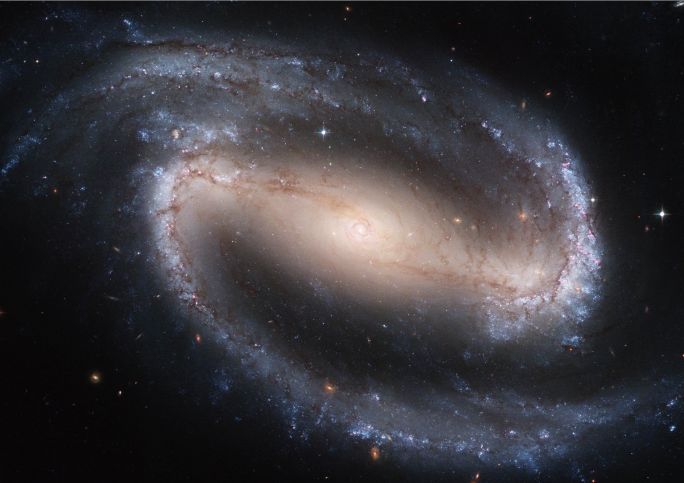
Barred Spiral Galaxy NGC 1300 Credit: Hubble Heritage Team, ESA, NASA |
| And again can be spread out
SBb NGC 7424 |
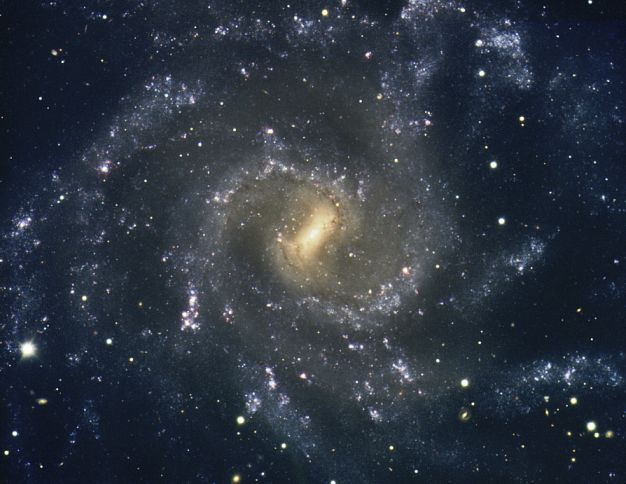
The Arms of NGC 7424 Credit: VIMOS / VLT, European Southern Observatory |
Ellipticals have v. great range in size, from 105 (dwarf) ->
Ellipticals look dull in pictures!
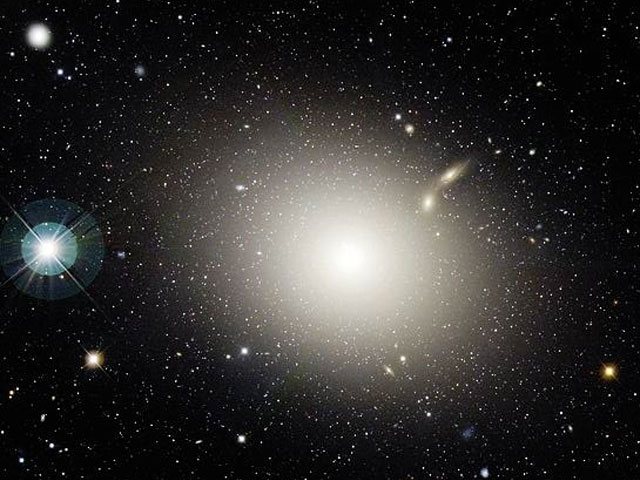
| M87 is one of the largest:
Note the spiral behind. (Stars have points on them).This is M87 (a giant elliptical) in Virgo. Almost perfectly spherical Has jet from centre (later) Note many globular clusters (>1000) |
 . . |
| Looks simple but...short exposure shows jet + very small core | 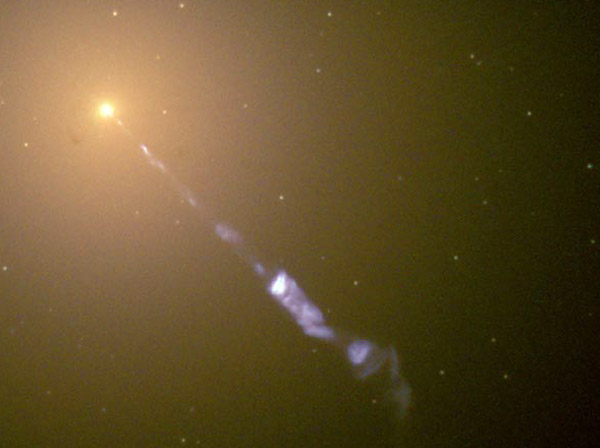 |
| And the jet looks more complicated the smaller the scale | 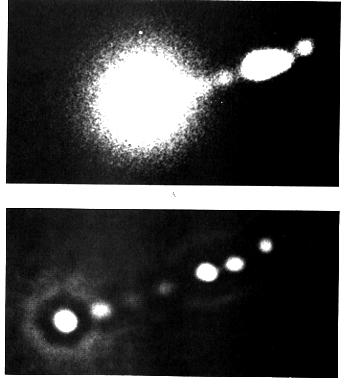 |
| and it seems to be related to radio "lobes" |  |
This is SMC ∼ 106 stars |
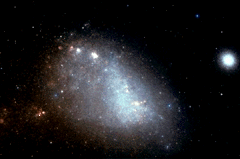 |
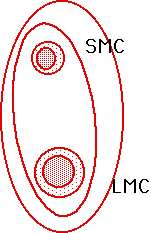
Have a lot of H Hydrogen bridge between them and even extends to our galaxy |
 |
| These are 3 galaxies (in a group called Stefan's quintet) which are colliding | 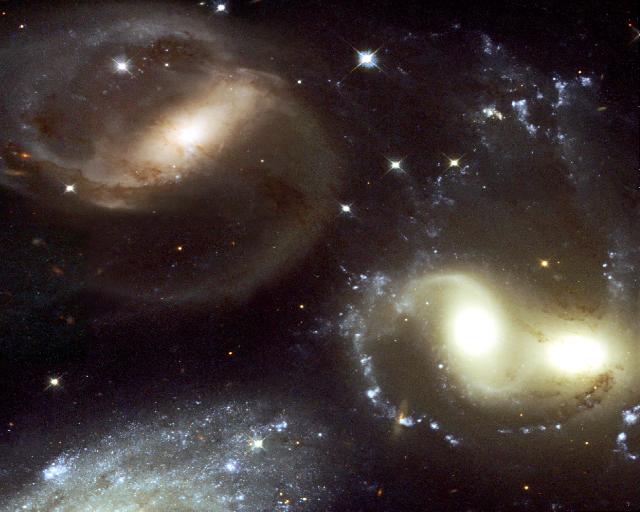 |
| "The Cartwheel Galaxy". Ring round (100000 lightyears across) consists of new stars produced in the collision with a smaller galaxy, which has now vanished. | 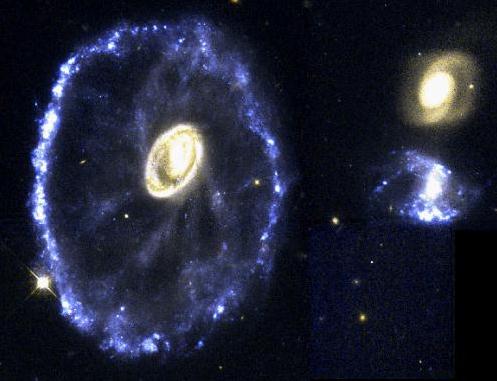 Credit: Kirk Borne (STScI), NASA |
| THe antennae galaxies are two very large galaxies in a violent collision: lats of stars being formed | 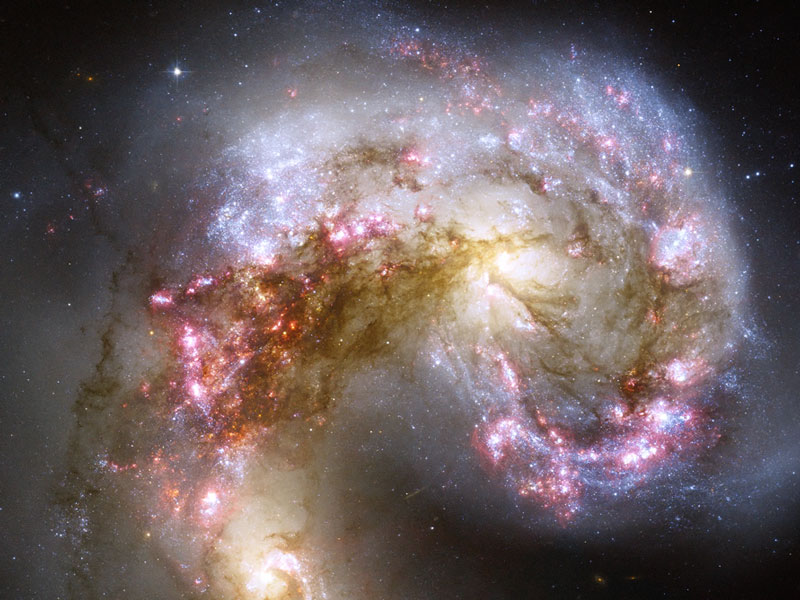
B. Whitmore (STScI), F. Schweizer (DTM), NASA |
| Not surprisingly the very hot gas produces lots of X-rays: this is the internal part of the antenna galaxies | 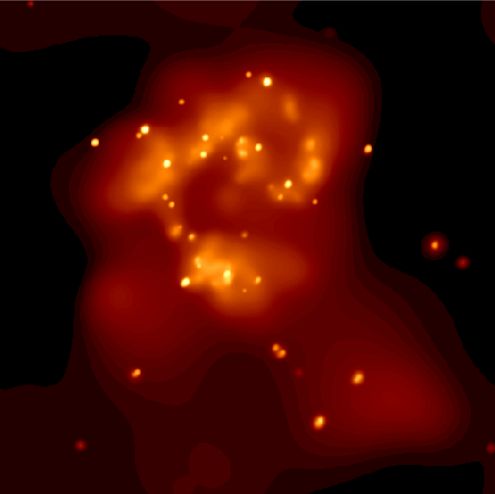 Credit: G. Fabbiano (CfA) et al., CXC, SAO, NASA |
| Centaurus A may be the result of the collision of two galaxies as well: lots of dust | 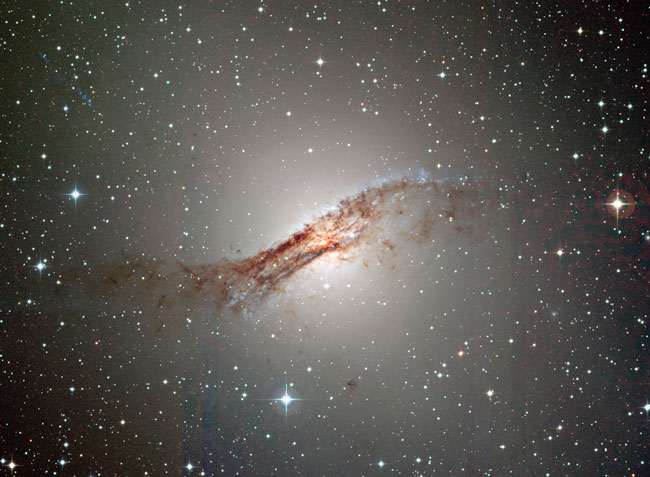
Credit: Marina Rejkuba (ESO-Garching) et al., ISAAC, VLT ANTU telescope, ESO Paranal Obs. |
| Closeup shows the star formation round the dust | 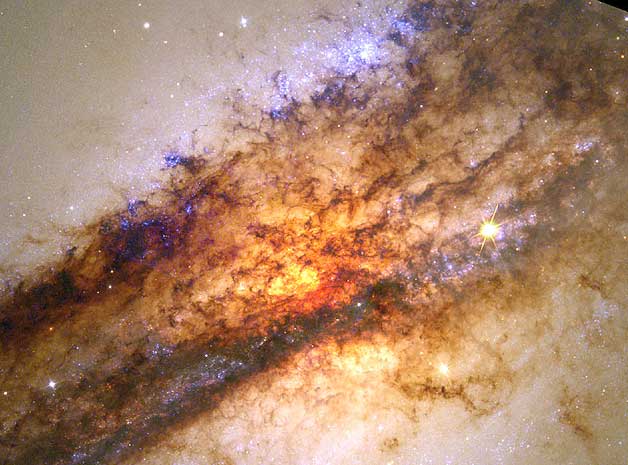 The Center of Centaurus A
Credit: E.J. Schreier (STScI) et al., HST, NASA |
Visual (apparent) mags. range from ∼ 6 (Andromeda) to lowest detectable (∼ 25)
Absolute brightest (giant ellipticals) ∼ -23
M31 ∼ -21
Milky Way galaxy ∼ -20
dwarf ellipticals ∼ - 9 (tho. dimmer ones would probably not be detected)

Ellipticals have mainly pop II stars everywhere: large number of red giants.
Spirals show complicated structure which confirms what is known about Milky Way
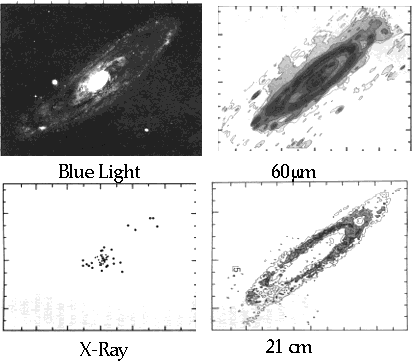
| e.g. M31 shows old stars evenly distributed X-rays from centre (maybe black hole) |
 |
| Objects | Extreme Pop I | Old Pop I | Disk Pop II | Halo Pop II |
|---|---|---|---|---|
| Dust, Gas | Sun | Planetary | Globular | |
| HII Regions | A&G stars | Nebulae | Clusters | |
| O&B stars | Giants | Dwarfs | sub-dwarfs | |
| T-tauri | Old Clusters | Pop II Cepheids | ||
| Avg Distance | 120 pc | 160 | 400 | 1000 |
| from Plane | ||||
| Approx Age | 108 | 108-1010 | 3*109-1010 | >1010 |
| MV | -8 | -5 | -3 | -3 |
| (brightest) | ||||
| Distribution | spiral | clusters | smooth | smooth |
| in Space | arms | |||
| Concentration | none | some | some | much |
| towards centre | ||||
| Galactic Orbit | circular | circular | eccentric | very |
| eccentric |
Probably variation in kinds of galaxies arises in following fashion
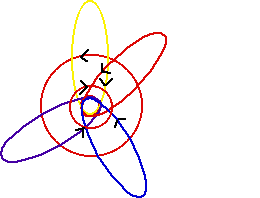
| Hydrogen gas with small ang. mom. will condense to form large clusters of galaxies with small ang. mom.
These galaxies will be roughly spherically symm. (i.e. elliptical) and stars will mop up H gas efficiently. Individual stars will be independent orbit around centre, wtih small total ang. mom. |
 |
Consistent with
H gas with large ang. mom (i.e. vortex) will contract to a disc, but ang. mom. will stop (by centrifugal force) contraction in plane. Less gas will condense into stars
Consistent with
What we don't know is what sets the basic scale, or where the angular momentum comes from.
e.g. we can predict that stars have masses .01 M₀ < M < 100M₀
(too light and they aren't large enough to burn H, too heavy and the radiation pressure blows off outside layers)
There is no theory that tells us that all spirals have ≈ 1010 stars and radius 20 kpc Some speculations later.
Also (a related problem) don't know whether it is a top-down or bottm up problem:
i.e. is the process
H-gas ⇒ stars ⇒ galaxies
or
H-gas ⇒ galaxies ⇒ stars
Irregular galaxies: the small ones (Irr1) are probably just failed spirals.
Most of Irr II are probably formed by galactic collisions
| Note: distance between stars ≈ 106 x radius, so collisions are very unlikely. For galaxies, d ≈ 10R |
 |
Note this is a galactic collision, there is (almost) no chance of stars colliding, but gas can become extremely hot⇒ X-rays
| e.g. Cartwheel galaxy: Compact, heavy galaxy kicks out core | 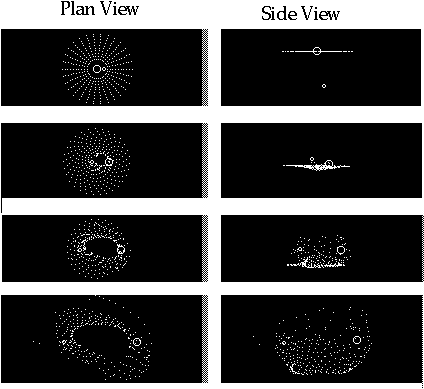 |