- ∼ 100 billion stars
- Large spiral arms outlined by hot stars
- Large dust lanes
- Bright centre
- Size: ∼ 50000 pc (50 kpc) across
- Bright patches are clumps of young stars
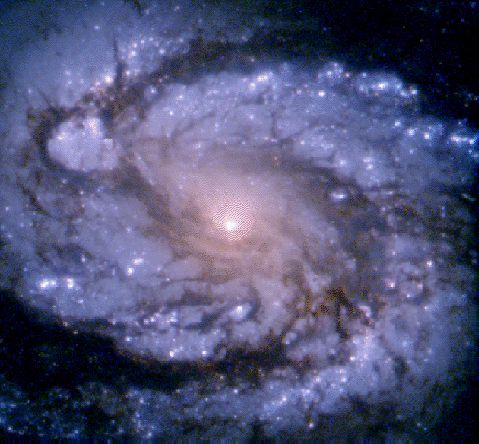
M100: A Grand Design Credit: NASA
Just as the Sun is "our" star, the Milky Way is "our" galaxy.
Unfortunately we see it from the inside, so first a look at a galaxy which is reasonably similar: M100. Large spiral galaxy, Note:
|
M100: A Grand Design Credit: NASA |
Looked at from the side, the Milky way looks a bit like
NGC 4565 (ignore the foreground stars): note
|
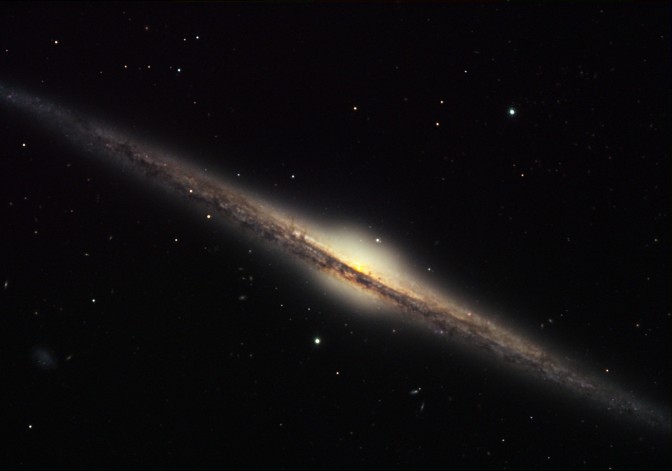 Credit: Bruce Hugo and Leslie Gaul, Adam Block (KPNO Visitor Program), NOAO, AURA, NSF |
| So the Milky Way probably looks like this | 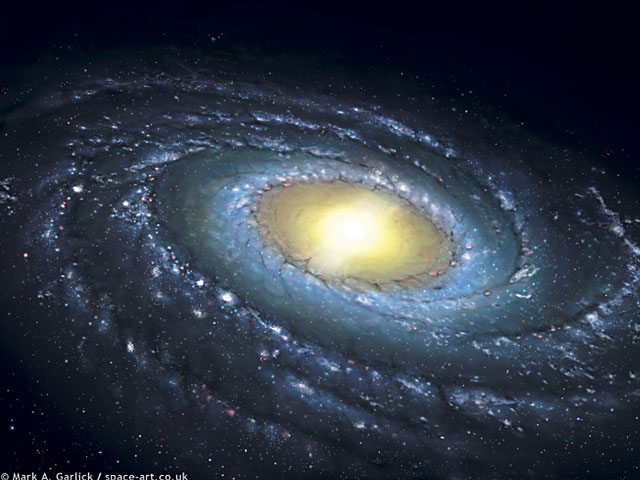 Illustration Credit & Copyright: Mark Garlick (Space-art |
| This is an old picture that shows the whole Milky Way | 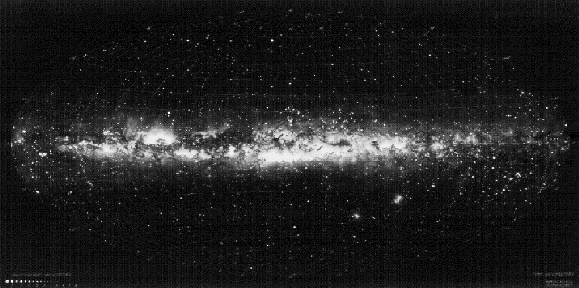 7,000 Stars And The Milky Way Credit: Knut Lundmark (Copyright: Lund Observatory) |
| and we can pick out the same general structure in radio waves, but note very intense source at centre | 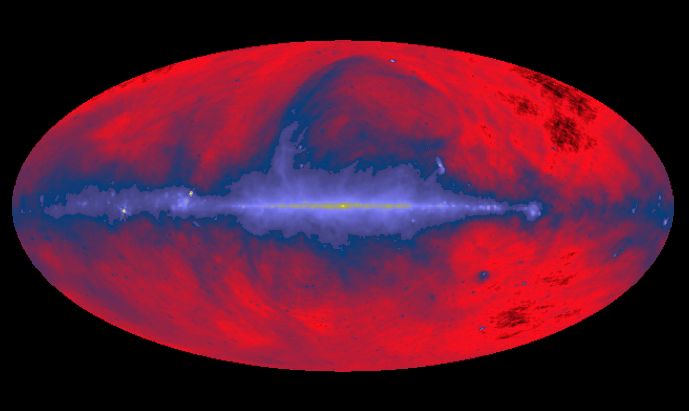 Credit: C. Haslam et al., MPIfR, SkyView |
| and γ-rays from the EGRET satellite | 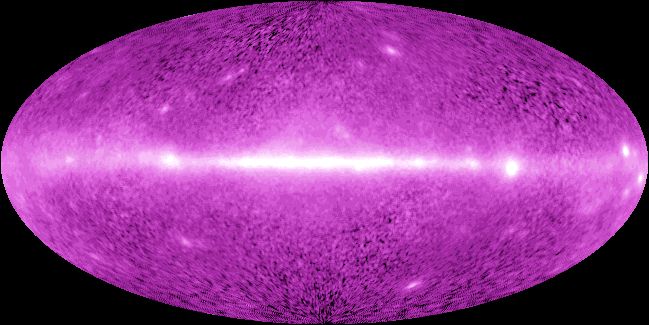 Credit: EGRET Team, Compton Observatory, NASA |
| Galactic Centre Not visible directly (too much dust) | 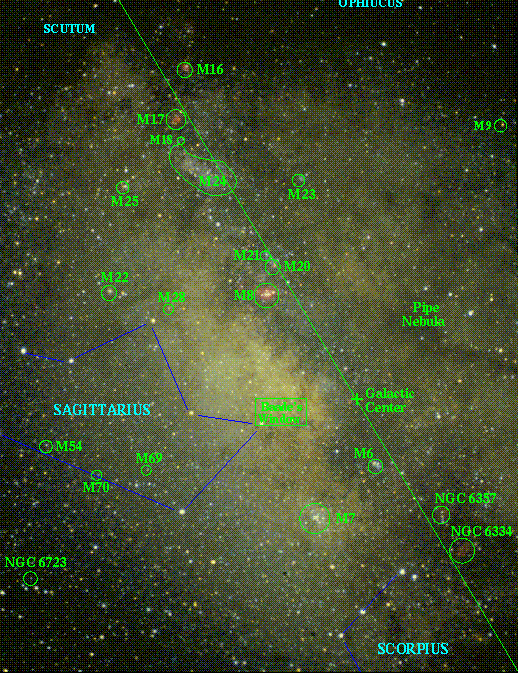 Credit: W. Keel (U. Alabama, Tuscaloosa), Cerro Tololo, Chile |
but strong radio source
| We can see through the dust (partially) with infra-red: note how dense the star field is | 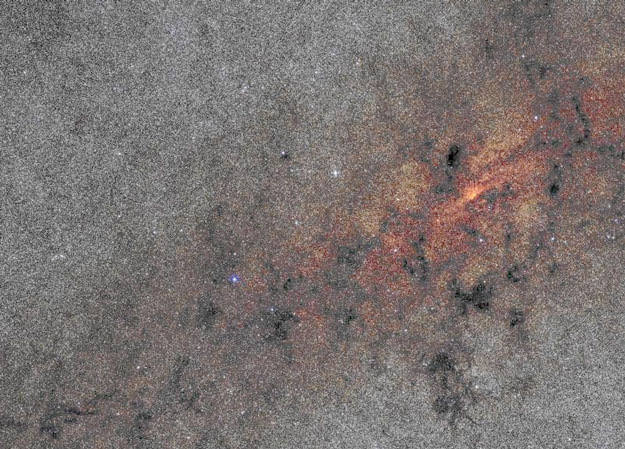
Credit: 2MASS Project, UMass, IPAC/Caltech, NSF, NASA |
| and X-rays | 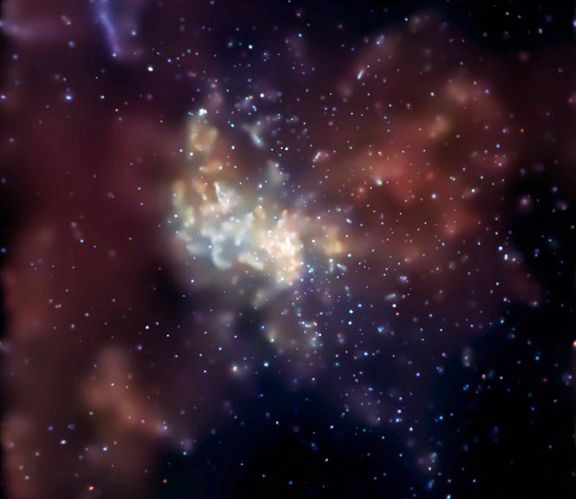 Credit: Fred Baganoff (MIT), Mark Morris (UCLA), et al., CXC, NASA Credit: Fred Baganoff (MIT), Mark Morris (UCLA), et al., CXC, NASA |
| Centre is very intense (and confused) source of radio waves (note the old supernova remnant) | 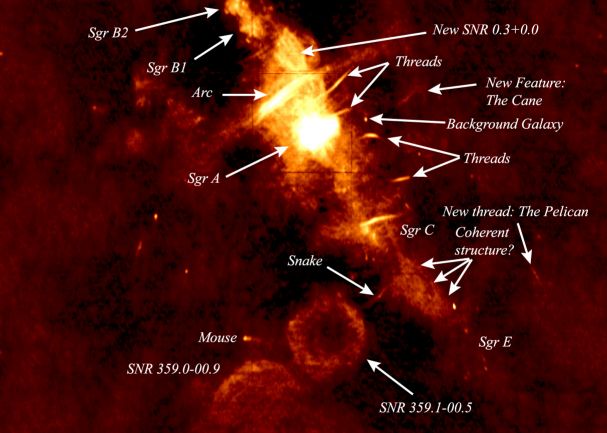
Credit: N. E. Kassim, D. S. Briggs, T. J. W. Lazio, T. N. LaRosa, J. Imamura (NRL/RSD) |
| Close to centre a lot of rapidly moving (300 km/s) hot (i.e. ionised) gas(Gravitational field at centre of galaxy should be very small, so would expect velocities to be small.) | 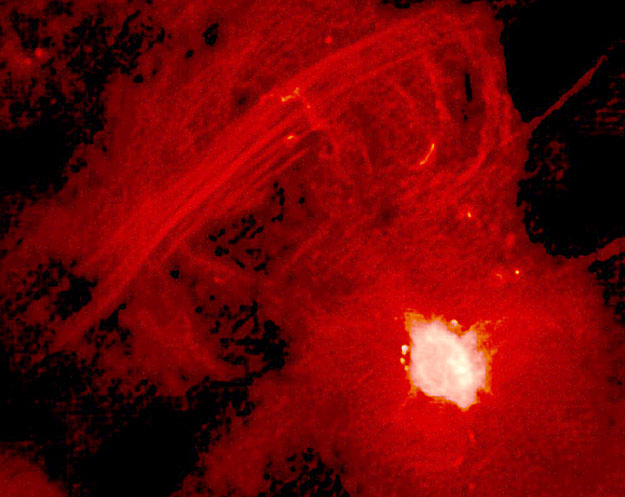 |
and hot stars
Could be very dense cluster of stars..........but note M31 (Andromeda), M100 and many others show a star-like central nucleus
| and very rapidly moving stars | 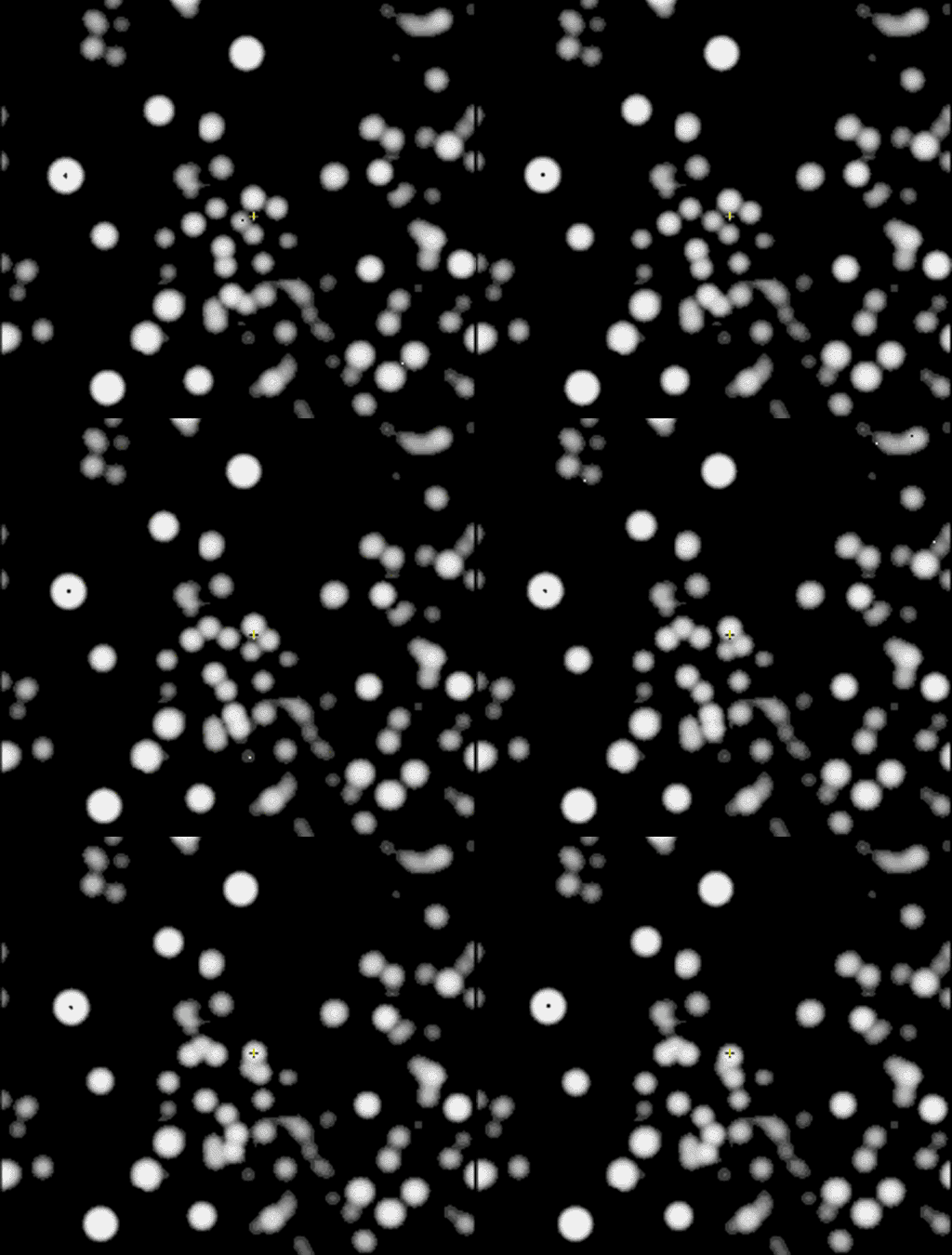 Credit: A. Eckart (U. Koeln) & R. Genzel (MPE-Garching), SHARP I, NTT, La Silla Obs., ESO Credit: A. Eckart (U. Koeln) & R. Genzel (MPE-Garching), SHARP I, NTT, La Silla Obs., ESO |
| Now there seems to be evidence for multiple black holes: very intense small X-ray sources close to the centre | 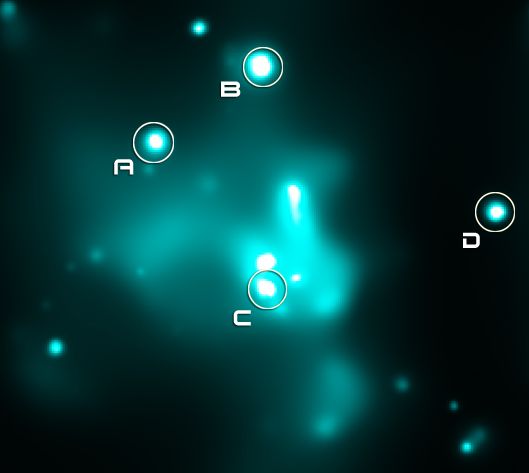
Credit: M. P. Muno (UCLA) et al., CXC, NASA |
Size of centre < 1pc
Mass of object ∼ 3000000 M₀
| Just recently have tracked star as it came within 17 light hours (3x distance to Pluto) of centre | 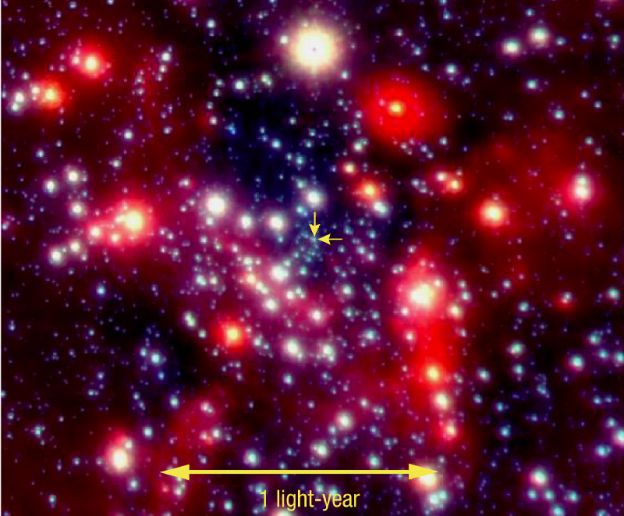 Credit: Rainer Schdel (MPE) et al., NAOS-CONICA, ESO |
| Whole picture is consistent with a very large black hole at centre, but not nearly as active as we see in other galaxies: e.g. this shows gas at the centre of NGC 1365 | 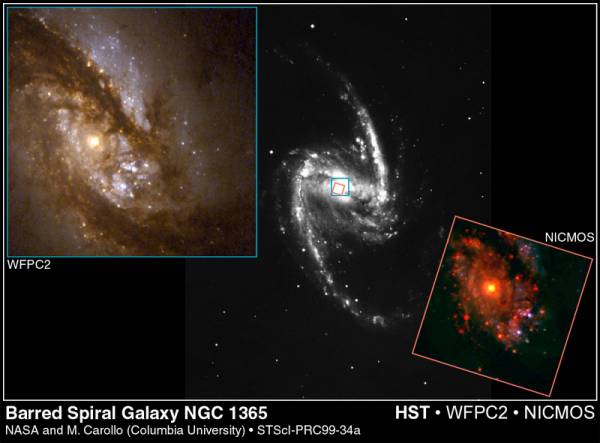
Credit: Ground-based image: Allan Sandage (Carnegie Observatories), John Bedke (CSC, STScI) WFPC2 image:John Trauger (JPL), NASA NICMOS image: C. Marcella Carollo (JHU, Columbia U.), NASA, ESA |
| and if you heard "As it Happens" on Tuesday... Star SDSS J090745.0+24507 is escaping from galaxy at ∼ 500 km/s. velocity points back towards galactic centre. Probably was one part of a binary system, companion was absorbed into black hole and speed acquired from black hole | 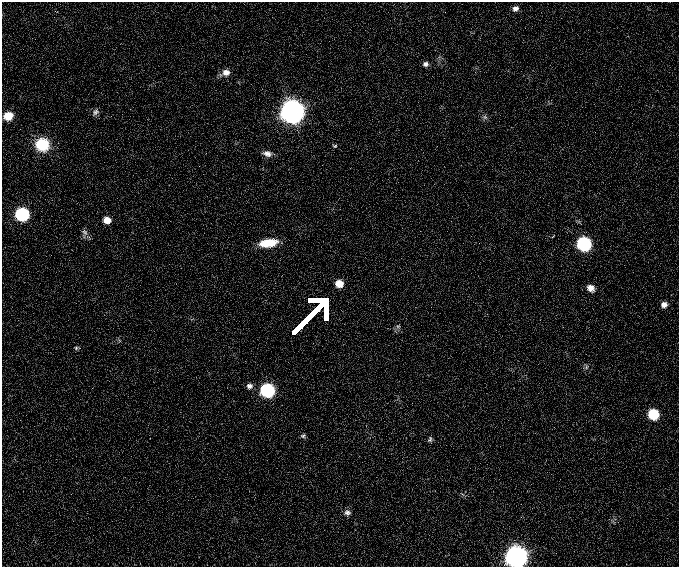 Credit: SDSS Collaboration (www.sdss.org) |
So are all galaxies the same?
MOTION OF STARS recap:
If we think of the sun as fixed, then stars can move at random (space velocity). Taking photo's at widely separated times (∼ 100 years) gives proper motion. Barnard's star moves ∼ 10"/year i.e. diameter of moon in 180 years. Distance ∼ 1.8 p.c.
Space velocity v = 4.74 μ/π km s-1
Proper motion is cumulative (i.e. just wait longer) so can be measured very accurately radial motion can be measured via Doppler.
=>space velocity
v² = v²|| + v² ⊥
From proper motion
a) can deduce binaries
b) could detect Jupiter sized planets round nearby dwarfs
c) can measure distances to clusters
d) can deduce how galaxy rotates
Obvious (almost) that spiral structure occurs because the outer arms are being dragged behind
Stars will rotate about centre of galaxy in independent orbits.
Assume they are ∼ circular. Local system of rest (LSR) is fixed so that it moves round galaxy at the same rate as average of stars in stellar neighbourhood.
| Stars will move partly at random Some of this motion will be due to sun's motion: consider sun to be at rest (=> local standard of rest). But presumably relative to the galaxy, the sun is moving.... |
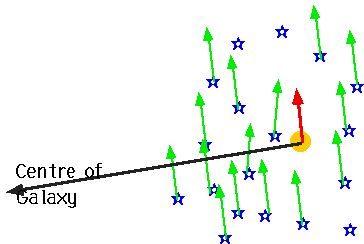 |
| The local system of rest is defined as moving at this average orbital velocity:
w.r.t. the L.S.R., sun moves at 20 km/sec. towards Hercules. Peculiar motions are defined w.r.t. L.S.R. |
 |
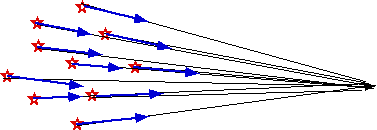
| Measuring distance to clusters:
If we see a group of stars, all apparently moving together at ∼ the same velocity, then when motions are projected on celestial sphere, they appear to converge at a point. |
 |
| Radial velocity vr measured by Doppler
Proper motion μ", so tangential component (but we don't know π" or d) |
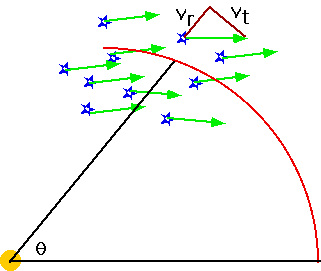 |
| But vt/vr = tan(θ), so if we knew θ we could find d.........
But if we have a cluster, we do know θ! |
|
So if we can measure the proper motion, μ", and the radial velocity, we can deduce distance
For Hyades v = 39.1 km/s, θ ∼ 280, μ = .36"
⇒ 44.3 (±2%!) pc.
Beehive cluster (Prasepe) at 158 pc
χ Perseus at 2290 pc
Gives us scale well beyond limits of parallax
| Assume (simplest) that the galaxy rotates as if there is a single large mass at the centre
then |
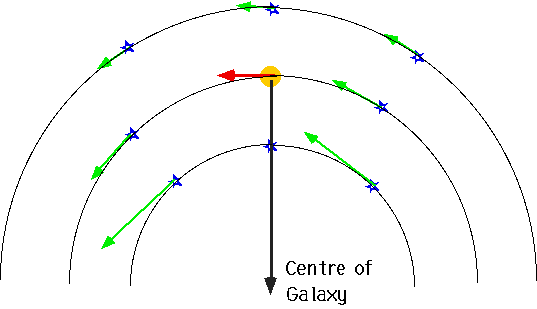 |
| This will give an illusion of motion relative to the sun | 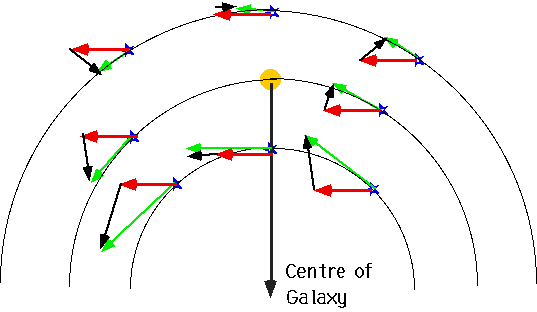 |
| Stars at l = 0 and 1800 will have no Doppler shift Stars at 90 and 270 will have max. | 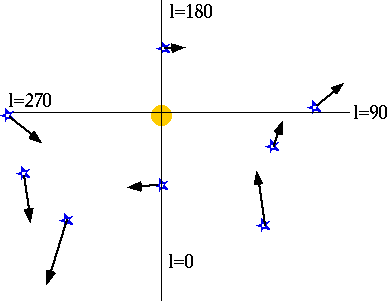 |
| To do this quantitatively: we want to find relative velocity of a star - relative to sun |
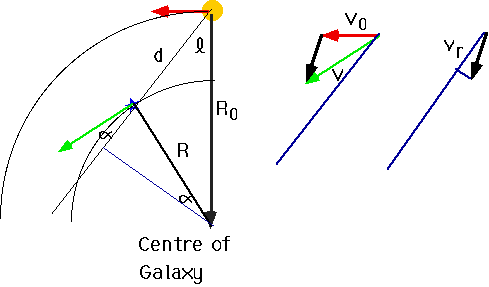 |
Angular vel of sun = ω₀, so R₀ω₀ = V₀

Angular vel of star = ω, so R ω = V
| SinƖ/R = sin (90+α)/R₀ = cos α/R₀ Also from geometry: Using these gives V = R₀(ω-ω₀) sin Ɩ |
|
Now if star is fairly close to sun
ω = ω₀ + (R-R₀) dω/dr +...............(Taylor series)
A = -1/2 R₀ dω|
                   dR|R=R₀
and R₀ - R = d cosƖ
V = A d sin (2Ɩ)
By a similar argument
Vt = d (A cos(2Ɩ) + A-ω₀)
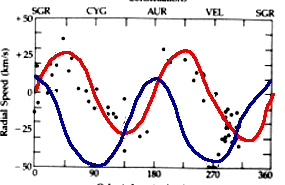
| i.e. If we measure velocities of more distant stars relative to LSR, they will appear to have different motions depending on GALACTIC LONGITUDE Ɩ
Want stars of known brightness and distance i.e. Cepheids. |
 |
Current numbers:
A = 15 km s-1 kpc-1, A-ω₀ = -10 km s-1 kpc-1 so  ω₀ = 25 km s-1 kpc-1

= 25x10³/3x1019 = 8.3x10⁻¹⁶ s-1
If we can measure v₀, we can then find
R₀ = v₀/ω₀, v₀ ∼ 220 km/s(from measuring speed rel. to external galaxies)
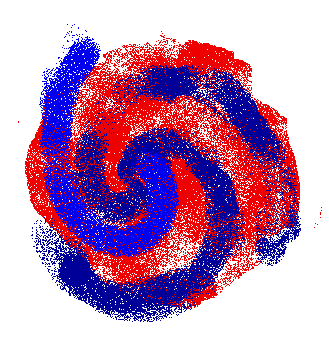
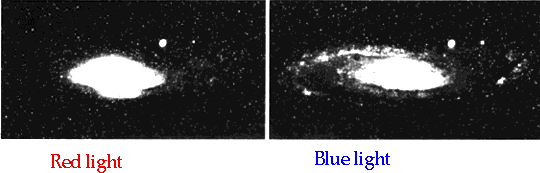
| Clear difference between external galaxies in red & blue light:
spiral structure only visible in blue, Implies spiral is made up of young stars: |
 |
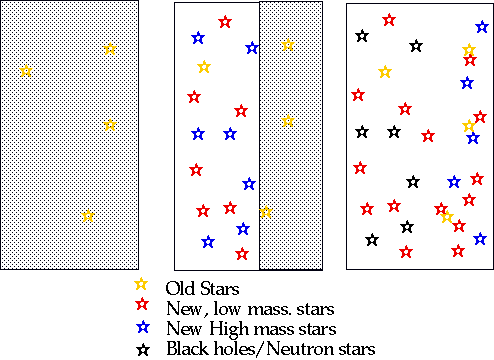
Since the spiral arms do not represent stars gravitationally orbiting in separate orbits, what are they? Look at Populations
|
 |
| Sound wave in a gas is a localised pressure/density fluctuation which travels at a definite speed v, (almost) unrelated to speeds of molecules
In galaxy, density wave will trigger the formation of both large and small stars By time wave has moved on, hot stars will have burnt through their life-cycle, but cool ones will be left |
 |
| Note: velocity of density wave is not related to velocity of stars: - probably 1/2 V Note: time for density wave to go round galaxy ∼ 5x10⁸yr. Lifetime of O & B stars ∼ 107 yr. |
 |
| If this is true, then we ought to be able to see the spiral structure outlined by blue stars & H clouds in our own galaxy | 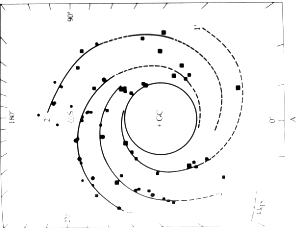 |