Why do all masses fall at same rate? All normal forces (e.g. electrical, friction, elastic...) don't produce same accn in all bodies.
F = ma = mg so a = g
Are we really sure the m's are the same? This concerned Newton
The first m (inertial mass mI) measures how hard things are to accelerate (2nd. law), the second (gravitational mass mG) measures gravitational force
F = mIa
F = mGg
Pseudo-forces (e.g. centrifugal force) behave the same way.
$$
\color{red}{
F = \frac{{mv^2 }}{R} = ma}
$$
so all bodies undergo same centrifugal accn.
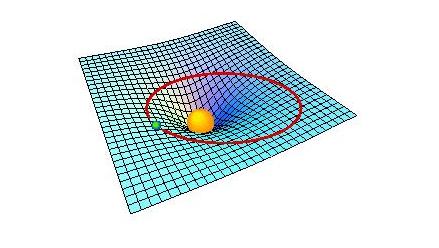
Maybe gravity is somehow a fictitious force (?!?!?!?)
mI = mG

F = mIa = mIg
so a = g only if the "inertial mass" the gravitational mass.
Can demonstrate this is true to 1 part in 1012 (Eötvos experiment).
Special relativity said you cannot do an experiment to decide if you are moving.
General says that you cannot do an experiment to distinguish between a gravitational field and an acceleration (!!!!!!!!!)
For example:
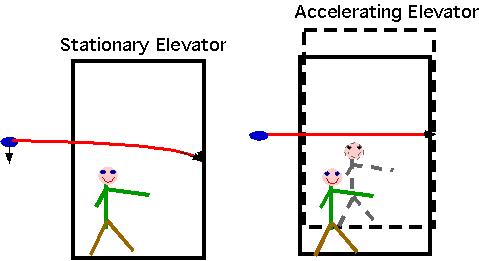
Suppose you are in a stationary elevator, and a bullet is shot horizontally, it will fall due to gravity..
Suppose you are in an accelerating elevator, and a bullet is shot horizontally, it will appear to fall..
You cannot distinguish the two.
For example:
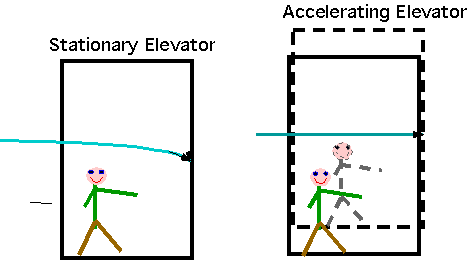
Suppose you are in an accelerating elevator, and a beam of light is shot horizontally, it will appear to fall..
Suppose you are in a stationary elevator, and a beam of light is shot horizontally, it will fall..
You cannot distinguish the two. Light gets affected by gravity?
General relativity: metrics
Physics should not depend on the frame of reference: e.g. which way is up?
Principle of General Covariance:
physical laws are the same in any frame.
(e.g. Newton's are not, since they aren't the same in an accelerating frame).
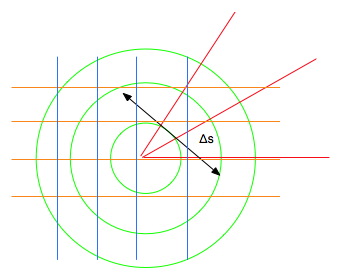
Metric is distance in terms of coords: in Cartesians:
Δs²=Δx²+Δy²+Δz²
In spherical polars:
Δs²=Δr² + r²(Δϑ² + sin²θΔφ²)
Δs² must be the same. Can include time via special rel:
Δτ²=Δt² - (Δx²+Δy²+Δz²)/c²
where τ is the proper time. e.g. for a moving body, this could be the interval between creation and decay of a particle, the (invariant) lifetime.
This contains (e.g.) time dilation: if the particle is travelling in some frame with vel
v = Δr/Δt (t is the time measured in the frame then
implies that proper time can be real or imaginary: more specifically if we have two events
Δτ² < 0 the events have a space-like separation
Δτ²= 0 the events have a light-like separation
Δτ² > 0 the events have a time-like separation
Defines "metric tensor" for us:
in 3-D, the distance between 2 points $
\color{red}{\Delta s^2 }$
cannot depend on the coord. system.
Suppose in one system we have
$$
\color{red}{
\Delta s^2 = \Delta x^2 + \Delta y^2 + \Delta z^2 }
$$
and we write $
\color{red}{x = x\left( {x^1 ,x^2 ,x^3 } \right)}$ etc..
Then in this case $$
\color{red}{
\begin{array}{l}
x = r\sin \left( \varphi \right) \\
y = r\cos \left( \varphi \right) \\
\end{array}}
$$
Can now find $$
\color{red}{
\Delta x = \frac{{\partial x}}{{\partial x^1 }}\Delta x^1 + \frac{{\partial x}}{{\partial x^2 }}\Delta x^2 + \frac{{\partial x}}{{\partial x^3 }}\Delta x^3 }
$$
etc. Then we can write$$
\color{red}{
\begin{array}{l}
\Delta s^2 = \left( {\frac{{\partial x}}{{\partial x^1 }}\Delta x^1 + \frac{{\partial x}}{{\partial x^2 }}\Delta x^2 + \frac{{\partial x}}{{\partial x^3 }}\Delta x^3 } \right)^2 + ..... \\
= \sum\limits_{}^{} {\sum\limits_{}^{} {g_{\mu \nu } \left( {x^1 ,x^2 ,x^3 } \right)\Delta x^\mu \Delta x^\nu } } = g_{\mu \nu } \Delta x^\mu \Delta x^\nu \\
\end{array}}
$$
Einstein summation convention: repeated indices are summed over.
Note:
$\Delta s^2 $ is invariant (Doesn't depend on the coord system or "frame of reference"
$\Delta x^1 $ etc do depend on frame
in general $
\color{red}{g_{\mu \nu } }$
depends on the location. Most (all!) of the cases we deal with will have a very simple dependence on space or time.
in 3-D (4-D) there are 9 (16) terms in $
\color{red}{g_{\mu \nu } }$
because of symmetry $$
\color{red}{
g_{\mu \nu } = g_{\nu \mu } }
$$
so 6 (10) of these are indep.
Note that we can have spaces with no metric: putting in metric gives geo"metry".
in special relativity
$$\color{red}{
g_{\mu \nu } = \left[ {\begin{array}{*{20}c}
1 & 0 & 0 & 0 \\
0 & { - \frac{1}{{c^2 }}} & 0 & 0 \\
0 & 0 & { - \frac{1}{{c^2 }}} & 0 \\
0 & 0 & 0 & { - \frac{1}{{c^2 }}} \\
\end{array}} \right]}
$$
In fact we often define c = 1. Note the space-like terms come with negative sign.
In GR we will have a more general metric.
Geometry of Curved spaces
Note we have carefully avoided saying what we mean by a curved space
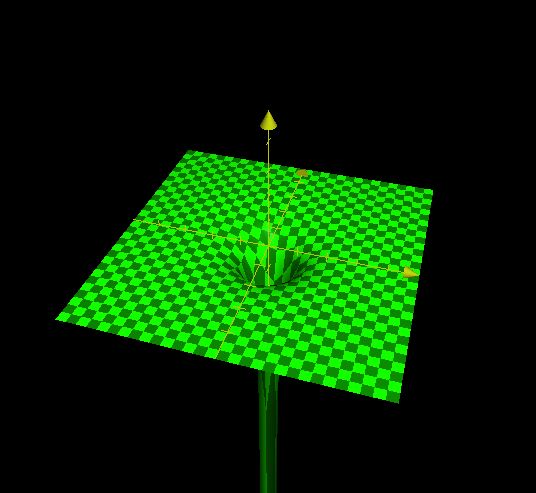
If you take the example of the 2-D curved surface of the Earth, this is embedded in a 3-D space. Hence If a massive body curves space, it almost implies extra dimensions. In fact we can carry out tests to decide if we live in a "normal" 3-D space (Euclidean)
e.g.
parallel lines
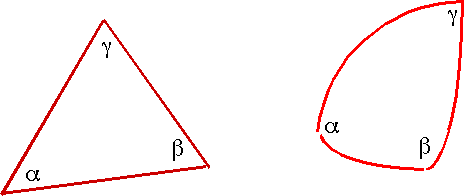
angles of a triangle add up to 1800
α + β + γ = π
These are experiments that we can almost do. (Gauss tried the 2nd!).
Specifically, consider a sphere: circles don't satisfy
C = 2πa
In fact,
C = 2πx = 2πRsin(a/R) = 2πa(1-a2/6R2)
i.e. by measuring the circ. of large circles, we can determine if we live in a curved space. We can measure the curvature k ≡ 1/R2; (a physicist would say we are measuring distant-dependence corrections to π!)
Can also have negative curvature K<0.
Triangle formula gets corrected in similar fashion:
Max value in positively curved space?
How do we know analytically if we are in a curved space?
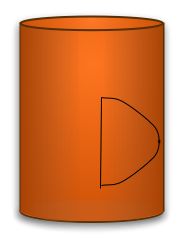
e.g. a cylinder will satisfy (most) Euclidean geometry. We can "unwrap" a cylinder into a flat surface, we can't unwrap a sphere without distorting it.
Constant metric implies a flat space, but the opp. doesn't hold: e.g. Cartesians
$$
\color{red}{
(x,y) \Rightarrow g_{\mu \nu } = \left[ {\begin{array}{*{20}c}
1 & 0 \\
0 & 1 \\
\end{array}} \right]}
$$
describes same space as polar coords
$$
\color{red}{
(r,\varphi ) \Rightarrow g_{\mu \nu } = \left[ {\begin{array}{*{20}c}
1 & 0 \\
0 & {r^2 } \\
\end{array}} \right]}
$$
If we go to cylinder, then r=R is fixed, and the distance $$
\color{red}{
\Delta s^2 = \Delta z^2 + R^2 \Delta \varphi ^2 = \Delta x^2 + \Delta y^2 :x = z,y = R\varphi }
$$
Note that on a cylinder we can have closed and open geodesics, in flat plane can only have open geodesics
Geometry ⇔ Metric ⇔ Local Properties
Topology ⇔ Connectedness ⇔ Global Properties
Compare with distance on a sphere: ,$$
\color{red}{
\Delta s^2 = R^2 \Delta \theta ^2 + R^2 \sin ^2 \left( \theta \right)\Delta \varphi ^2 \Rightarrow g_{\mu \nu } = \left[ {\begin{array}{*{20}c}
{R^2 } & 0 \\
0 & {R^2 \sin ^2 \left( \theta \right)} \\
\end{array}} \right]}
$$
How do we know we cannot flatten this? Gauss' tells us how to measure curvature in frame-indep fashion. $$
\color{red}{
K = \frac{1}{{2g_{11} g_{22} }}\left[ { - \frac{{\partial ^2 g_{11} }}{{\partial \left( {x^2 } \right)^2 }} - \frac{{\partial ^2 g_{22} }}{{\partial \left( {x^1 } \right)^2 }} + \frac{1}{{2g_{11} }}\left( {\frac{{\partial g_{11} }}{{\partial x^1 }}\frac{{\partial g_{22} }}{{\partial x^1 }} + \left( {\frac{{\partial g_{11} }}{{\partial x^2 }}} \right)^2 } \right) + \frac{1}{{2g_{22} }}\left( {\frac{{\partial g_{11} }}{{\partial x^2 }}\frac{{\partial g_{22} }}{{\partial x^2 }} + \left( {\frac{{\partial g_{22} }}{{\partial x^1 }}} \right)^2 } \right)} \right]}
$$
(no, it isn't obvious! Gauss called it the "Theorem Egregium"). Note this is the 2-D case: in general we will have a curvature tensor. Rijkl: much of GR can be done with this (e.g. a single black hole but not a rotating BH and definitely not colliding BH's!).
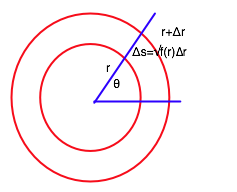
Very important for what we are going to do later is 3-D constant curvature solution (hyper-spherical geometry). Generalise fixed r relation
$$
\color{red}{
\Delta s^2 = r^2 \Delta \theta ^2 + r^2 \sin ^2 \left( \theta \right)\Delta \varphi ^2 }
$$
to 3-D: but now we expect some r dependence:
Gauss gives us $$
\color{red}{
k = \frac{1}{{2rf^2 }}\frac{{df}}{{dr}} \Rightarrow f = \frac{1}{{C - k r^2 }}}
$$
which can easily be solved: C is const. of integration:
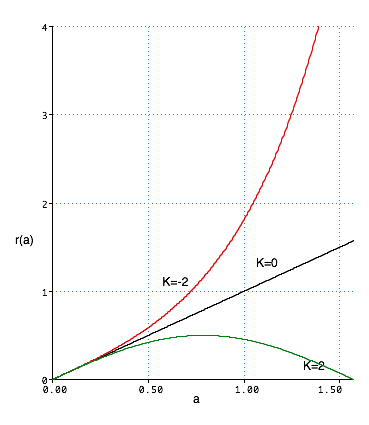
We can find the area and radius of an r-sphere:$$
\color{red}{
a\left( r \right) = \int_0^a {ds} = \int_0^r {\frac{{dr}}{{\left( {1 - k r^2 } \right)^{1/2} }}} = \frac{1}{{\sqrt k }}\sin ^{ - 1} \left( {r\sqrt k } \right)}
$$
How do we interpret this?
Black Holes
Chap 5 in Berry tells you how to write down and use the metric for a isolated massive body
First step is curvature due to a massive body
$$
\color{red}{
k \left( r \right) = - \frac{{GM}}{{c^2 r^3 }}}
$$
(Dimensional argument, but also can show this reduces to Newton's laws. Then Schwarzchild metric
$$
\color{red}{
g_{\mu \nu } = \left[ {\begin{array}{*{20}c}
{1 - \frac{{2GM}}{{c^2 r}}} & 0 & 0 & 0 \\
0 & { - \frac{1}{{c^2 \left( {1 - \frac{{2GM}}{{c^2 r}}} \right)}}} & 0 & 0 \\
0 & 0 & { - \frac{{r^2 }}{{c^2 }}} & 0 \\
0 & 0 & 0 & { - \frac{{r^2 \sin ^2 \left( \theta \right)}}{{c^2 }}} \\
\end{array}} \right]}
$$
(can find g11 by variant of last argument: to find g00 need to have the metric independent of time even though. clocks run slow. Schwarzchild radius R = 2GM/c2 is where metric becomes singular.
in particular, if
r = 2GM
     c2
then t = ∞: i.e. if I watch a clock at the Schwarzchild radius, it appears to have stopped.
From this can get all the classic tests of GR (see Clifford Will).
Gravitational Waves
A final consequence:
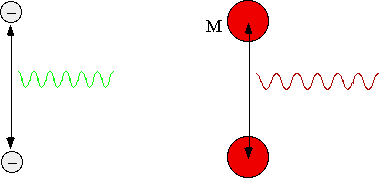
Vibrating charge radiates E.M. waves
Vibrating mass radiates grav. waves
Differences: that
Gravitational force between 2 electrons ~ 10-42 electric force Radiation is quadrupole, not dipole, which also means it is still weaker
Quadrupole nature means that grav. radiation cannot be produced by monopole or dipole system: e.g. supernova collapse (which has plenty of energy) is probably symmetric, so no radiation
Hence (well, more or less hence!) it requires a large amount of mass to produce a grav. wave, and a large amount to see one: e.g need to detect motions of << atomic radius in a one ton sapphire crystal.
Note what is happening here is that space-time is stretching (!)
History:
Joseph Weber claimed to have seen grav waves in 1970.
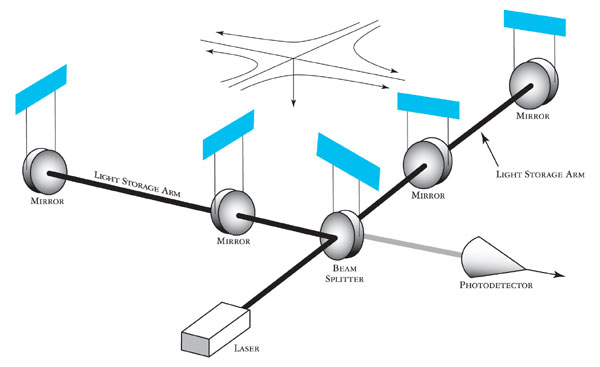
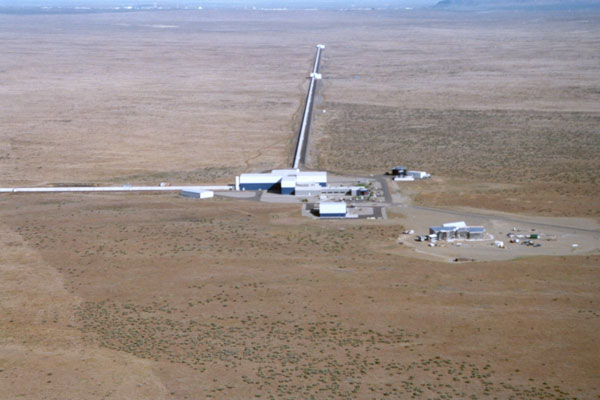
LIGO (Laser interferometer Gravitational Wave Observatory) detectes GW's by interfering 2 beams of laser light after sending them along 4 km arms
LIGO turned on in 2004: will see coalescing binary systems
LISA (space interferometer) will detect grav. radiation from anything within 106 light years
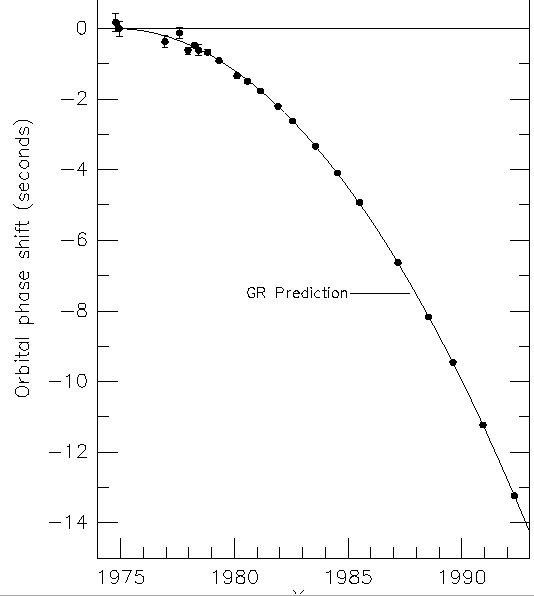
Hulse and Taylor: Binary Pulsar
PSR1913+16 discovered 1974. Like all pulsars, emits very regular radio pulse every 59 ms. (Frequency is 16.940 539 184 253 Hz: i.e. is better known than atomic clocks)
This consists of two neutron stars, in orbit 106 km in radius, with period of hours. Change in frequency allows orbit to be calculated exactly, and can measure..
Rate of precession = 4.22662 0/yr (i.e. 30,000x that of Mercury)
and that pulsar is losing energy, by gravitational radiation (mass~1.4 M0, and accns are large)
Decrease of the orbital period P (about 7h 45 min) of the binary pulsar PSR B1913+16, measured by the successive shifts T(t) of the crossing times at periastron; the continuous curve corresponds to $$
\color{red}{
T(t) = \frac{{t^2 }}{{2P}}\frac{{dP}}{{dt}}}
$$
given by the general relativity (reaction to the gravitational waves emission).
Reference:
Taylor J.H. 1993, General Relativity and Gravitation 1992, eds. R.J. Gleiser, C.N. Kozameh, O.M. Moreschi. Institute of Physics Publishing (Bristol).