so all the information is in curvature k(t) and scale-factor a(t)
FRW (Friedmann-Robertson-Walker) metric. Note this is cosmic kinematics: i.e. it doesn't depend on any model for a(t), k(t).
Can't be measured, but we can now use this to derive measurable quantities.
Warning
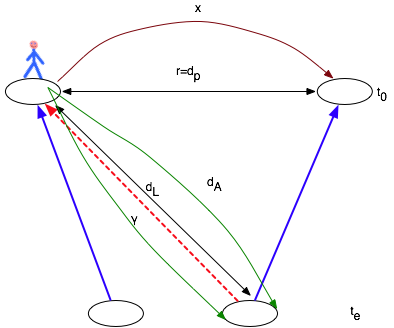
There are several distances in cosmology:
coordinate distance (x in Ryden's notation: not measurable)
Proper Distance dp (r in Ryden's notation: not measurable)
Luminosity distance ("standard candles") dL
Angular size distance dA
All are equivalent if universe is flat and distances are small.
Notation: books differ on the metric.
we'll separate the sign of the curvature from its value:
\color{red}{k }
is the value of the curvature: expect this to depend on time
\color{red}{R_0 }
gives the magnitude of the curvature
\color{red}{\kappa = 1,0, - 1}
is the sign of the curvature: (about half the books mix \color{red}k and \color{red}{\kappa }) so \color{red}{k = \frac{\kappa }{{R_0 ^2 }}}
Ryden uses
a dimensionless scale factor \color{red}{a(t)}
two choices for the FRW metric
r and x are two choices for the "co-moving coord." defined with respect to local frame (draw a grid on the balloon). Both have dimensions of length
The metric is defined in terms of proper distance ds
\color{red}{
v = \dot d_p \left( t \right) = H\left( t \right)d_p \left( t \right) = \frac{{\dot a\left( t \right)}}{{a\left( t \right)}}d_p \left( t \right) = \frac{{\dot R\left( t \right)}}{{R\left( t \right)}}d_p \left( t \right)}
the magic of factoring into scale dependent part and co-moving part.
in most calculations of observables, the R0 will cancel out
Time, distance and red-shift
Connection between distance and red-shift:
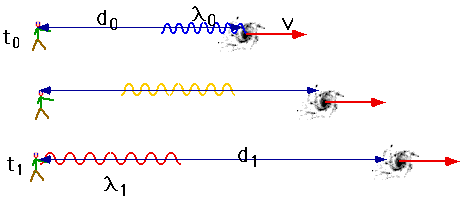
At time t₀, a galaxy is at a distance d₀ from us, and is travelling at v=zc . It emits a photon with wavelength λ0
We see the photon at time t1 with wavelength λ1
In time t between γ emission and absorption, the distance has increased (universe has expanded) by zct. so γ has to travel further:
travel time
t = d1/c
so
d1 = d₀ + zct = d₀ + zd1 so that d1 = d₀/(1-z) (non-relativistic)
i.e. if z = .25, the universe was 75% of current size when γ was emitted
(Note we have made a subtle change in the description: it is not the other galaxy which is moving away, it is the space in between which is stretching!)
We can also relate red-shift and age: At t = 0, universe had no size so
d₀ = vt₀ = zct₀ hence t₀/t1 = d₀/d1 = (1-z)
so that
t₀ = t1(1-z)
so again if z = .25, the universe was only 75% of its current age
(Correctly d1 = d₀(1+z) and t₀ = t1/(1+z), because of relativistic effects, but we also need to allow for slowing down of the expansion)
Note: the red-shift is more fundamental than the velocities: e.g. we'll talk about z = 3000 for the CMBR, which describes the time at which it was emitted, but it's not really sensible to turn this into v.
To see how to use the FRW meric, we'll do the red-shift calculation properly
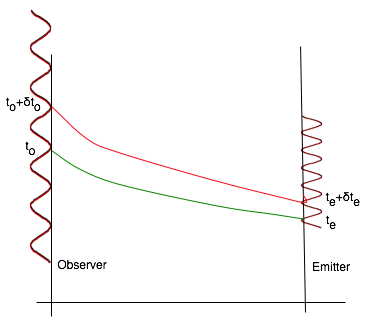
Emitting galaxy produces photon, with gap \color{red}{\delta t_e }
between crests, observing galaxy sees gap of \color{red}{\delta t_o }
Both crests travel at speed of light so follow null-geodesic
Note normally this will happen: the dimensional quantities will cancel
Hence Red-shift $\color{red}{z = \frac{{a\left( {t_o } \right)}}{{a\left( {t_e } \right)}} - 1}$
is given the ratio of the size of the universe when it was emitted to now (obviously!). We can then expand this
Object horizon (distance of most distant object we can see now
$\color{red}{\int_{t_{\min } }^{t_o } {\frac{{dt}}{{R\left( t \right)}}} = \int_0^{r '} {\frac{{dr }}{{\sqrt {1 - \kappa \sigma ^2 }}}} }$
(note that in some $\kappa =1$ models we can see the whole universe!)
Apparent luminosity: $\color{red}{l = \frac{L}{{4\pi D^2 }} \Rightarrow l = \frac{L}{{4\pi a\left( t \right)^2 r _E^2 }}}$:
again can expand result to give $\color{red}{l = \frac{{LH_0 ^2 }}{{4\pi c^2 z_{}^2 }}\left[ {1 + \left( {q_0 - 1} \right)z + ...} \right]}$
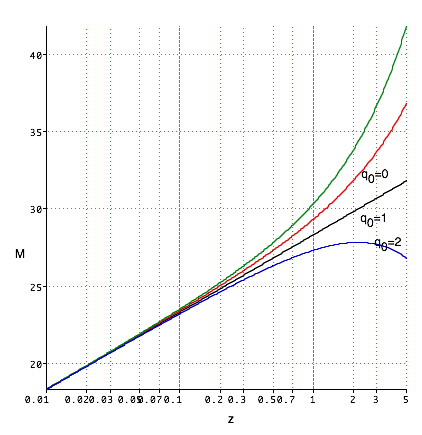
Since we measure magnitudes, better to use $\color{red}{m - M \approx 25 - 5\log H_0 + 5\log \left( {cz} \right) + \left( {1 - q_0 } \right)z}$
Number counts: How can we decide if universe is closed or open?
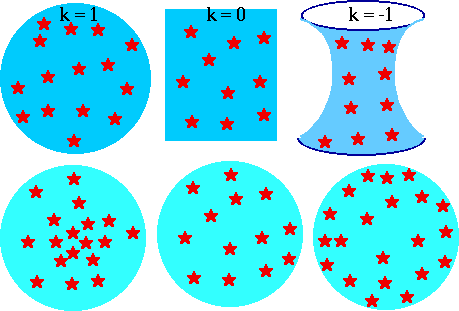
This becomes an observational question: density of galaxies at different distances depends on $\kappa$
Note that all have same density of galaxies but (e.g.) $\kappa = 1$ has fewer galaxies at large distances
(Earth has less land at large distance than a flat plane would have!)
Observationally this could be done via Hubble plot at very large distance:
Unfortunately, only individual objects that can be seen at these red-shifts are quasars: these have evolved since the BB and hence cannot be used as constant density markers