| 10 billion m or 8 light-minutes | 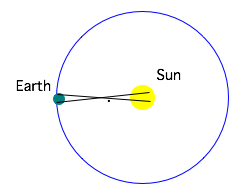 |
|
| 1018m ∼ 100pc |  |
|
| 1019m ∼ 2kpc |
 |

Distances to Galaxies: Steps out from earth,
| 10 billion m or 8 light-minutes | |
|
| 1018m ∼ 100pc | |
|
| 1019m ∼ 2kpc |
|
| Novae: smaller stellar explosions: this is Nova Cygni 1991 (expansion of shells) | 2kpc |
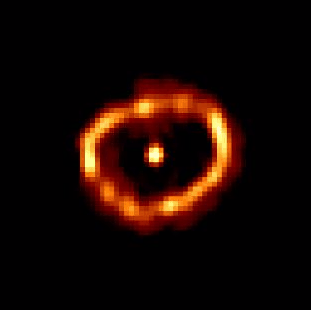
Nova Cygni 1992 Credit: NASA, ESA, HST, F. Paresce, R. Jedrzejewski (STScI) |
| Cepheids: supergiant stars which pulsate regularly, can be seen in M100 | 20 Mpc |
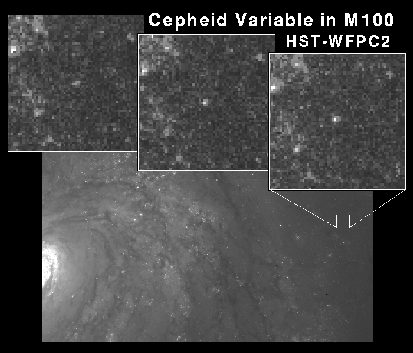 Credit: NASA, HST, W. Freedman (CIW), R. Kennicutt (U. Arizona), J. Mould (ANU) |
| Supergiants , Brightest Mv=-6 | 100 Mpc |
| Type 1a Supernovae Mv = -20 | 3000Mpc |
| Brightest galaxies in clusters | 1000 Mpc |
| Various methods overlap, but still some problems Uncertainty increases at large distances. |
 |
We have found about 108 galaxies. Galaxies cluster together into groups which appear to be gravitationally bound together
| This is the VIrgo cluster: over 1000 galaxies: 3 big ellipticals, including M87 at the bottom. Closest big cluster | 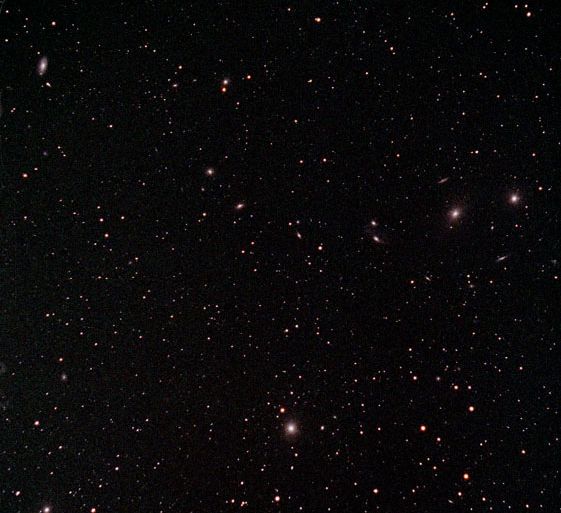 Galaxies Of The Virgo Cluster Credit & Copyright: Matt BenDaniel |
| This is the core of the Virgo cluster: M 84 and M 86 are the big ellipticals: also some small ellipticals and spirals |  Credit & Copyright: Jean-Charles Cuillandre (CFHT), Hawaiian Starlight, CFHT |
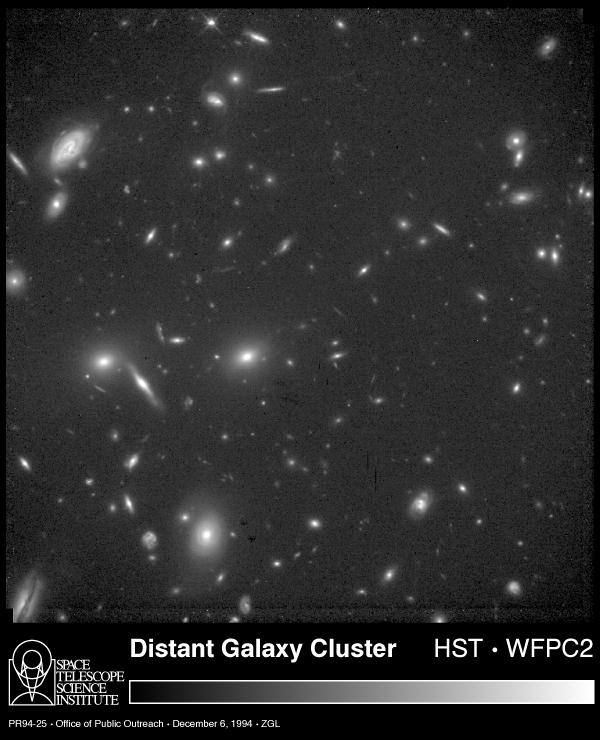
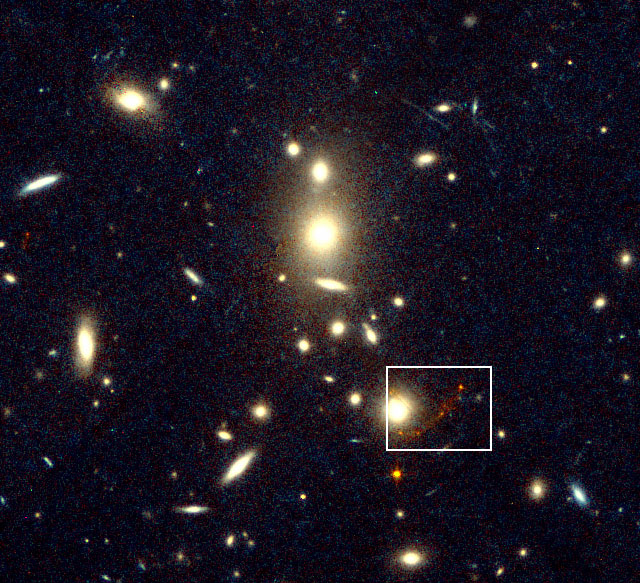
| Coma cluster contains at least 104 galaxies | 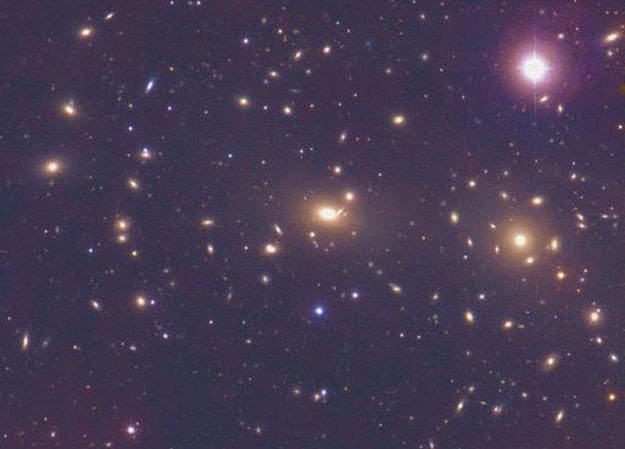 |
| The Hickson cluster is a very small compact one | 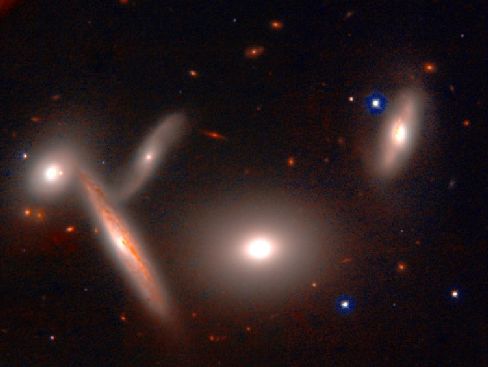 |
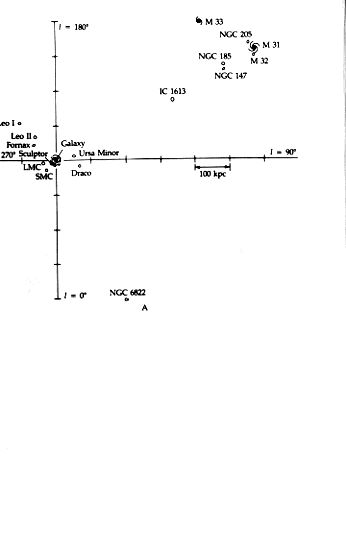
| Local group contains Milky Way & about 20 others
LMC & SMC 50 kpc |
 |
| Remainder of local group are almost all dwarf elliptical.
Closest component may be a dwarf galaxy "only" 20 kpc from us, in plane of Milky Way in Pegasus. Maffei I and II, seen as faint galaxies in I.R., but probably giant elliptical and spiral, probably at distance of 1-2 Mpc, and form their own group |
 |
Regular clusters resemble globular cluster of stars: spherical symmetry and largest density of galaxies at centre. Usually contain mainly elliptical galaxies. Irregular do not.Local is typical irregular.
Study of clusters shows faint ones predominate, brightest galaxies have M ≈-23.
ν' = ν [(1-v/c)/(1+v/c)]1/2
In general, define red-shift, z, via
$\color{red}{\lambda ' = \lambda \left( {1 + z} \right)}$ so $z = \frac{v}{c}$ for non-relativistic shifts, relativistically $$ \color{red}{ z = \sqrt {\frac{{1 + \frac{v}{c}}}{{1 - \frac{v}{c}}}} - 1} $$| Found in 1920's (Hubble, Humason, Slipher) that faint galaxies show a red shift: fainter the galaxy, faster the recession. |  |
| Hubble was able to measure distances to closer clusters and found that velocity ∝ distance | 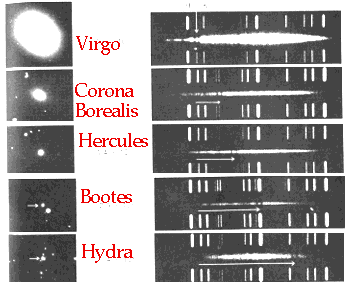 |
| v = H d H is Hubble constant: As measured by Hubble H = 550 km s-1/Mpc: Now we know H ~ 65 km s-1/Mpc : i.e. the average galaxy at 100 Mpc is receding at 6500 km/s |
 |
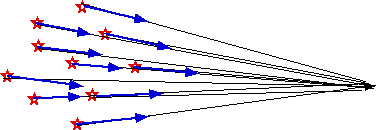
| Can look at clusters in z: unfortunately random ("peculiar") velocities distort picture | 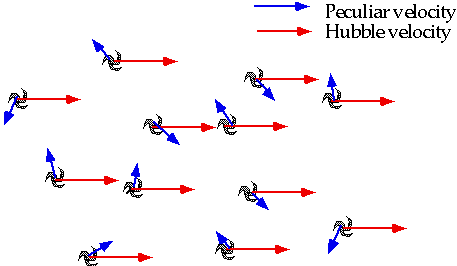 |
| For a single galaxy:
can only measure vel. in radial direction, so radial component of peculiar motion gets added on.t |
 |
| This distorts picture
Coma cluster is close together in space, but velocity dispersion spreads it out in z. |
.gif) |
Clusters appear to form
| local cluster together with Virgo and others form local super-cluster 100 Mpc. across |  |
Do superclusters cluster?
Or how is mass distributed on the largest possible scale?
Might expect Stars ⇒ galaxies ⇒ clusters ⇒ superclusters
becoming smoother at each stage
Instead of super-clusters being approx. spheres of clusters, we seem to see voids separated by clusters
| Voids are very empty: 1/100 th of the density of galaxies that might be expected |
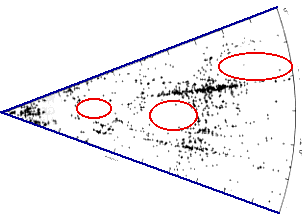 |
| Space is like a foam: voids are like empty bubbles |  |
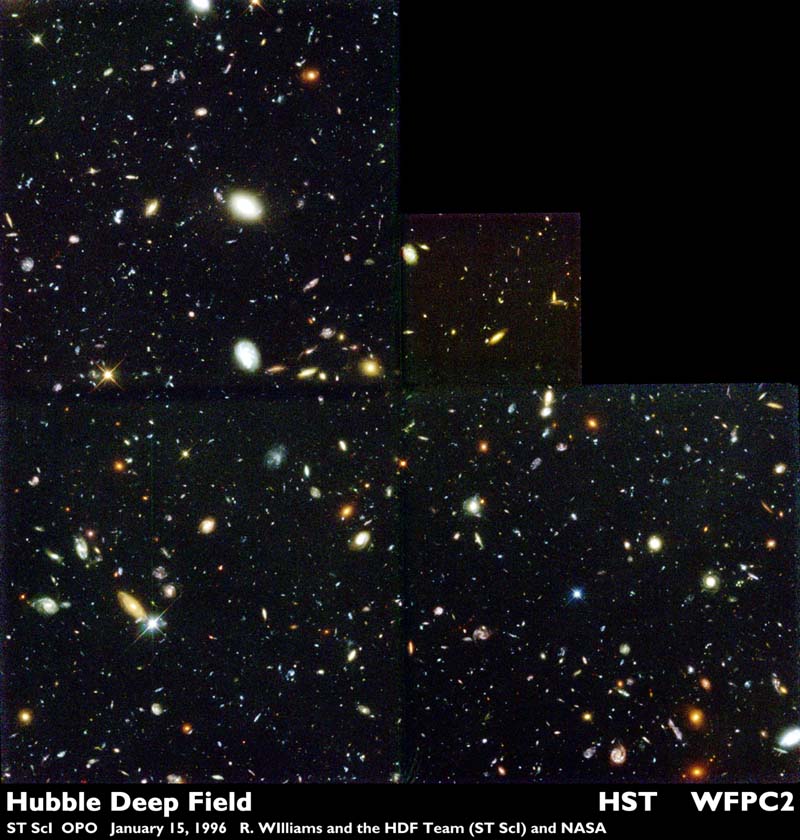 and we can go deeper