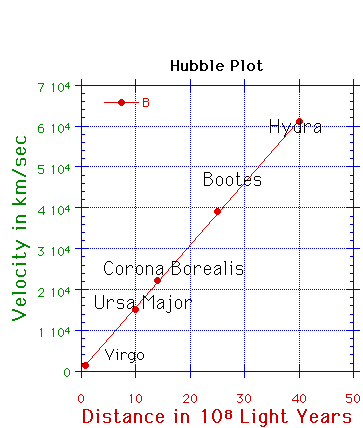
zc = Hd = v
H ~ 65kms-1/Mpc
1 Mpc (megaparsec) = 3x10²² m
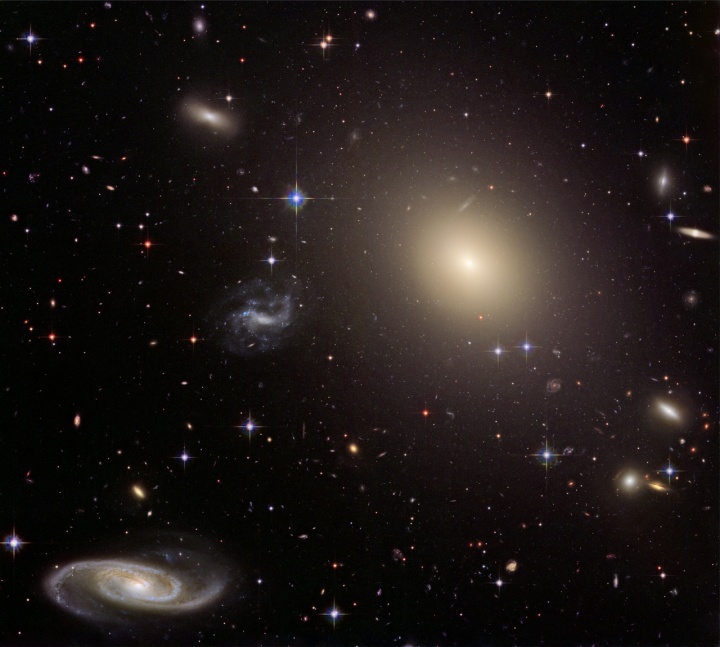
Redshift: Slipher-Hubble-Humason found light from most galaxies is redshifted. The Doppler effect gives z = (λ-λ₀)/λ₀ = Δλ/λ₀ Velocity of recession: v = zc = Δλc/λ₀
Hubble
found vel. of recession ∝
distance zc = Hd = v H ~ 65kms-1/Mpc 1 Mpc (megaparsec) = 3x10²² m |
|
| Note although all galaxies are receding from us, does not imply we are at the centre: in the currant cake model all currants see all the others as recediing | 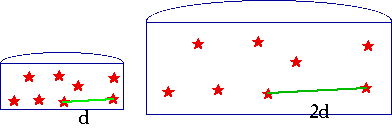 |
RULE 1 in Physics 100: Never mix your units!)
H = 65x10³  = 1.8x10⁻¹⁸ (m s-1)/m
      3.1022
We can invert this to give H-1 = 5.4x10¹⁷ s = 1.7x10¹⁰ yr. |
 |
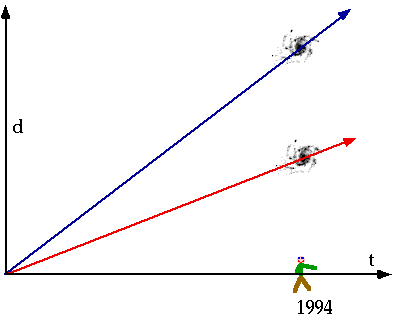
What does this time represent? Must be age of universe: if expansion does not change i.e. 17x109 yr ago, all the galaxies were in the same place. Universe had a beginning, implied by the big bang. Can run Hubble expansion back: we would like to use this to predict what will happen in the end |
 |

A 2-D analog is the surface of a balloon: Note the following:
If we measure from now (t = t₀) then R = 0 when t = t₀ - 1/H₀ independent of R₀.
Gravitational attraction would have slowed expansion since the early universe. So Hubble's constant is important: we had better be sure of what it is!
(Incidentally, it isn't a constant...when the universe was smaller, R was less; if v was constant H must have been bigger. Better "the Hubble parameter"
|
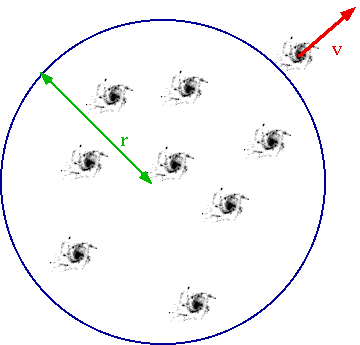 |
So if
|
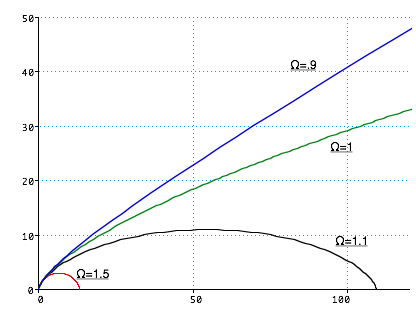 |
| Note that this implies that the rate of expansion must change Gravity will slow down expansion in the early stages, so Hubble's constant isn't a constant... when the universe was smaller, v was larger so H must have been bigger. Better "the Hubble parameter" |
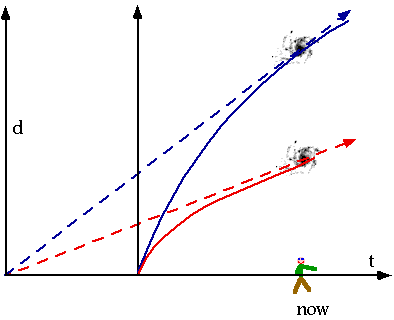 |