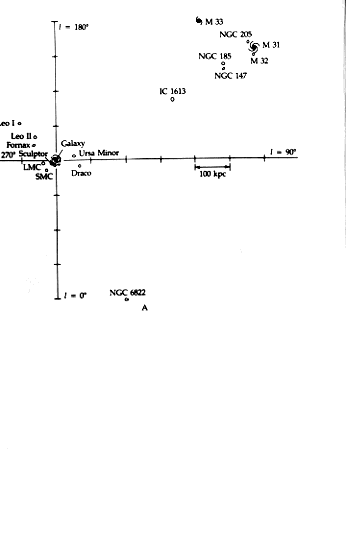
LMC & SMC 50 kpc
M31 and satellites (M32) 690 Kpc
M33 2.7 mpc in Triangulum
Remainder of local group are almost all dwarf elliptical.
Closest component may be a dwarf galaxy "only" 20 kpc from us, in plane of Milky Way in Pegasus. Maffei I and II, seen as faint galaxies in I.R., but probably giant elliptical and spiral, probably at distance of 1-2 Mpc, and form their own group
Velocity of galaxies
Redshift
red-shift, z, via
$$
\color{red}{
\nu ' = v\sqrt {\frac{{1 - \frac{v}{c}}}{{1 + \frac{v}{c}}}} }
$$
In general, define red-shift, z, via
$$\color{red}{\lambda ' = \lambda \left( {1 + z} \right)}$$
so $z = \frac{v}{c}$ for non-relativistic shifts, relativistically
$$
\color{red}{
z = \sqrt {\frac{{1 + \frac{v}{c}}}{{1 - \frac{v}{c}}}} - 1}
$$
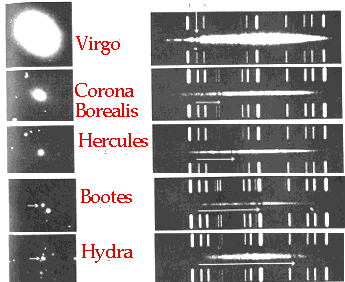
Found in 1920's (Hubble, Humason, Slipher) that faint galaxies show a red shift: fainter the galaxy, faster the recession.
Hubble was able to measure distances to closer clusters and found that velocity ∝ distance
v = H d
H is Hubble constant: As measured by Hubble H = 550 km s-1/Mpc:
Now we know
H ~ 65 km s-1/Mpc :
i.e. the average galaxy at 100 Mpc is receding at 6500 km/s
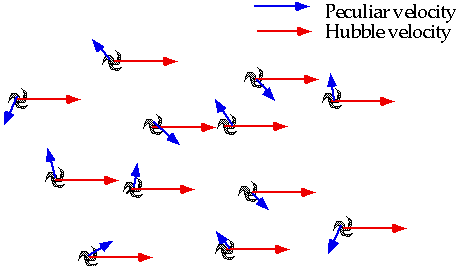
Can look at clusters in z: unfortunately random ("peculiar") velocities distort picture
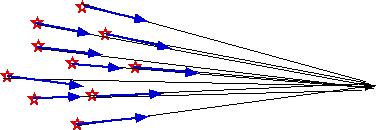
For a single galaxy, can only measure vel. in radial direction, so radial component of peculiar motion gets added on.t
This distorts picture
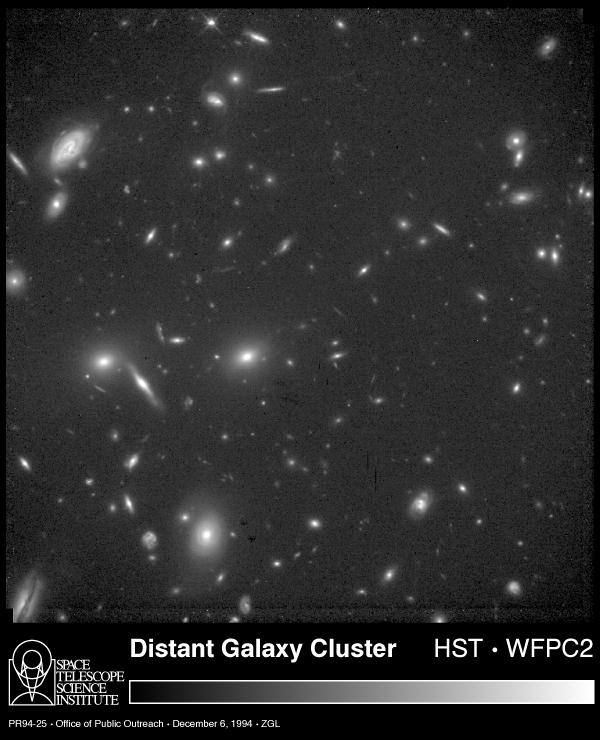
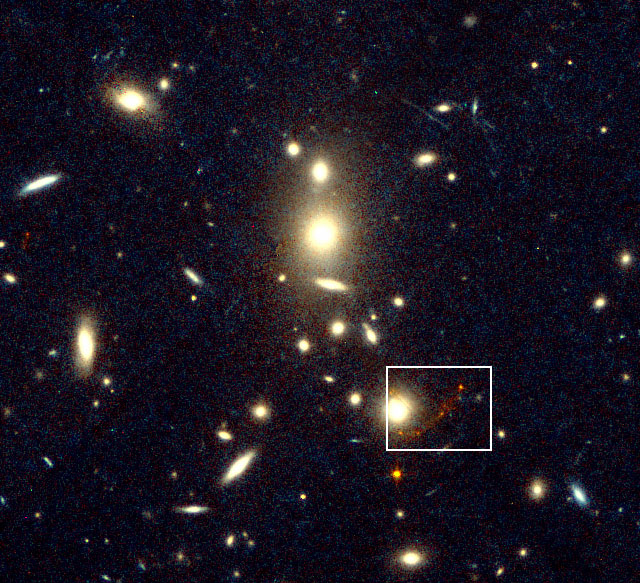
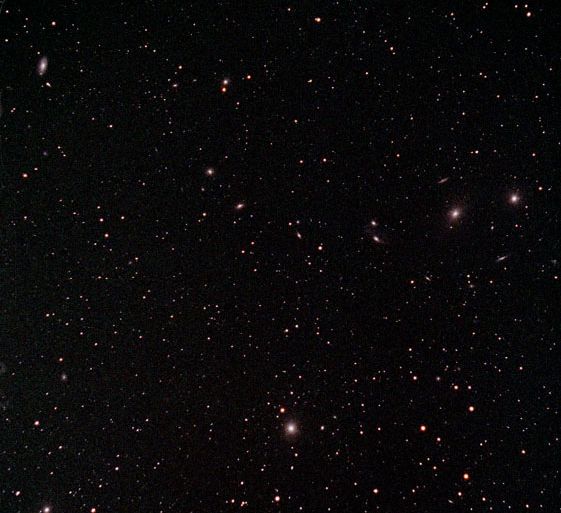
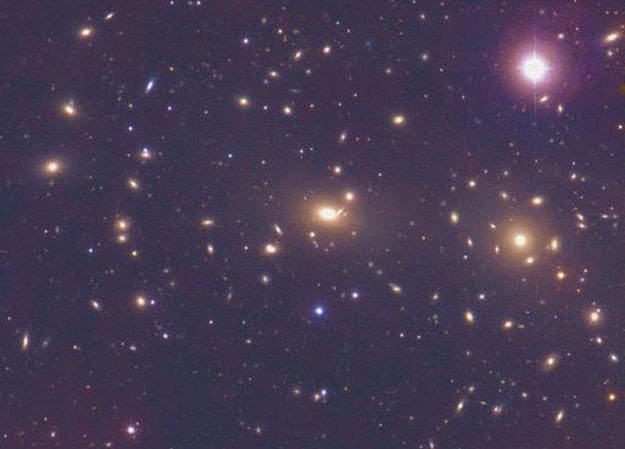
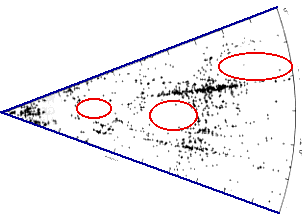
Coma cluster is close together in space, but velocity dispersion spreads it out in z.
Clusters always point towards us: Finger of God effect!
Clusters appear to form
super-clusters:
local cluster together with Virgo and others form local super-cluster 100 Mpc. across
Do superclusters cluster?
Or how is mass distributed on the largest possible scale?








.gif)


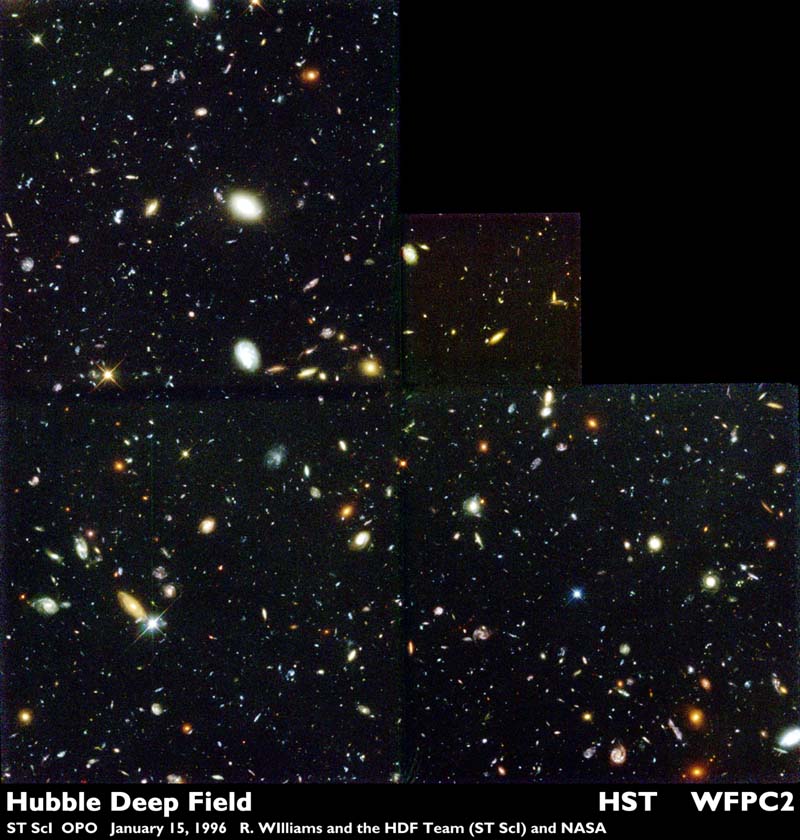 and we can go deeper