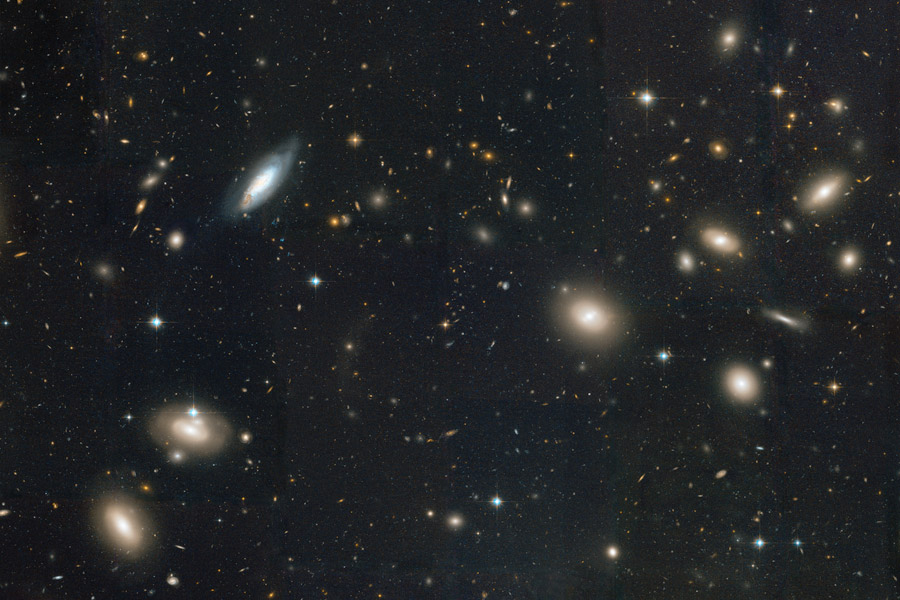
Coma Cluster
NASA, ESA, Hubble Heritage (STScI/AURA); Acknowledgment: D. Carter (LJMU) et al. and the Coma HST ACS Treasury Team
Coma Cluster | NASA, ESA, Hubble Heritage (STScI/AURA); Acknowledgment: D. Carter (LJMU) et al. and the Coma HST ACS Treasury Team |
In the beginning the Universe was created. This has made a lot of people very angry and has been widely regarded as a bad move. Many people believe that it was created by some sort of God, though the Jatravartid people of Viltvodle Six firmly believe that the entire Universe was in fact sneezed out of the nose of a being they call the Great Green Arkleseizure.
The Jatravartids, who live in perpetual fear of the coming of a time that they call The Coming of the Great White Handkerchief, are small blue creatures . However, the Great Green Arkleseizure theory was not widely accepted outside Viltvodle Six, and so one day a race of hyper-intelligent beings built themselves a gigantic computer called Deep Thought to calculate once and for all the answer to the Ultimate Question of Life, the Universe and Everything.
which was, of course,
From "The Hitchhiker's Guide to the Galaxy", Douglas Adams
Ingredients for a creation myth:Space is big. Really big. You won't believe how vastly, hugely, mind-bogglingly big it is.
Hitchhiker's guide to the Galaxy.
How big? Could it be infinite?
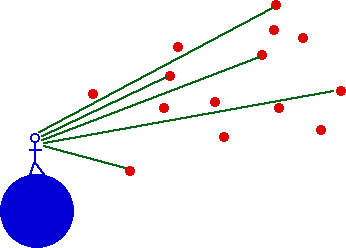
If universe is a) infinite and b) uniformly filled with stars Any line of sight will end on a star, so night sky will be bright |
 |
But it isn't !
But it is for galaxies
|
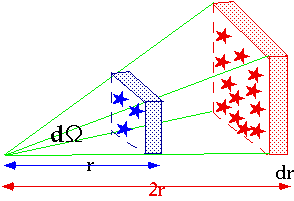
Light from stars falls off as inverse square law 1 /r²
But the number of stars increases as r² so the effects cancel |
 |
But the matter would by now be hot and radiating
|
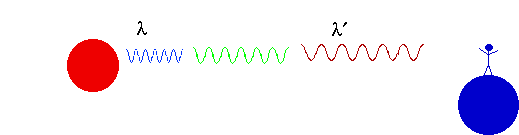
Light is redshifted to very long wavelengths so objects within ~ 3000 Mpc will have any visible radiation at all
But this implies that the universe must be expanding |
 |
|
.gif) |
Atoms => Stars => Galaxies=> =>Clusters=>Superclusters
At each stage the distribution becomes more regular, and finally there is no evidence that superclusters clump
Note: this is a hope, not even an observation! Out to the largest scales we could observe reliably pre 1985, d ≈ 1 Gpc or z ≈ 0.2c, there are still voids on the largest observable scale.
How can we tell if the universe will expand forever? or....
The water beetle was sent on an exploration, and after darting about on the surface and finding no rest, it dived down to the depths, whence it brought up a bit of mud, from which the earth grew by accretion. Apache Creation Myth
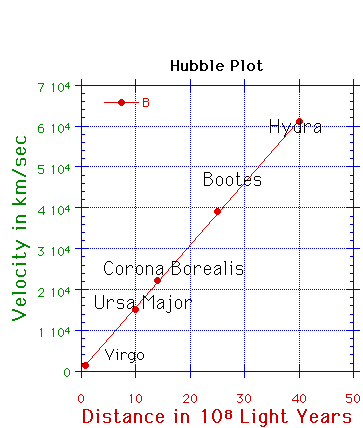
Redshift: Slipher-Hubble-Humason found light from most galaxies is redshifted.
| Hubble
found vel. of recession ∝
distance
\color{red}{
v = zc = Hd,H = 70{\rm{km s}}^{{\rm{ - 1}}} {\rm{Mpc}}^{{\rm{ - 1}}} }
1 Mpc (megaparsec) = 3x10²² m |
 |
RULE 1 in Physics 100: Never mix your units!)
\color{red}{
v = zc = Hd,H = 70.1 \pm 1.3{\rm{km s}}^{{\rm{ - 1}}} {\rm{Mpc}}^{{\rm{ - 1}}} }
so \color{red}{
H = \frac{{70.1 \times 10^3 }}{{3.1 \times 10^{22} }} = 2.26 \times 10^{ - 18} s^{ - 1}
}
We can invert this to give
\color{red}{
H^{ - 1} = 4.4 \times 10^{17} s = 14 \times 10^9 yr}
|
 |
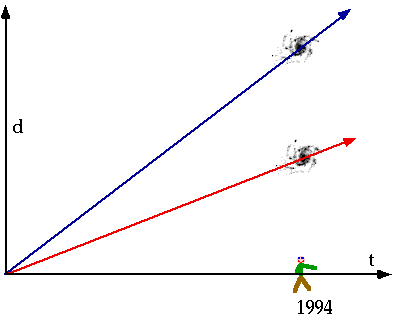
What does this time represent? Must be age of universe: if expansion does not change i.e. 14x109 yr ago, all the galaxies were in the same place. Universe had a beginning, implied by the big bang. Can run Hubble expansion back: we would like to use this to predict what will happen in the end |
 |

A 2-D analog is the surface of a balloon: Note the following:
If we measure from now (t = t₀) then R = 0 when t = t₀ - 1/H₀ independent of R₀.
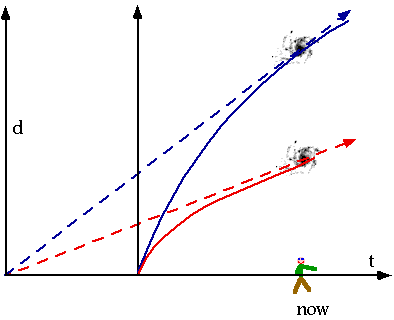
Gravitational attraction would have slowed expansion since the early universe. So Hubble's constant is important: we had better be sure of what it is!
(Incidentally, it isn't a constant...when the universe was smaller, R was less; if v was constant H must have been bigger.
Better "the Hubble parameter"
The sky becomes black, Earth sinks into the sea From Heaven fall the bright stars The sea ascends in storm to Heaven It swallows the Earth, the air becomes sterile
From the Hyndluljod (Iceland)
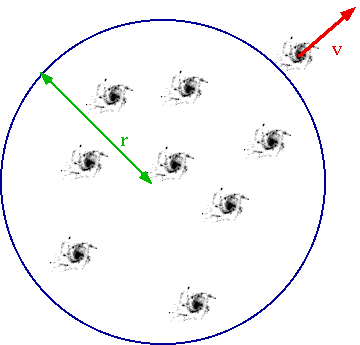
| As a model, consider this as an escape velocity problem. How hard do we need to throw a galaxy on the "outside" so that it escapes? Note: our calculation had better not depend on r!
\color{red}{
\frac{1}{2}mv^2 - \frac{{GMm}}{r} = 0}
but \color{red}{v = Hr}
and the total mass of the universe inside is \color{red}{M = \frac{4}{3}\pi r^3 \rho }
|
 |
(we got lucky: the r cancels out!). We can turn this round and write it as an equation for ρ
Hence the critical density \color{red}{ \rho _0 = 9.2 \times 10^{ - 27} kgm^{ - 3} \sim 5.5 } H atoms m-3 (Number is slightly flaky).
Will mostly use \color{red}{\Omega = \frac{\rho }{{\rho _0 }}} because some errors cancel out. The entire future of the universe is given by this one number!!!!!!!!!
So if
More important: we live forever if Ω ≤ 1, (well maybe). |
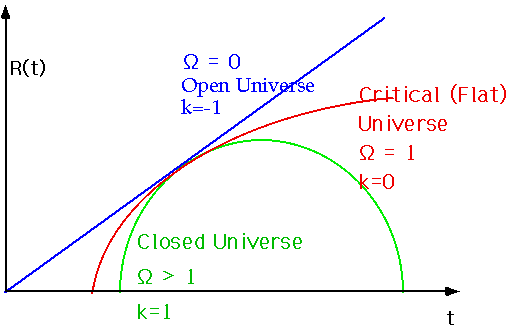 |
Note that this implies that the rate of expansion must change
Gravity will slow down expansion in the early stages |
 |
Universe is "full" of light: fossil light from Big Bang, discovered accidentally by Penzias and Wilson (1964) |
 |
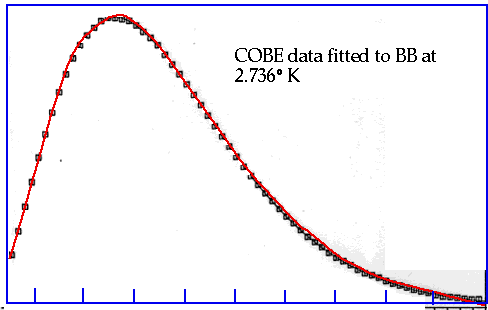
Found that "noise" came from universe independent of what angle horn was pointed in: corresponded to a black-body temp of 30K Have to get above atmosphere and point away from Milky Way. |
 |
| Have to get above atmosphere and point away from Milky Way
Subsequent values came from balloon flights: Finally COBE launched 1990: Note the perfect Black Body curve. |
 |
Where does it come from?
Gamow (1948) discussed Hot Big Bang for first time, suggested that E.M radiation from it should still be observable. Peebles (1964) had calculated that it should be observable, but thought T ~ 10 0K, (and everyone had general feeling that it would be unobservable).
This is often the way it is in physics: our mistake is not that we take our theories to seriously, but that we do not take them seriously enough. It is hard to believe that the numbers that we play with at our desks have something to do with the real world. Steven Weinberg The First Three Minutes
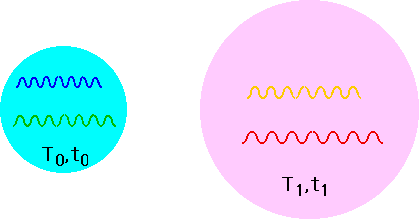
| As the universe expands, the density of γ's decreases.
\color{red}{
\rho _\gamma \left( t \right) = \rho _\gamma \left( {t_0 } \right)\frac{{R_0^3 }}{{R\left( t \right)^3 }}}
and also the temperature T falls as each γ gets redshifted. Hence the energy density
\color{red}{
u\left( t \right) = R\left( t \right)^{ - 4} }
|
 |
More exactly: from the Black Body equation:
Energy density:
Mean γ-energy
Peak of BB curve is at λ = 2.898x10⁻³/T Now, the peak is at 1.05 mm: what is the T, N, E, ργ?
From this (incredibly naive) model we can deduce:
Steady state theory of Bondi, Hoyle, Gold
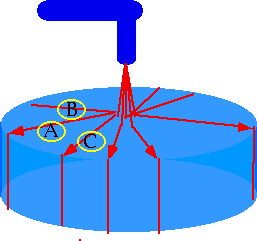
| Basic assumption is that universe is not only isotropic in space, but also in time: i.e. it always looked much the same
How can this be squared with expansion? Imagine a stream of water falling into full bucket: (A) will see (B) and (C) receding even though the situation does not really change |
|