- ∼ 100 billion stars
- Large spiral arms outlined by hot stars
- Large dust lanes
- Bright centre
- Size: ∼ 50000 pc (50 kpc) across
- Bright patches are clumps of young stars
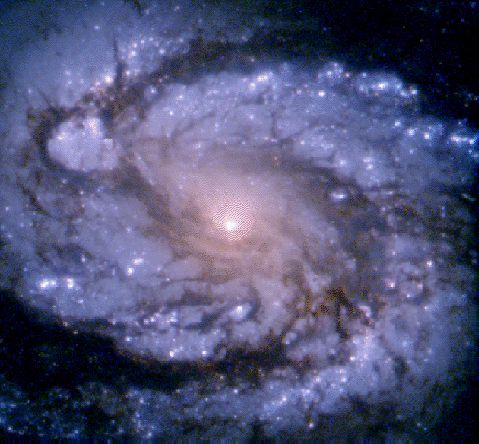
M100: A Grand Design Credit: NASA
Unfortunately we see it from the inside, so first a look at a galaxy which is reasonably similar: M100. Large spiral galaxy, Note:
|
M100: A Grand Design Credit: NASA |
Looked at from the side, the Milky way looks a bit like
NGC 4565 (ignore the foreground stars): note
|
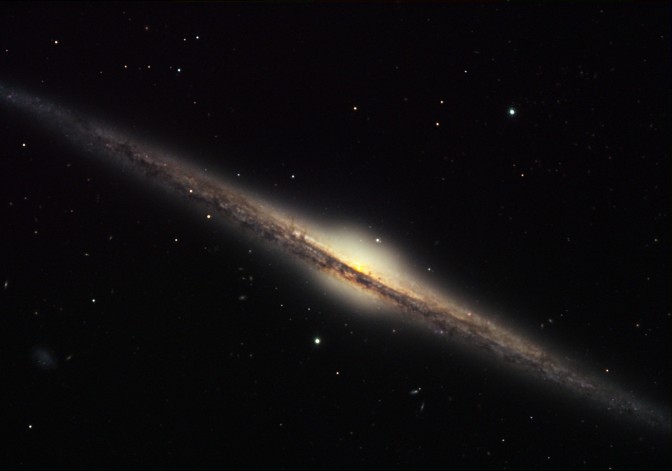 Credit: Bruce Hugo and Leslie Gaul, Adam Block (KPNO Visitor Program), NOAO, AURA, NSF |
| So the Milky Way probably looks like this | 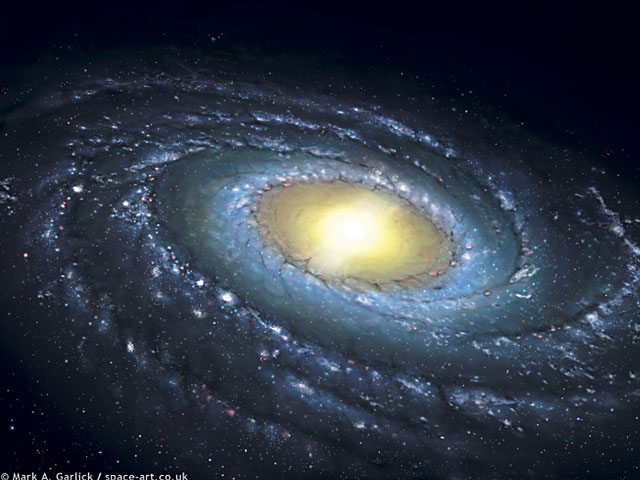 Illustration Credit & Copyright: Mark Garlick (Space-art |
| Most of the whole Milky Way from Chile | 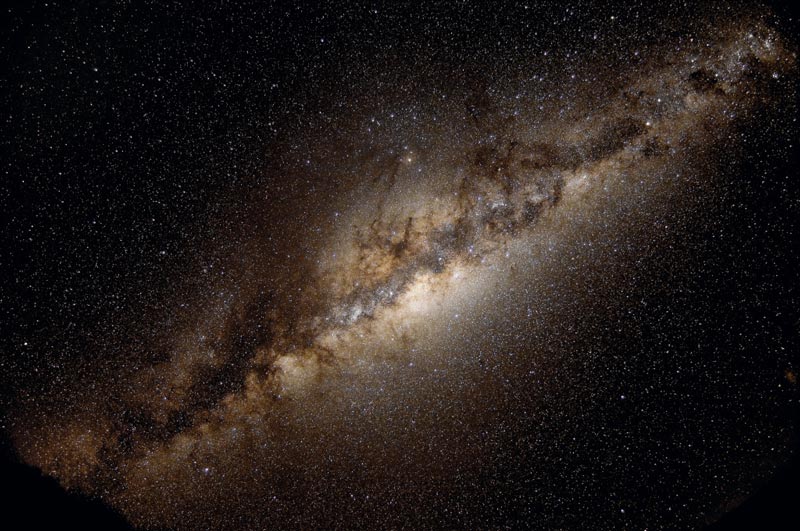 The Milky Way Credit:© Serge Brunier |
| and we can pick out the same general structure in radio waves, but note very intense source at centre | 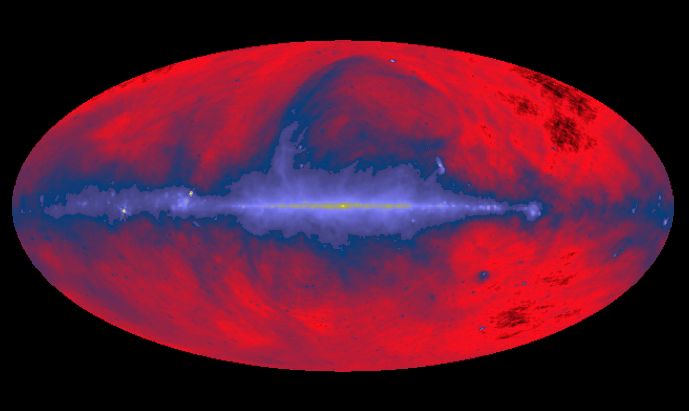 Credit: C. Haslam et al., MPIfR, SkyView |
| and γ-rays from the EGRET satellite | 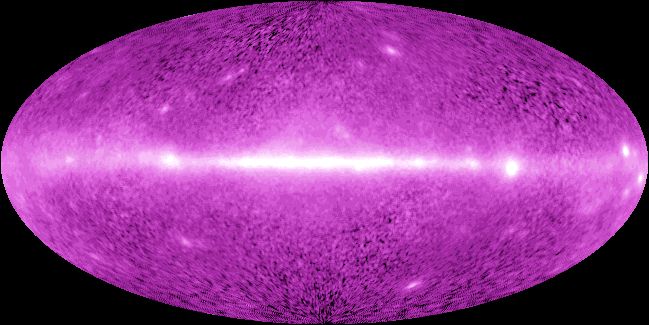 Credit: EGRET Team, Compton Observatory, NASA |
| Galactic Centre Not visible directly (too much dust) | 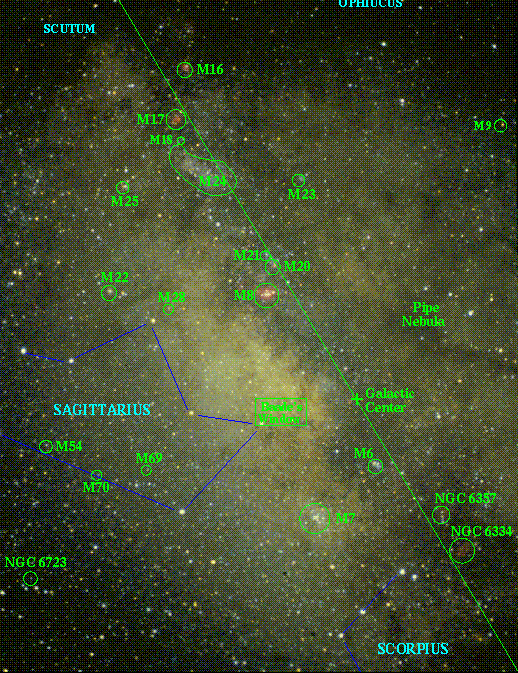 Credit: W. Keel (U. Alabama, Tuscaloosa), Cerro Tololo, Chile |
but strong radio source
| We can see through the dust (partially) with infra-red: note how dense the star field is | 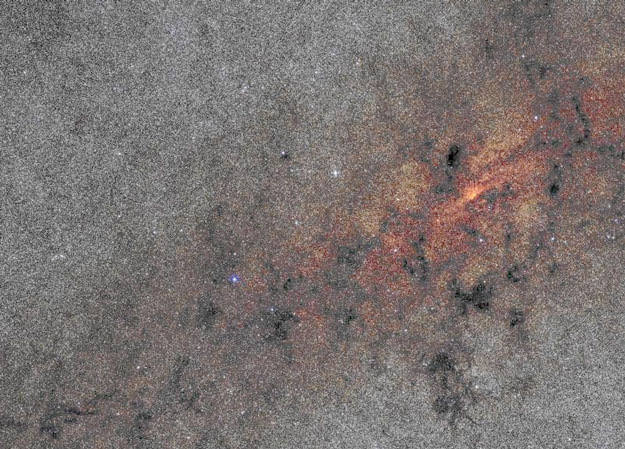
Credit: 2MASS Project, UMass, IPAC/Caltech, NSF, NASA |
| and X-rays | 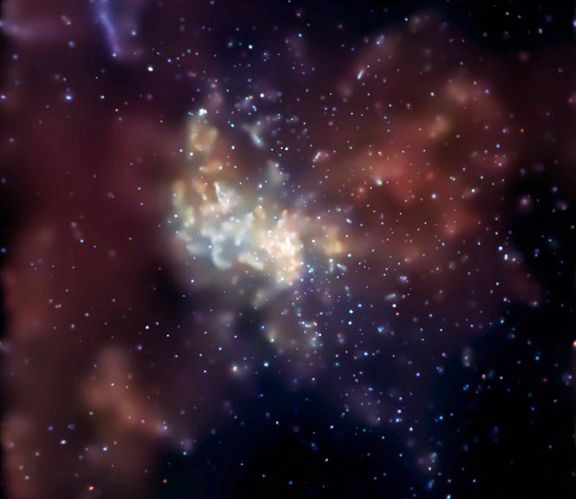 Credit: Fred Baganoff (MIT), Mark Morris (UCLA), et al., CXC, NASA |
| Close to centre a lot of rapidly moving (300 km/s) hot (i.e. ionised) gas(Gravitational field at centre of galaxy should be very small, so would expect velocities to be small.) | 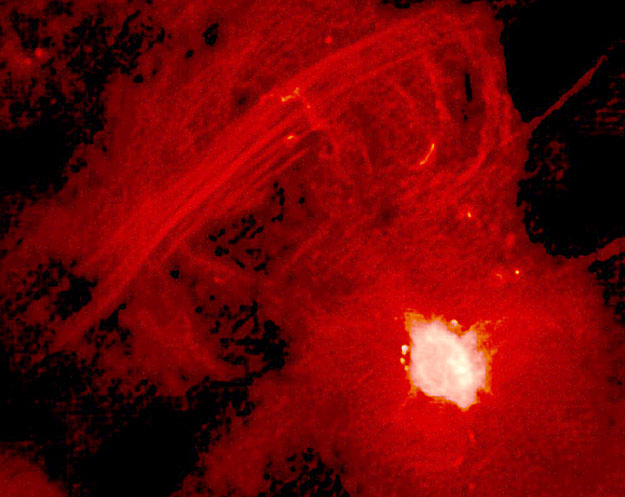 |
and hot stars. Could be very dense cluster of stars..........but note M31 (Andromeda), M100 and many others show a star-like central nucleus
| and very rapidly moving stars | 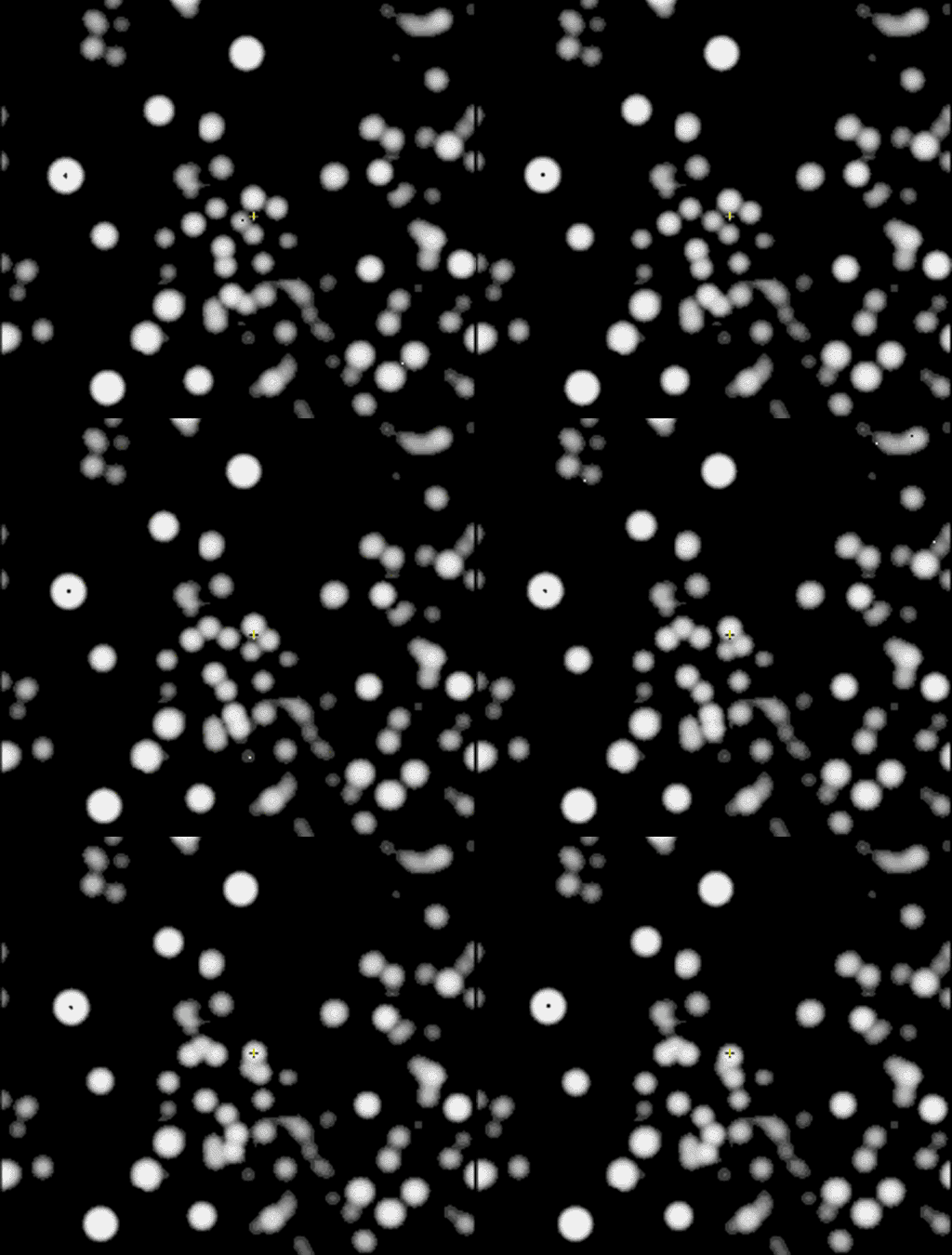 Credit: A. Eckart (U. Koeln) & R. Genzel (MPE-Garching), SHARP I, NTT, La Silla Obs., ESO |
Size of centre < 1pc
Mass of object ∼ 3000000 M₀
| Whole picture is consistent with a very large black hole at centre, but not nearly as active as we see in other galaxies: e.g. this shows gas at the centre of NGC 1365 | 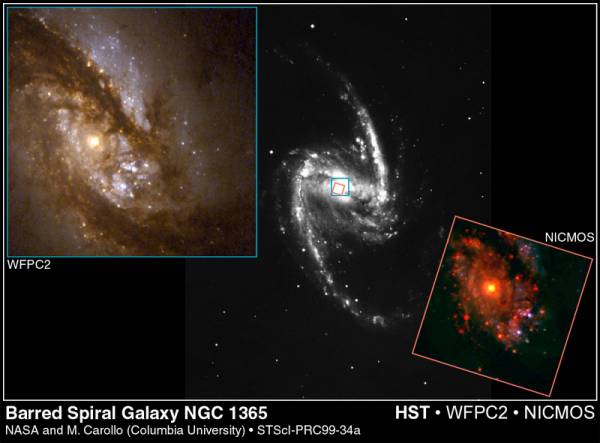
Credit: Ground-based image: Allan Sandage (Carnegie Observatories), John Bedke (CSC, STScI) WFPC2 image:John Trauger (JPL), NASA NICMOS image: C. Marcella Carollo (JHU, Columbia U.), NASA, ESA |
Spirals & Barred Spirals show much smaller range of size, 109 -> 1011 stars.
| The classic is M31 (Andromeda): tightly wound spiral with 2 satellites, a bit bigger than the Milky Way |  |
| Core maybe has two black holes and billions of stars: superimposed are knots of dust | 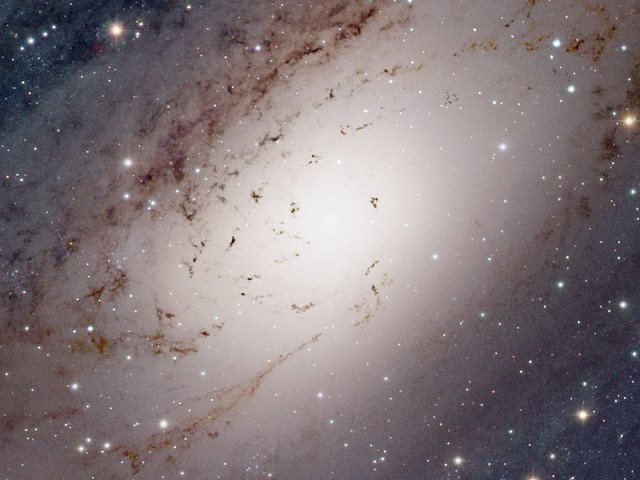
Credit & Copyright: Robert Gendler |
| Very bright in X-rays, with an intense course at the centre | 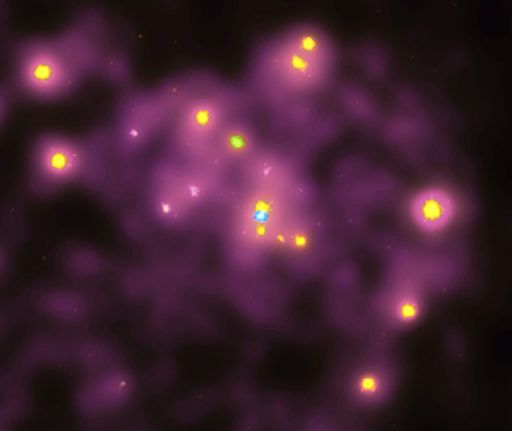 |
| NGC 1512 is an unusual spiral: tightly wound at the centre, with "star-burst" proceeding in a narrow ring | 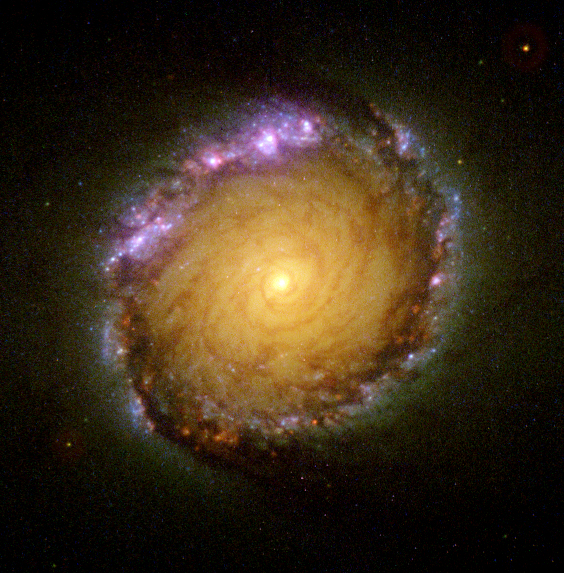 |
| NGC 6946: The Fireworks Galaxy. Shows the spiral structure for what it is: in this case, lots of new stars, (blue) and huge hydrogen clouds (red), and very bright small nucleus | 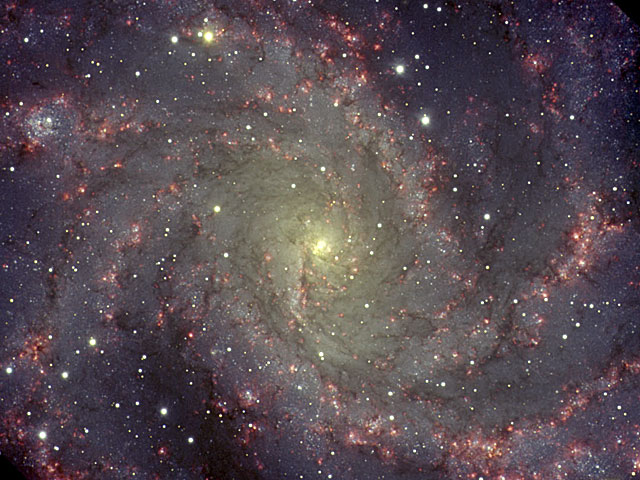 Credit & Copyright: T. Rector (U. Alaska Anchorage), Gemini Obs., AURA |
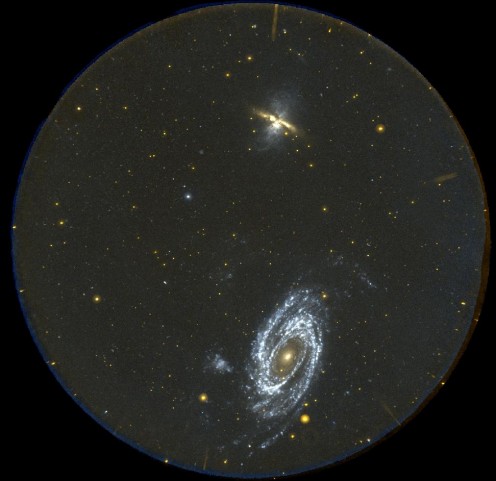
| M81 and M82 in Ursa Major make an intriguing pair: M81 seems to be destroying M82 via collisions | GALEX Full Field
Credit: GALEX Team, Caltech, NASA
|
| Closeup of centre of M82 shows massive wind blowing out of centre of galaxy | 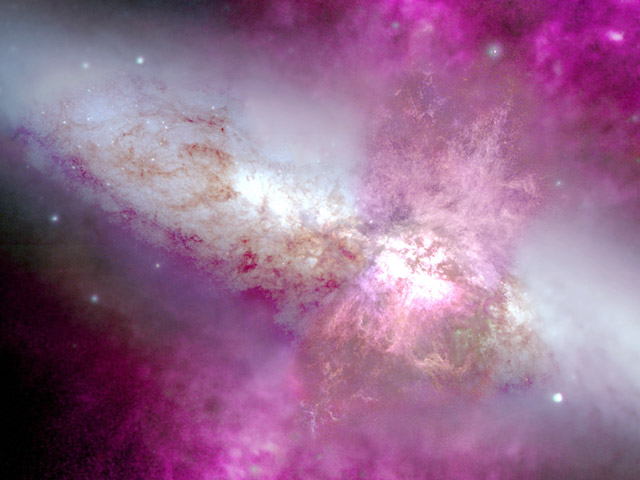
Credit: M. Westmoquette (UCL), J. Gallagher (U. Wisconsin-Madison), L. Smith (UCL), WIYN/NSF, HST, NASA/ESA |
| Some are seen side-on, which shows the X-sect
NGC 4565 |
|
Ellipticals have v. great range in size, from 105Lo (dwarf) ->1013 Lo(giant)<
Ellipticals look dull in pictures!
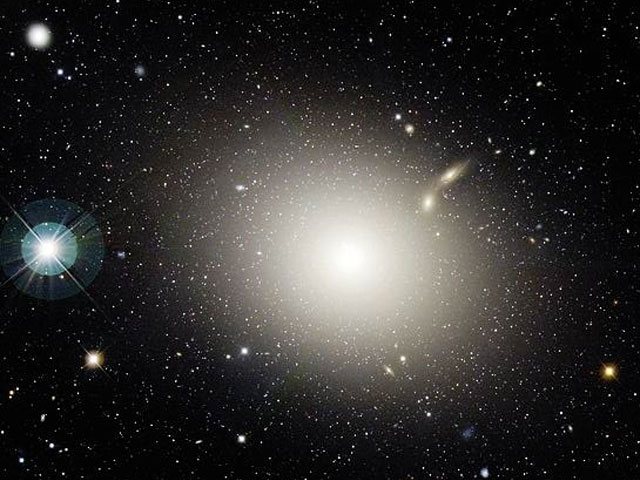
| M87 is one of the largest:
Note the spiral behind. (Stars have points on them).
Almost perfectly spherical
Note many globular clusters (>1000) |
 . . |
| Looks simple but...short exposure shows jet + very small core | 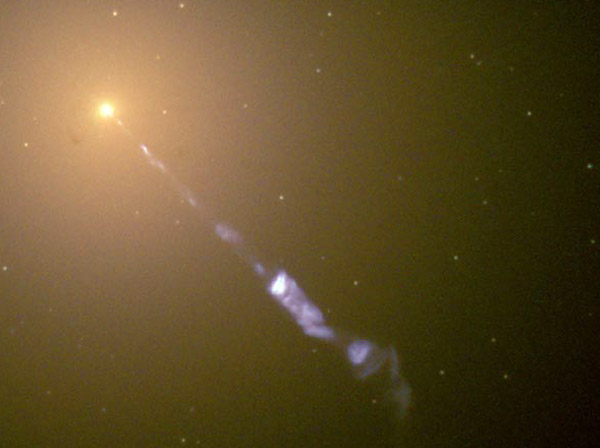 |
| And the jet looks more complicated the smaller the scale | 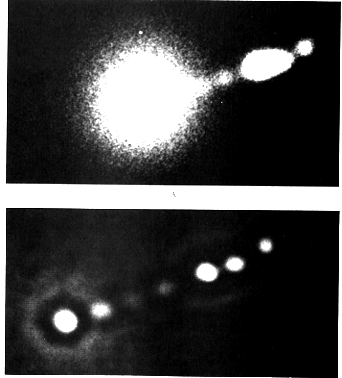 |
| and it seems to be related to radio "lobes" |  |
This is SMC ∼ 106 stars |
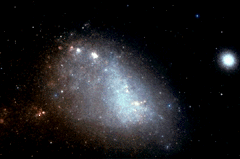 |
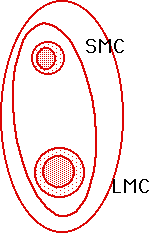
Have a lot of H Hydrogen bridge between them and even extends to our galaxy |
 |
| These are 3 galaxies (in a group called Stefan's quintet) which are colliding | 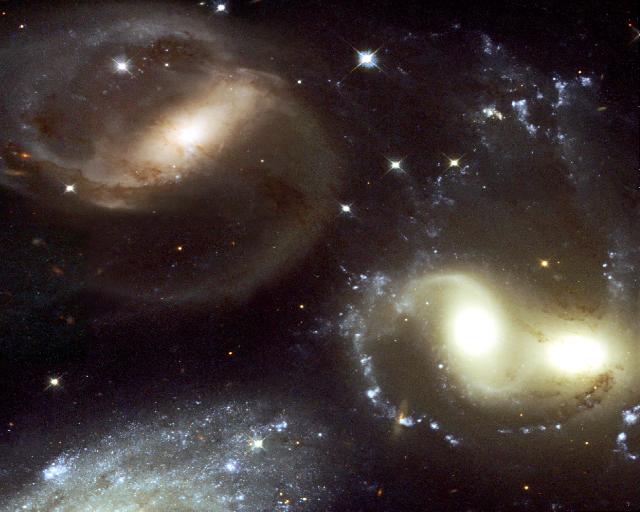 |
| "The Cartwheel Galaxy". Ring round (100000 lightyears across) consists of new stars produced in the collision with a smaller galaxy, which has now vanished. | 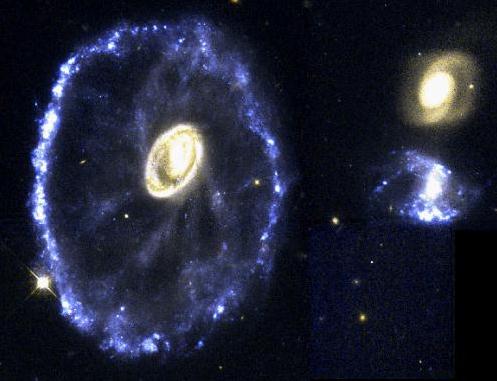 Credit: Kirk Borne (STScI), NASA |
| The antennae galaxies are two very large galaxies in a violent collision: lats of stars being formed | 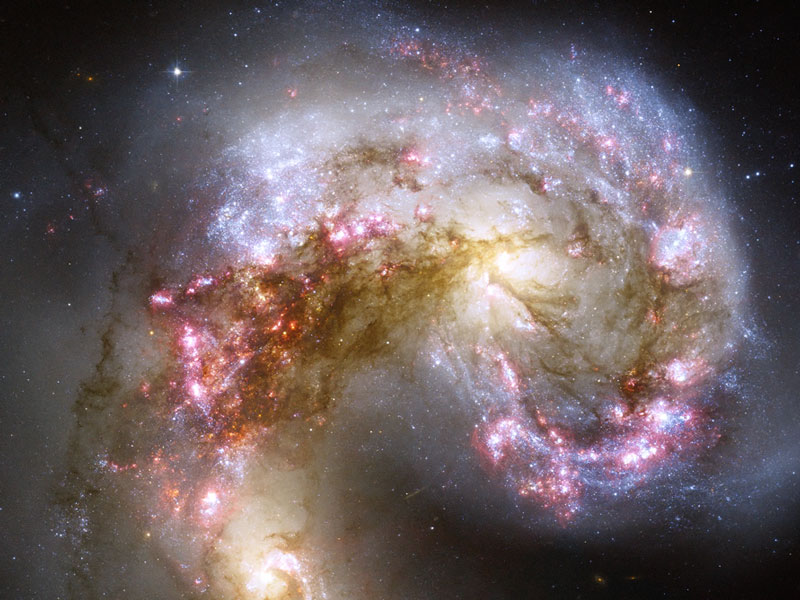
B. Whitmore (STScI), F. Schweizer (DTM), NASA |
| Not surprisingly the very hot gas produces lots of X-rays: this is the internal part of the antenna galaxies | 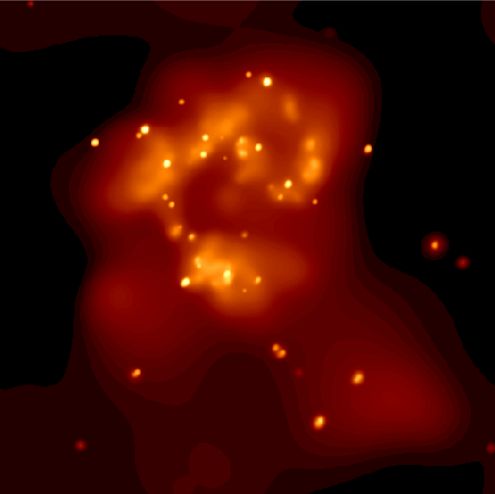 Credit: G. Fabbiano (CfA) et al., CXC, SAO, NASA |
Visual (apparent) mags. range from ∼ 6 (Andromeda) to lowest detectable (∼ 25)
Absolute brightest (giant ellipticals) ∼ -23
M31 ∼ -21
Milky Way galaxy ∼ -20
dwarf ellipticals ∼ - 9 (tho. dimmer ones would probably not be detected)
| Centaurus A | 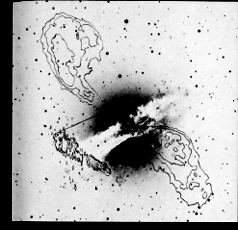 |
| M87 jet turns into intense radio source | |
| Cygnus A appears to be double galaxy with radio emission coming from distant lobes | 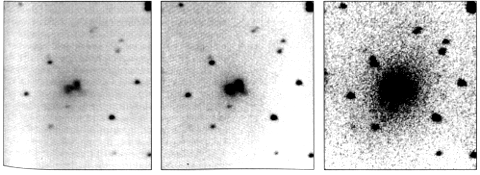 |
| Brightest radio object in sky: took a long time to find optical counterpart, since it is a distant galaxy. Emission is synchrotron from electrons ejected from centre
Note jet |
 |
| Nowhere near largest radio source! | 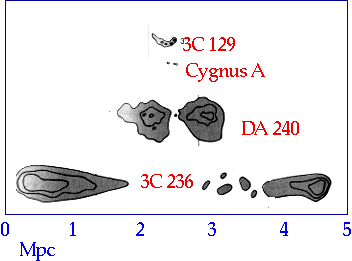 |
|
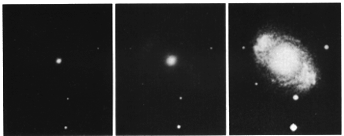 |
| Position of 3C273 found v. accurately by lunar occultation, so could be identified with 13 mag. blue "star" with jet projecting from it |  |
| This shows the problem: it shows a galaxy (maybe 2) a quasar and a star. Which is which? | 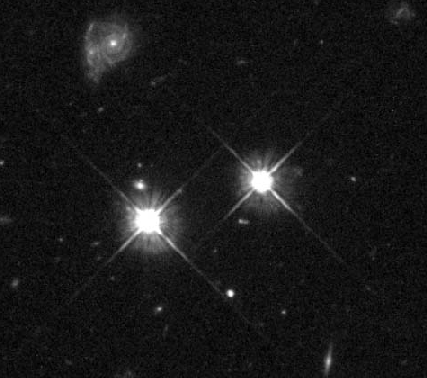 Credit: C. Steidel (Caltech), HST, NASA |
| 3C 273 bright enough that it had been recorded on old plates: hadn't moved in sky, so must be distant. | 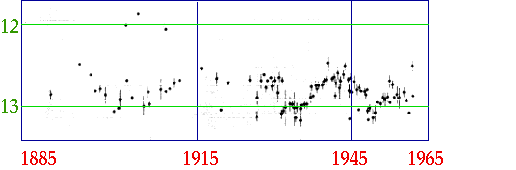 |
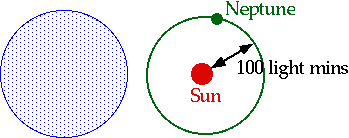
i.e. light output occurs from same size region as supergiant star, but energy ∼ 1010 larger |
 |
| Best Bet Model! Supermassive black hole, consuming 10-20 M₀/year Surrounding galaxy produces emission lines "Flickering" from stars falling into black hole | 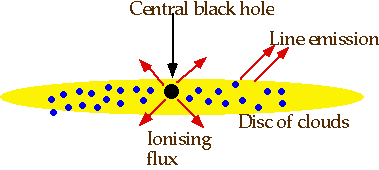 |
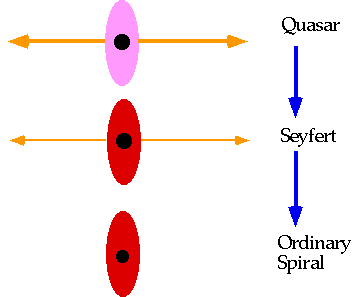
Quasars very plentiful in early universe. We see Seyfert galaxies, which seem to be intermediate, so quasars evolve to Seyferts or radio galaxies as black hole consumes most of central core, and then to normal spiral as central core becomes used up |
 |
About 10000 quasars known, and each is very characteristic: red-shifts and spectrum are very distinct.
However several pairs which lie very close in sky: e.g. 0957 +561A & 0957 +561B are 6" apart in sky and have identical red-shifts. Note "fuzz" sticking out of lower one |
 |
| Can be understood via radio image: massive galaxies will bend light |  |
| THis one is imaged 4 times (the Einstein cross) Can just see the galaxy. Allows us to measure mass of intervening galaxy, but not easy in practice. | 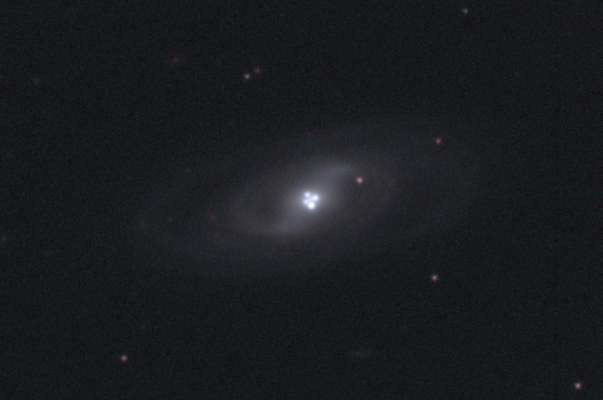 Credit & Copyright: J. Rhoads (STScI) et al., WIYN, AURA, NOAO, NSF |
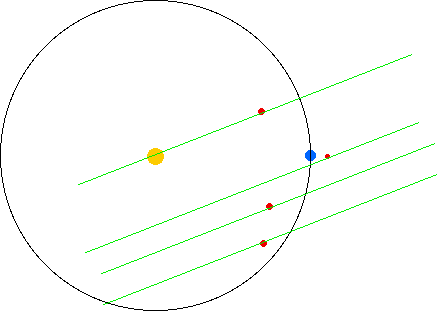
Found originally by Vela satellite (designed to look for γ's from nuclear explosions). Can identify source by using timinng with various satellites Bursts last 1/10 - 100s, no particular pattern |
 |
Problems: Could not be identified with any known object
| Possibly collisions between stars in very distant galaxies, or some unusual form of supernova | 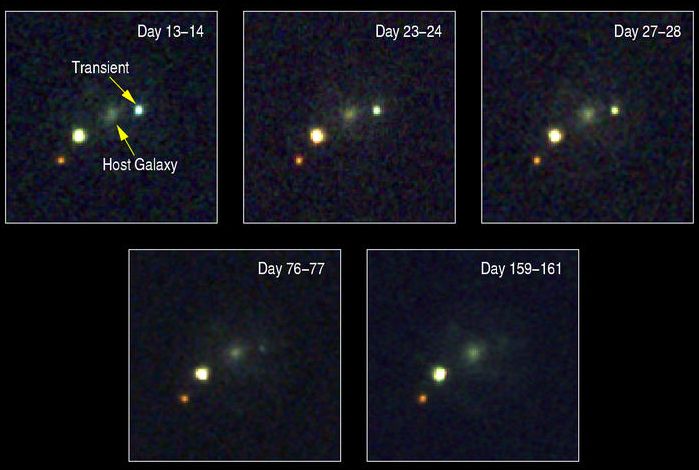 Image Credit: S. Kulkarni, J. Bloom, P. Price, Caltech - NRAO GRB Collaboration |