Why do all masses fall at same rate? All normal forces (e.g. electrical, friction, elastic...) don't produce same accn in all bodies.
\color{red}{
F = m_I a = m_G g \Rightarrow a = g}
Are we really sure the m's are the same? This concerned Newton
The first m (inertial mass mI) measures how hard things are to accelerate (2nd. law), the second (gravitational mass mG) measures gravitational force
F = mIa
F = mGg
Pseudo-forces (e.g. centrifugal force) behave the same way.
$$
\color{red}{
F = \frac{{mv^2 }}{R} = ma}
$$
so all bodies undergo same centrifugal accn.
Maybe gravity is somehow a fictitious force (?!?!?!?)
\color{red}{
m_I \equiv m_G }
so a = g only if the "inertial mass" is the gravitational mass.
Can demonstrate this is true to 1 part in 1012 (Eötvos experiment).
Special relativity said you cannot do an experiment to decide if you are moving.
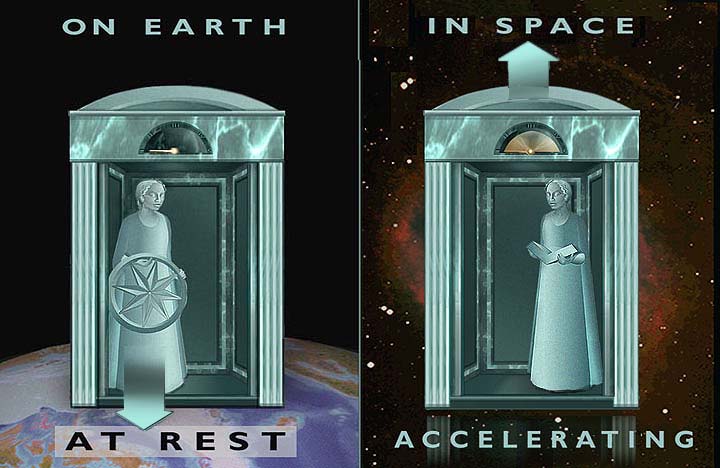
General says that you cannot do an experiment to distinguish between a gravitational field and an acceleration (!!!!!!!!!)
For example:
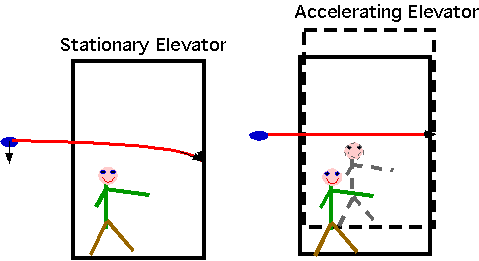
Suppose you are in a stationary elevator, and a bullet is shot horizontally, it will fall due to gravity..
Suppose you are in an accelerating elevator, and a bullet is shot horizontally, it will appear to fall..
You cannot distinguish the two.
For example:
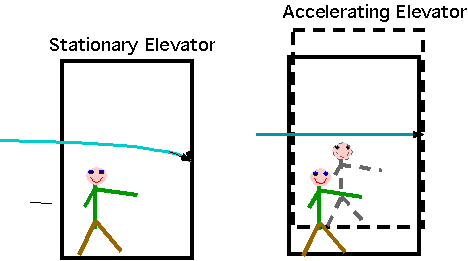
Suppose you are in an accelerating elevator, and a beam of light is shot horizontally, it will appear to fall..
Suppose you are in a stationary elevator, and a beam of light is shot horizontally, it will fall..
You cannot distinguish the two. Light gets affected by gravity?
This is the Equivalence Principle
General relativity:
Handles frames which are accelerating w.r.t. each other.
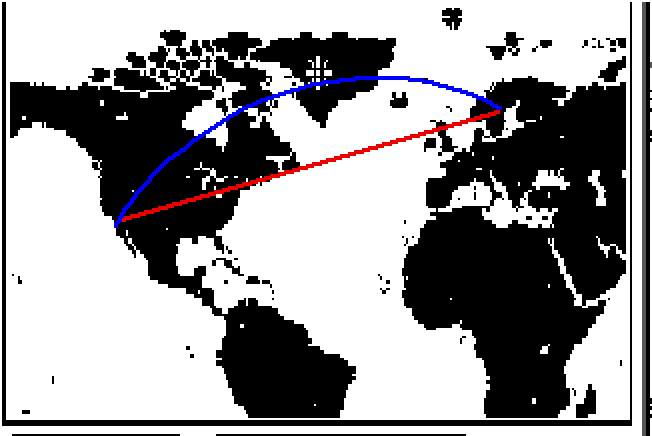
What is a straight line?
which is the straight line?
General relativity: metrics
Physics should not depend on the frame of reference: e.g. which way is up?
Principle of General Covariance:
physical laws are the same in any frame.
(e.g. Newton's are not, since they aren't the same in an accelerating frame).
Metric is distance in terms of coords: in Cartesians:
where τ is the proper time. e.g. for a moving body, this could be the interval between creation and decay of a particle, the (invariant) lifetime.
This contains (e.g.) time dilation: if the particle is travelling in some frame with vel
v = Δr/Δt (t is the time measured in the frame then
implies that proper time can be real or imaginary: more specifically if we have two events
Δτ² < 0 the events have a space-like separation
Δτ²= 0 the events have a light-like separation
Δτ² > 0 the events have a time-like separation
Defines "metric tensor" for us:
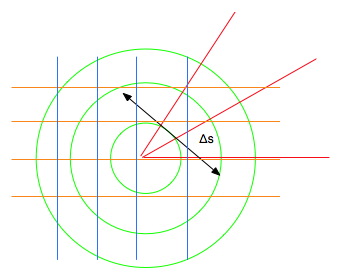
in 3-D, the distance between 2 points $
\color{red}{\Delta s^2 }$
cannot depend on the coord. system.
Suppose in one system we have
$$
\color{red}{
\Delta s^2 = \Delta x^2 + \Delta y^2 + \Delta z^2 }
$$
and we write $
\color{red}{x = x\left( {x^1 ,x^2 ,x^3 } \right)}$ etc..
e.g. for polar coords $$
\color{red}{
\begin{array}{l}
x = r\sin \left( \varphi \right) \\
y = r\cos \left( \varphi \right) \\
\end{array}}
$$
Can now find $$
\color{red}{
\Delta x = \frac{{\partial x}}{{\partial x^1 }}\Delta x^1 + \frac{{\partial x}}{{\partial x^2 }}\Delta x^2 + \frac{{\partial x}}{{\partial x^3 }}\Delta x^3 }
$$
etc. Then we can write$$
\color{red}{
\begin{array}{l}
\Delta s^2 = \left( {\frac{{\partial x}}{{\partial x^1 }}\Delta x^1 + \frac{{\partial x}}{{\partial x^2 }}\Delta x^2 + \frac{{\partial x}}{{\partial x^3 }}\Delta x^3 } \right)^2 + ..... \\
= \sum\limits_{}^{} {\sum\limits_{}^{} {g_{\mu \nu } \left( {x^1 ,x^2 ,x^3 } \right)\Delta x^\mu \Delta x^\nu } } = g_{\mu \nu } \Delta x^\mu \Delta x^\nu \\
\end{array}}
$$
Einstein summation convention: repeated indices are summed over.
Note:
$\Delta s^2 $ is invariant (Doesn't depend on the coord system or "frame of reference"
$\Delta x^1 $ etc do depend on frame
in general $
\color{red}{g_{\mu \nu } }$
depends on the location. Most (all!) of the cases we deal with will have a very simple dependence on space or time.
in 3-D (4-D) there are 9 (16) terms in $
\color{red}{g_{\mu \nu } }$
because of symmetry $$
\color{red}{
g_{\mu \nu } = g_{\nu \mu } }
$$
so 6 (10) of these are indep.