Inflation
 Theseo 2000 | `I can't believe THAT!' said Alice.
`Can't you?' the Queen said in a pitying tone. `Try again:
draw a long breath, and shut your eyes.'
Alice laughed. `There's not use trying,' she said: `one CAN'T
believe impossible things.'
`I daresay you haven't had much practice,' said the Queen.
`When I was your age, I always did it for half-an-hour a day.
Why, sometimes I've believed as many as six impossible things
before breakfast. '
|
Inflation
We are left with two major problems: the flatness problem and the horizon problem, and also one you haven't head of: the monopole problem
- Why is the universe large and flat?
- It could naturally be very much smaller, and there is no reason to have Ω=1 (this is the "Why the hell" question!)
- Why is the universe all the same temperature?
- Parts of it have never been in contact. Why does CMBR correlations extend below l = 180?
- As the universe cooled, bits of it spontaneously made phase transitions. This should lead to defects: where are they?
- Huh?
Why the Hell?
At any time, critical energy density is given by
\color{red}{
\varepsilon _c \left( t \right) = \frac{{3c^2 H^2 }}{{8\pi G}}}
so (YAWOWTFE)
\color{red}{
H\left( t \right)^2 = H\left( t \right)^2 \Omega - \frac{{\kappa c^2 }}{{R_0^2 a\left( t \right)^2 }}}
which can be rewritten
\color{red}{
H_0^2 \left( {\Omega _0 - 1} \right) = H\left( t \right)^2 a\left( t \right)^2 \left( {\Omega \left( t \right) - 1} \right)}
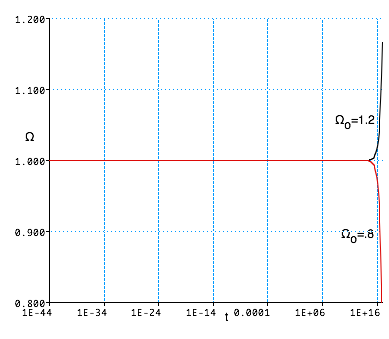
so (1-Ω) can never change sign.
| Suppose (for simplicity) we have a radiation-dom. universe (doesn't affect the argument)
\color{red}{
\Omega \left( t \right) = 1 + \left( {1 - \frac{1}{{\Omega _0 }}} \right)a^2 }
- If κ = 0, Ω = 1 for all time
- If κ > 0, then Ω decreases away from 1.
- Ifκ < 0, then Ω increases away from 1.
This is the "flatness problem" |
 |
| Since we measure Ω now ≈ .1...this means that at the time of the BB, Ω ≈ 1 - 10-60
i.e. Ω = 1 is an unstable critical point |
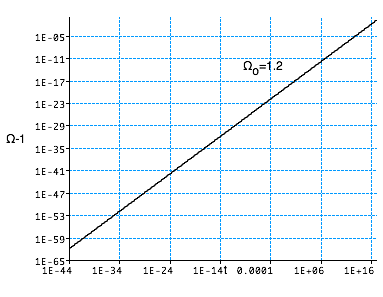 |
The flatness problem is worse than you would think: If the universe started out at 10-44 s with (say) Ω = 3, it would last ≈ 10-35 s (!!!!)
Horizon problem:
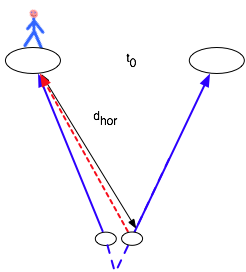
Parts of the universe separated by Hubble dist. d > c/H
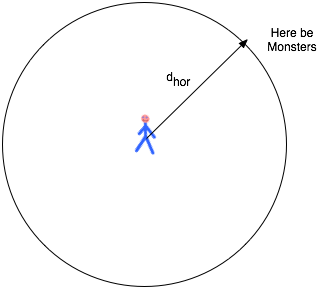
| More exactly: the most distant object that we can see today is given by the "horizon distance": |
|
in general, this is
\color{red}{
d_{hor} \left( t \right) = ca\left( {t_0 } \right)\int_0^{t_o } {\frac{{dt}}{{a\left( t \right)}}} \Rightarrow c\int_0^{t_o } {\frac{{dt}}{{a\left( t \right)}}} }
| (note light is emitted at t = 0).
If we have a one-component universe, this is
\color{red}{
\frac{{a\left( {t_0 } \right)}}{{a\left( t \right)}} = \left( {\frac{{t_0 }}{e}} \right)^{2/\left( {3 + 3w} \right)} w \ne - 1}
so
\color{red}{
d_{hor} \left( {t_0 } \right) = \frac{c}{{H_0 }}\frac{2}{{1 + 3w}}}
|
 |
so in matter-dom universe (w=0), this is now
\color{red}{
d_{hor} = \frac{{2c}}{{H_0 }} \approx 2.6 \times 10^{26} m}
Note if w <-1/3, dhor=∞: i.e. can see all the universe.
Space-time defects
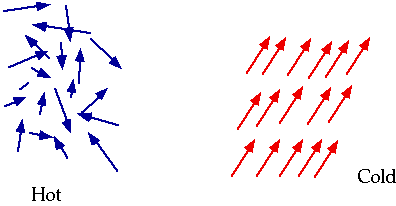
Many systems in physics show "spontaneously broken symmetry"
e.g. a ferromagnet is made up of electron spins which can point
- at high temp, in any direction
- at low temp, all in the same direction, but that direction is arbitrary
|
 |
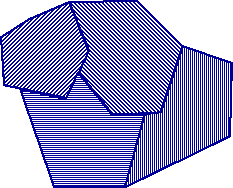
| What actually happens is a bit more complicated: if you take a slab of Fe and cool it, different parts will choose different directions. These are domains: you can make them all the same by (e.g.) hitting the magnet in a mag field. |
 |
Theories of matter work in a somewhat similar way: can have (e.g.) the electromagnetic coupling chosen differently in different parts of space via a phase factor: (q = q0eiθ ). This can't be seen as long as θ varies smoothly from one point in space to another (local gauge invariance)
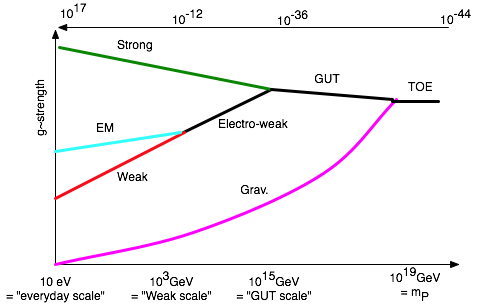
| Hierarchy of theories: simplest at highest temps:
|
|
| At very high energy, symmetry is unbroken: at lower energy universe must choose between different vacua. |
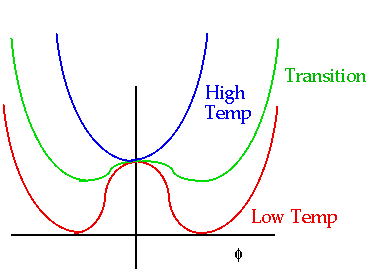 |
| In particular, Higgs field (gives rise to mass of particles) becomes spontaneously broken since minimum has a random phase |
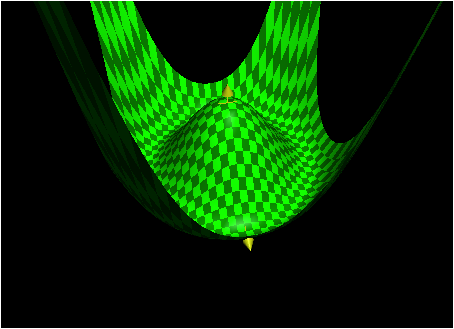 |
| However since the universe starts off very hot, these are arranged randomly. When the universe cools, bits of space can be trapped with different values. |
.gif) |
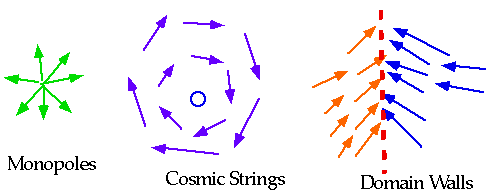
There are three possible structures:
-
- Domain walls vanish (noisily!)
- Monopoles behave like extremely massive particles (and hence could be related to dark matter).
- Cosmic strings are the most interesting, since they behave like infinitely thin, long loops of string with a mass of 1020 kg/m. Analogous to vortices in a fluid
|
 |
How would we see them?
- What would they do?
- Can estimate masses: set by scales at which they break, so
Mmonopole∼1015 GeV (Heavy!).
-
However, they will be in thermal equilm from 10-44 s: since temp at this stage is 1019 GeV, density is 1082 m3.
- Sounds a lot but the horizon distance was 10-28 m. Stable, so they would act as CDM (!) and crunch the universe at 10-16s.
The inflationary universe
solves these problems:
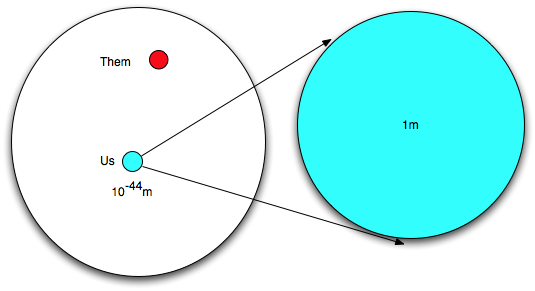
| consider a very small volume of the (original) universe.
e.g. at t = 10-34 s, the size of the horizon is d = ct = 10-23 cm (≈ 10-8 size of a proton)
The inflationary phase leads to an increase in the size of universe by 1080 (effect is very like continuous creation, in that the energy density remains the same). |
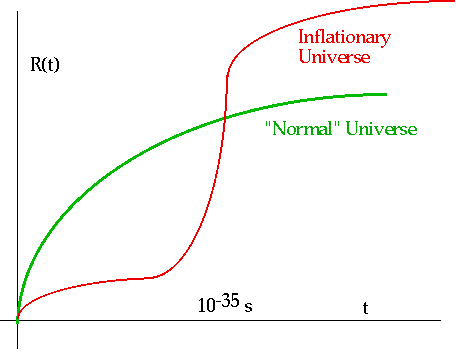 (diagram not exactly to scale!) (diagram not exactly to scale!) |
| An inflationary phase "smoothes out the wrinkles". The temperature in this volume was already in equilibrium. Now, after inflation, it is much larger and smoother than before. |
 |
How do we get this? This was one "special case": if vacuum itself has an energy ρv=Λ/3 ≠0? Obviously
$$
\color{red}{
\frac{{d\rho _v }}{{dt}} = 0}
$$
so (setting ρm= ρr=0 for simplicity) we can use $$
\color{red}{
\left( {\frac{{\dot a}}{a}} \right)^2 = \frac{\Lambda }{3}}
$$
which is our previous results with w = -1: this gives$$
\color{red}{
a(t) = a_0 e^{\sqrt {\frac{\Lambda }{3}} t} }
$$
Note that
\color{red}{
H_i = \frac{{\dot a}}{a} = \sqrt {\frac{{\Lambda _i }}{3}} }
i.e. Hubble param is constant.
Assume that inflation switches on at ti and off at tf. Then scale param at start of inflation is ai so before
\color{red}{
a\left( t \right) = a_i \left( {\frac{t}{{t_i }}} \right)^{1/2} }
so
\color{red}{
H_i = \frac{{\dot a}}{a} = \frac{1}{{2t_i }} \approx 10^{36} s^{ - 1} }
(which obviously fixes Λ)
Usual to talk about E-foldings:
\color{red}{
N = \frac{{t_f - t_i }}{{H_i }}}
Number of times that universe expanded by a factor of e.
Flatness problem
At 10-36 s, the universe could have deviated from Ω = 1.
\color{red}{
\Omega \left( t \right) - 1 = \frac{{\Omega _i - 1}}{{a\left( t \right)^2 }}}

After inflation, the density hasn't changed (remember steady state model?) but the universe is 1043 times larger!
This means that it can never deviate much from Ω = 1: i.e. flatness problem is fixed.
Horizon problem
\color{red}{
d_{hor} \left( t \right) = ca\left( {t_0 } \right)\int_0^{t_o } {\frac{{dt}}{{a\left( t \right)}}} \Rightarrow c\int_0^{t_o } {\frac{{dt}}{{a\left( t \right)}}} }
Before inflation,
\color{red}{
d_{hor} = \frac{{2c}}{H} = 2ct_i \sim 10^{ - 29} m}
(seriously: about 10-14x size of proton!)
after inflation
\color{red}{
d_{hor} \left( {t_f } \right) = e^N c\left( {2t_i + \frac{1}{{H_i }}} \right) \sim 3ct_i e^N \sim 1 pc}
What we really want to do is to ensure that the currently visible universe was small enough prior to inflation that it could be in thermal contact.
Surface of last scattering is at zls ≈1100 so proper distance
\color{red}{
\begin{array}{l}
d_p \left( {t_0 } \right) = c\int_{t_e }^{t_o } {\frac{{dt}}{{a\left( t \right)}}} = c\int_{t_e }^{t_o } {\frac{{dt}}{{\left( {\frac{t}{{t_0 }}} \right)^{2/3} }}} = \frac{{3c}}{{t_0 }}\left( {1 - \left( {\frac{{t_e }}{{t_0 }}} \right)^{1/3} } \right) \\
= \frac{{2c}}{{H_0 }}\left( {1 - \frac{1}{{\sqrt {1 + z} }}} \right) \approx 4 \times 10^{26} m = 1.4 \times 10^4 Mpc \\
\end{array}}
(universe is matter-dom since then, so we know \color{red}{a\left( t \right) = \left( {\frac{t}{{t_0 }}} \right)^{2/3} }
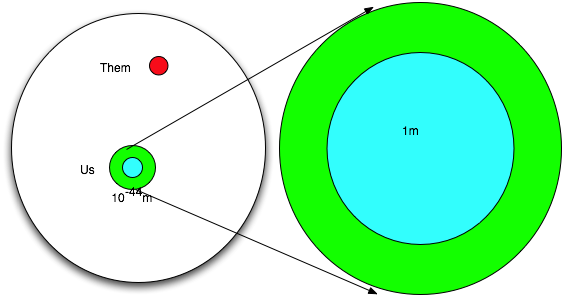
| After inflation ended,
\color{red}{
d_p \left( {t_f } \right) = a_f d_p \left( {t_0 } \right) \approx 1m}
Before inflation started,
\color{red}{
d_p \left( {t_i } \right) = e^{ - N} d_p \left( {t_f } \right) \approx 10^{ - 44} m}
which is much smaller than horizon |
 |
Monopole problem
Effectively, monopoles become so dilute at most one in our observable universe (but Cabrera saw it!)
Origins of Inflation: preamble
- Need to turn on inflation at ti
- Turn it off at tf
Need a scalar field (inflaton) with large energy density:
- e.g. ES field E has \color{red}{V\left( E \right) = \frac{1}{{2\varepsilon _0 }}E^2 }
- However time varying fields add a KE term.
- For a single particle in (e.g.) SHO\color{red}{H = \frac{1}{{2m}}p^2 + \frac{1}{2}m\omega ^2 x^2 }
(H is Hamiltonian, not Hubble param!).
- If we convert this into a field (e.g. a 1-D string) by adding SHO's, we get a Hamiltonian density (aka energy density)
\color{red}{
\varepsilon _\varphi = \frac{1}{2}\rho \left( {\frac{{\partial \phi }}{{\partial t}}} \right)^2 + \frac{1}{2}\rho c^2 \left( {\frac{{\partial \phi }}{{\partial x}}} \right)^2 }
- (first term is "KE", second is "PE")
- In general, for an arbitrary field, we will get
\color{red}{
\varepsilon _\varphi = \frac{1}{2}\frac{1}{{\hbar c^3 }}\left( {\dot \phi } \right)^2 + V\left( \phi \right)}
Pressure
\color{red}{
P = - \left( {\frac{{\partial U}}{{\partial v}}} \right)_S }
(v is volume: normally energy decreases as gas expands, here it increases) so
\color{red}{
P_\phi = \frac{1}{2}\frac{1}{{\hbar c^3 }}\left( {\dot \phi } \right)^2 - V\left( \phi \right)}
which gives us inflation if \color{red}{{\dot \phi }}
is small. Fluid equation for inflaton is
\color{red}{
\dot \varepsilon _\varphi + 3\frac{{\dot a}}{a}\left( {\varepsilon _\varphi + P_\phi } \right) = 0}
which becomes (note \color{red}{\frac{{\partial V\left( \phi \right)}}{{\partial t}} = \dot \phi \frac{{\partial V}}{{\partial \phi }}}
)
\color{red}{
\ddot \phi + 3H\left( t \right)\dot \phi = - \hbar c^3 \frac{{\partial V}}{{\partial \phi }}}
which looks like a equation of motion with some friction:
If \color{red}{{\dot \phi }} is small, can ignore \color{red}{{\ddot \phi }}
. Hence can find \color{red}{{\dot \phi }}
\color{red}{{\dot \phi }}
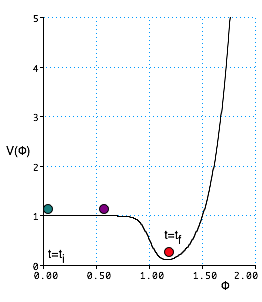
- Start off in "false vacuum" at φ ≈ 0
- \color{red}{{\dot \phi }} is small
- so field "rolls" towards minimum
|
 |
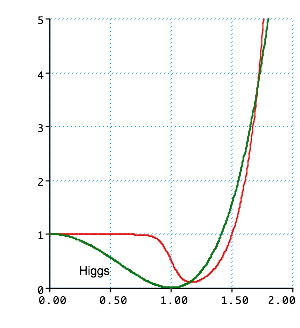
| Would be nice and economical to do this with the Higgs field, but it changes too fast
\color{red}{
V = a\left| \phi \right|^4 - b\left| \phi \right|^2 + V_0 }
|
 |
so scenario is
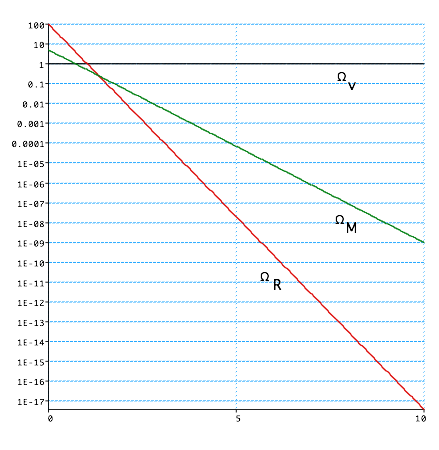
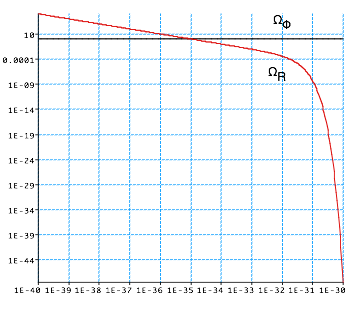
| as the universe expands, the value of Ωφis static, but the other two fall. If we start off with any values of ΩM and ΩR but Ωφ=1, the other two will disappear during inflation |
 |
- Start with radiation dominated universe
ΩR >> Ωφ >> ΩM, φ ≈ 0
- Cool until ΩR ≈ Ωφ (ti, T(ti)≈TGUT ≈ 1015GeV
-
Ωφ drives exponential expansion until \color{red}{\varphi \approx \varphi _0 }
, \color{red}{T\left( {t_f } \right) \approx e^{ - N} T_{GUT} \approx 10^{ - 28} GeV \approx 10^{ - 15} K}
(!)
- Inflaton then decays, reheats universe
|
 |
- Remaining problem is that universe is now too flat and homogenous(!)
- however quantum fluctuations in inflaton field ⇒ macroscopic flucts. ⇒ temp differences in CMBR ⇒ galaxies
-
So this fixes the problems:
- however we would like some fundamental theory for the inflaton
- or is there some other way of fixing the flatness and horizon problems?
- The good news: we have a large, flat universe, so we can make galaxies (and any structure): where do they come from?