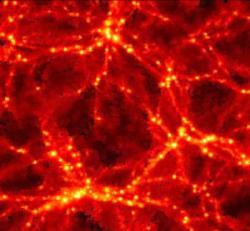
A typical output from a simulation of large-scale structure formation. The brightest spots in this image are clusters of galaxies. Credit: Uri Keshet et al.
We now have a flat universe with plenty of matter: how do we make galaxies (and humans!)? Discussion follows Ryden Chap 12.
Note "frothiness" of universe on large scale: voids of up to 500 Mpc
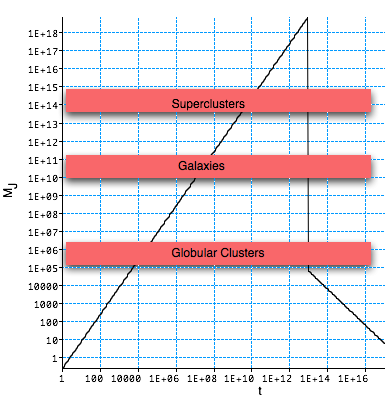
Sizes of Things
3 characteristic sizes
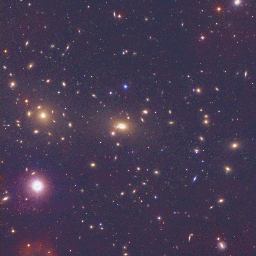
Clusters
\color{red}{M \sim 10^{15} M_o }
\color{red}{R \sim 2Mpc}
Galaxies
\color{red}{M \sim 10^{11} M_o }
\color{red}{R \sim 20kpc}
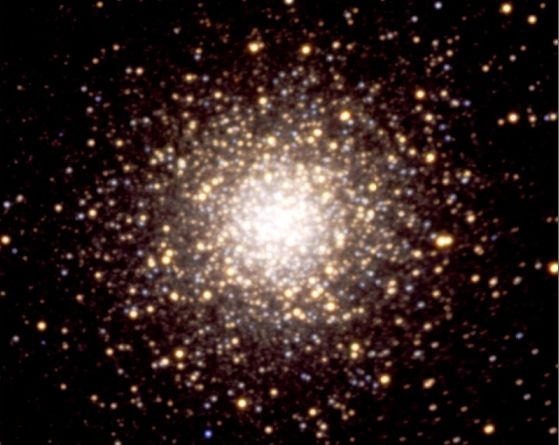
Globular clusters/Dwarf Galaxies
\color{red}{M \sim 10^6 M_o }
\color{red}{R \sim 1kpc}
How and when do they form?
What happens to fluctuations;
Four competing processes
Gravitation: causes inhomogeneites to become unstable and collapse
Cosmic fluid pressure: causes inhomogeneites to vanish as acoustic waves
Photon viscosity: slows down processes
expansion of universe smooths out everything: "Hubble friction"
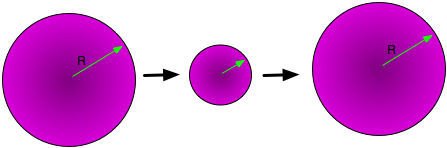
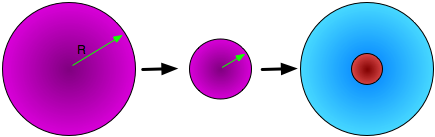
We worked out the free-fall time once before:
i.e. how long would it take for a particle to fall from the outside of a star to the centre if there was no resistance:
(Note that for t > > tdyn, δ(t) is no longer small)
Pressure
stops the collapse.
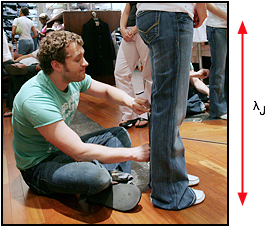
Size R ∼ wavelength λ of acoustic wave
If wave travels with speed cs, restoring time tpre ∼ λ/cs
If tpre < tdyn, collapse won't happen. so need speed of sound in gas.
Before decoupling, Universe is filled with photon-baryon fluid.
\color{red}{
P = w\varepsilon
}
with w = 1/3 for photons, w = 0 for matter so 0<wpb<1/3.
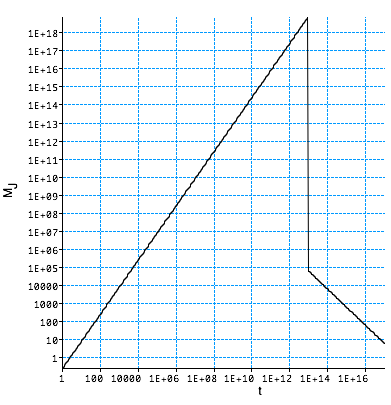
i.e. we could start collapsing material up to dec, but the lighter structures become unstable and get washed out. After dec, can only create small structs
which gives us a problem
Note: ν's don't help: they freeze out but don't become non-rel: speed of sound ∼ .5 c.
Interpreted literally, this means that all structures formed in short time around dec.
but....
Add some WIMPs
These are heavy, freeze out very early and become non-rel.
Repeat previous Jeans analysis, but now include expansion and ingnore pressure (since WIMPS are cold!)
as before, consider a sphere, rad R with and over-density δ
\color{red}{\rho = \bar \rho \left( {1 + \delta } \right)}
and so
First and last terms give us usual expanding universe (put δ = 0) so put \color{red}{\frac{{\ddot a}}{a} = - \frac{{4\pi }}{3}G\bar \rho }
gives eqn. for growth of fluct:
\color{red}{
\delta \propto t^{2/3} \propto a \propto \frac{1}{{1 + z}}}
i.e. if we had to wait for matter alone, would only get collapse (growth of fluctuations) after tls or z =1100.
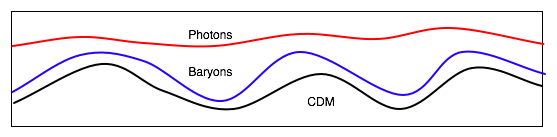
However, CDM decouples earlier and dominates earlier
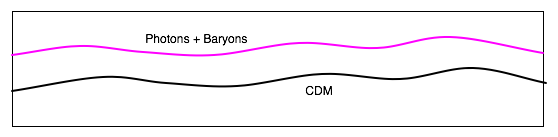
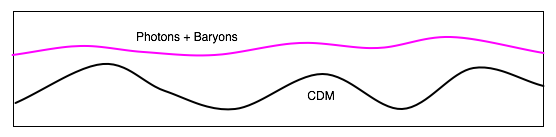
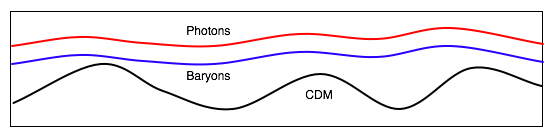
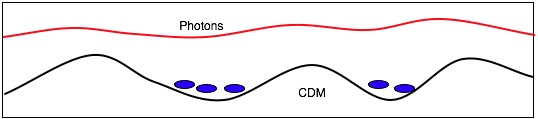
Hence Scenario
CDM decouples
CDM dominates and clumps
Baryons decouple
Baryons clump onto CDM
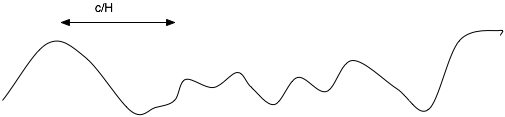
Up to now we have idealised density fluctuations into spheres: in reality, they would be far more complicated. Just as we decompose a sound wave into Fourier, write δ as Fourier integral over co-moving volume V
\color{red}{
\lambda _k = \frac{{2\pi }}{k}a\left( t \right)}
so need
\color{red}{\lambda _J < \lambda _k < \frac{c}{H}}
Then power spectrum
\color{red}{P\left( k \right) = \left\langle {\left| {\delta _{\vec k} } \right|^2 } \right\rangle }
Best guess is that spectrum will be Gaussian:
\color{red}{p\left( \delta \right) \sim e^{ - \frac{{\delta ^2 }}{{2\sigma ^2 }}} }
Power Spectrum
Pink noise has P(k)∼k, so higher frequncies are emphasised.
Expected form
\color{red}{
P\left( k \right) \propto k^n ,n = 1}
If n= 0, would have "white-noise" spectrum (In acoustics "white noise" has flat power spectrum), means points would be randomly distributed. Larger n will give more "power at short distances": i.e. fluctuations will more likely to produce smaller objects.
consider spheres, rad L, average mass
For random (Poisson distrib.) of masses m, number in sphere rad. L will be
N = M/ m,
so fluctuation will be √N, so
\color{red}{
\frac{{\delta M}}{M} \sim \frac{{\sqrt N }}{N} \sim \frac{1}{{\sqrt N }}}
so n = 0
however we can write \color{red}{\frac{{\delta M}}{M} \approx M^{ - \left( {3 + n} \right)/6} }
Must not diverge at large M (otherwise would make super-large structures) so
For n < -3, fluctuations will diverge at large L or M, so universe would not be homogeneous.
For random (Poisson distrib.) of masses m, number in sphere rad. L will be
N = M/ m,
so fluctuation will be √N, so
\color{red}{
\frac{{\delta M}}{M} \sim \frac{{\sqrt N }}{N} \sim \frac{1}{{\sqrt N }}}
so n = 0
However also want to keep potential eenrgy finite:
so only simple power spectrum that works on all scales is n=1
HDM/CDM
need to be defined:
Hot dark Matter was still rel. when it decoupled: kTdec >> mxh2
CDM had kTdec << mhc2
More exactly, if rel. at time of creation of galaxies, would not have caused fluctuation: galaxies (or at least seeds) created close to matter-radiation equality (say z = 3700) when T ∼ 5000.
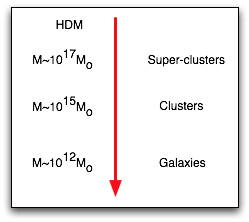
HDM would wipe out small scale fluctuations (particles free-stream)
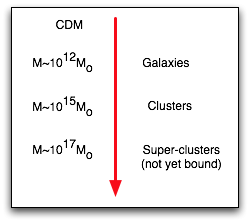
CDM amplifies fluctuations.
if you aren't part of the solution you are part of the problem!
particle with mass mhc2 (energy in eV) become non-rel when temp is
note just low mass isn't enough: e.g axions (required to make theory of strong interactions CP invariant) have masses 10-12 <
mAc2 < 10-4 eV. HBowever, they are created at rest and never interact with any other particle, so never couple!
Implication: the H-Z spctrum is the starting point.
Hence if HDM consists of (say) 1 eV ν's which would almost close universe, would have no stable structure smaller than 1017M0, which is too large.
CDM alows small structures to form immediately, and large structs form from them
Can simulate cluster formation with (massive) n-body codes
and on scale of galaxies.
{Performed at the National Center for Supercomputer Applications
by Andrey Kravtsov (The University of Chicago) and Anatoly Klypin (New Mexico State University).
Conclusion
We can understand structure formation;
run simulations,
compare statistical properties with observations
CDM dominant, but need some HDM mix
ΩCDM∼ .26
ΩHDM∼ .03:
means either ν's have some mass, or have some new unknown HDM component
Re-Ionisation
A topic we have not discussed at all:
at tls the universe is matter-dom and the matter is neutral hydrogen.
What happens to it?
As the galaxies form, the stars emit vast quantities of UV, which re-ionises the H gas.
Universe was dark at z ∼ 1100: end of Dark Ages came by z ∼ 30.
Again Simulations are the only good way to go: need fully nonlinear, 3D treatment that includes hydrodynamics and Friedmann solutions