Celestial Mechanics
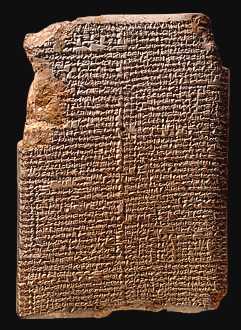 | Mul Apin tablet
http://www.mesopotamia.co.uk/astronomer/explore/exp_set.html
|
Kepler 1571-1627
| Corresponded with Brahe and acquired records after his death. (i.e. refused to give them up to his heirs) |
 |
Keplers laws :
| Planets move in ellipses, with one focus at the sun |
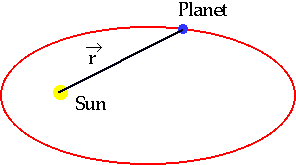 |
Keplers laws :
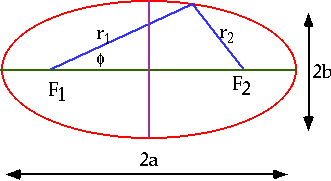
| Ellipses: a circle is a point moving so that its distance from one point is constant. An ellipse is a point which moves so that the sum of its distance from two points is constant |
|
Relations for ellipse
Keplers laws :
Second Law
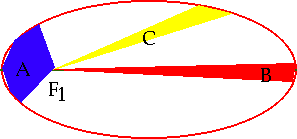
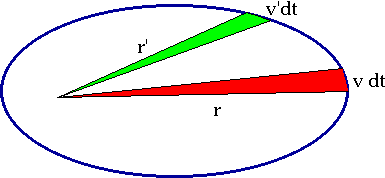
A vector drawn from the planet to the sun will sweep out equal areas in equal times
A = B = C Means "Planet moves faster closer to sun" |
|
Third Law
The period (P) and the semi-major axis (a) are related by
\color{red}{
\frac{{P^2 }}{{a^3 }} = Const}
Note that these are empirical laws: there is no indication of where they come from...
Newton
1642-1727 (born the day of Galileo's death)
Newton (in Principia) showed that the motion of the planets can be undestood in terms of the gravitational force at the earth's surface.
Universal Gravitation + Mechanics ⇒
- Keplers 3rd law
- Keplers 2nd law
- Keplers 1st law
- Energy and Virial Theorem
- Tidal forces and Roche's limit
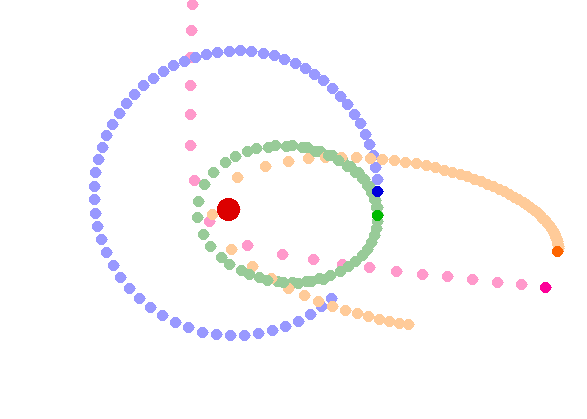
- Stability of orbits
\color{red}{
\vec F = m_{} \vec a_{} = - \frac{{GMm_{} }}{{\left| {r_{} } \right|^2 }}\hat r_{} }
The fundamental relations:
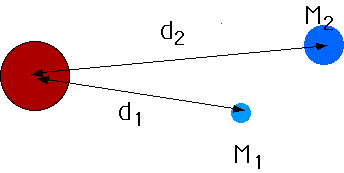
But now we want to have two bodies moving under mutual gravitation, so that the force of m2 on m1 is
\color{red}{
\vec F_{21} = m_2 \vec a_2 = - \frac{{Gm_1 m_2 }}{{\left| {r_{12} } \right|^2 }}\hat r_{12} }
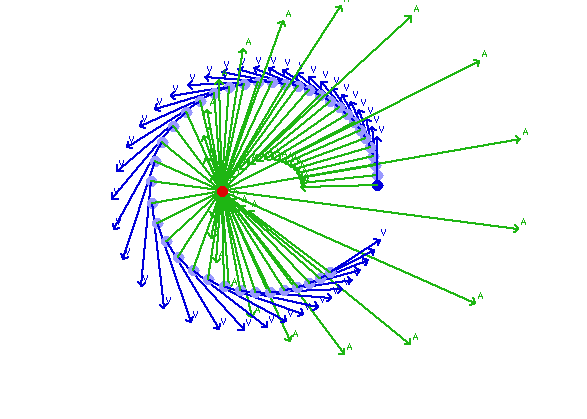
with the changing velocity and acceleration of m1
due to m2 shown thus: |
 |
Centre of Mass
- Define Relative and Centre of Mass variables.
\color{red}{
\vec R = \frac{{m_1 \vec r_1 + m_2 \vec r_2 }}{{m_1 + m_2 }},\vec r = \vec r_1 - \vec r_2 }
where R is the vector for the centre of mass, and r is the vector describing the relative displacement of one body from the other.
- Then by differentiating these, we can get the C.of M. and relative velocities
\color{red}{
\vec V = \frac{{m_1 \vec v_1 + m_2 \vec v_2 }}{{m_1 + m_2 }},\vec v = \vec v_1 - \vec v_2 }
- and accelerations.
\color{red}{
\vec A = \frac{{m_1 \vec a_1 + m_2 \vec a_2 }}{{m_1 + m_2 }},\vec a = \vec a_1 - \vec a_2 }
-
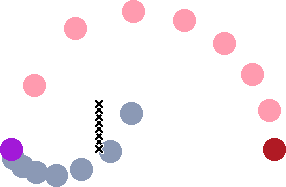
| The C.of M. motion can be eliminated immediately, so that A = 0 (no C.of M. acceleration.)., and the motion of the bodies follows the pattern shown.
with the motion of the centre of mass shown by the series of X's (ie constant motion, no acceleration).
|
 |
- The Relative motion contains all of Kepler's laws:
Kepler's Third Law.
It is theoretically justified for circular orbits via:
\color{red}{
\frac{{d^2 \vec r}}{{dt^2 }} = \vec a = \vec a_1 - \vec a_2 = - \frac{{Gm_1 }}{{\left| {r_{} } \right|^2 }}\hat r_{} - \frac{{Gm_2 }}{{\left| {r_{} } \right|^2 }}\hat r_{} = - \frac{{GM}}{{\left| {r_{} } \right|^2 }}\hat r}
Second Law
\color{red}{
\vec F = m_{} \vec a_{} = - \frac{{GMm_{} }}{{\left| {r_{} } \right|^2 }}\hat r_{} }
Take × product with r
i.e. Angular momentum doesn't change: L=const
|
\color{red}{
\begin{array}{l}
\vec L = m\vec r \times \vec v \Rightarrow \\
\frac{{d\vec L}}{{dt}} = m\left( {\frac{{d\vec r}}{{dt}} \times \vec v + \vec r \times \frac{{d\vec v}}{{dt}}} \right) \equiv 0 \\
\end{array}}
|
| What does this have to do with 2nd Law? Area of triangle
\color{red}{
A_\Delta = \frac{1}{2}\left| {\vec r \times \vec vdt} \right|}
so if dt is fixed,
\color{red}{
A_\Delta = \frac{1}{{2m}}\left| {\vec L} \right|}
is constant |
 |
1st Law:
MUCH HARDER
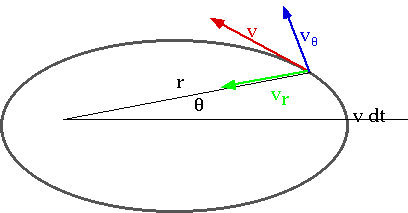
| Split into tangential and radial components
\color{red}{
\vec v = v_r \hat r + v_\theta \hat \theta = \frac{{dr}}{{dt}}\hat r + r\frac{{d\theta }}{{dt}}\hat \theta }
|
 |
\color{red}{
E = \frac{1}{2}m\vec v.\vec v = \frac{1}{2}m\left( {\left( {\frac{{dr}}{{dt}}} \right)^2 + r^2 \left( {\frac{{d\theta }}{{dt}}} \right)^2 } \right)}
\color{red}{
\vec L = m\vec r \times \vec v = r^2 \frac{{d\theta }}{{dt}}\hat \theta }
So we can write the energy and ang mom. conservation laws in terms of the new variables.
Conservation of energy:
\color{red}{
E = \frac{1}{2}mv^2 - \frac{{GMm}}{r}}
so
\color{red}{
\frac{{dE}}{{dt}} = m\left( {\vec v.\frac{{d\vec v}}{{dt}} - GM\frac{d}{{dt}}\left( {\frac{1}{{\left| {\vec r} \right|}}} \right)} \right)}
-
Take dot product with v:
\color{red}{
\vec v.\frac{{d\vec v}}{{dt}} = \vec v.\frac{{d^2 \vec r}}{{dt^2 }} = - \frac{{GM}}{{\left| {r_{} } \right|^2 }}\vec v.\hat r}
and
\color{red}{
\frac{d}{{dt}}\left( {\frac{1}{{\left| {\vec r} \right|}}} \right) = - \frac{{\vec v.\hat r}}{{\left| {r_{} } \right|^2 }}}
Can combine these to give...
\color{red}{
\frac{{dE}}{{dt}} = 0}
\color{red}{
\left| {\vec L} \right| = m\left| {\vec r \times \vec v} \right| \Rightarrow mr^2 \frac{{d\theta }}{{dt}}}
Energy is a conserved quantity. define
\color{red}{
J = \frac{{\left| {\vec L} \right|}}{m}}
We now need to combine the last 2 equations and energy conservation to give us...
\color{red}{
E = \frac{1}{2}mv^2 - \frac{{GMm}}{r} = \frac{1}{2}m\left( {\frac{{dr}}{{dt}}} \right)^2 + \frac{{L^2 }}{{r^2 }} - \frac{{GMm}}{r}}
(look familiar?) so
\color{red}{
\begin{array}{l}
\frac{{dr}}{{dt}} = \sqrt {2E - \frac{{L^2 }}{{r^2 }} + \frac{{2GM}}{r}} \\
r^2 \frac{{d\theta }}{{dt}} = J \\
\end{array}}
- This is correct, but not very interesting: to get the shape of the orbit, we need to divide the last two equations.
-
\color{red}{
\frac{1}{{r^2 }}\frac{{dr}}{{d\theta }} = \sqrt {\frac{{2E}}{{J^2 }} - \frac{1}{{r^2 }} + \frac{{2GM}}{{rJ^2 }}} }
To solve this is a mess: you need to make the following substitution.
\color{red}{
u = \frac{1}{r},u_0 = \frac{{GM}}{{J^2 }},e = \left( {1 + \frac{{2EJ^2 }}{{G^2 M^2 }}} \right)^{1/2} }
Energy and the Virial theorem
Total energy of the moon in orbit = K.E. + P.E.
\color{red}{
K.E. = \frac{1}{2}mv^2 ,P.E. = - \frac{{GMm}}{r}}
and
\color{red}{
\frac{{mv^2 }}{r} = \frac{{GMm}}{{r^2 }}}
Tidal Effects
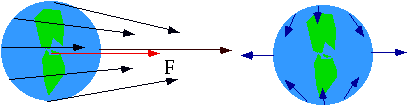
Newton thought of
- water on the near side of earth as being pulled away by the moon,
- the earth being pulled away from the water on the far side,
- gives tides on opposite sides of the earth.
|
 |
More accurately, there is a force on every point on the earth, and one must subtract the force on the centre from this.Note that the effect is really that the water at ± 900 (with the moon to the right at 00) is pulled flat!
The size of the effect is given by
\color{red}{
\delta \vec F = \frac{{GMm_{} }}{{\left| {r_{} } \right|^2 }}\hat r_{} - \frac{{GMm_{} }}{{\left| {r_{} + \delta r} \right|^2 }}\hat r \Rightarrow \left| {\delta \vec F} \right| = - - \frac{{2GMm_{} }}{{\left| {r_{} } \right|^3 }}\delta r}
|
 |
|
- Note that δr is the radius of the object, r is the distance from the mass. Also note that the Moon is more important than the sun because of the 1/r³
-
Babylonians Observed total Eclipse 15 April 136 BC.
-
| But they shouldn't have! |
 |
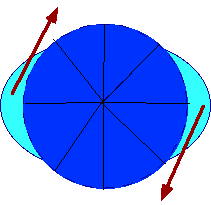
- Earth's rotation has slowed down, by 1/100 sec/century, because of tidal effects! i.e. earth isn't a very good time-keeper
Long term effects of tidal friction: Friction extracts energy from the system, so the rotational speed of the earth decreases.
|
 |
Instability
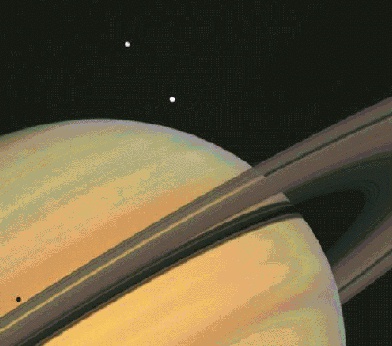
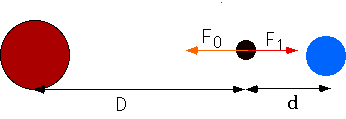
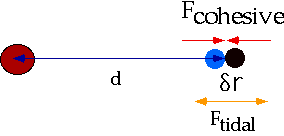
| Similar idea: if a satellite moves too far away, then it can be dragged away from the planet. |
 |
Tidal locking
A (semi-)stable configuration will occur when tidal forces increase the orbital period of the moon and decrease the rotational period until the two are the same. e.g.
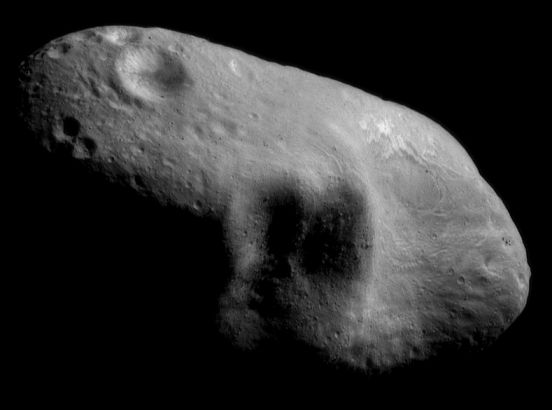 Eros
Eros  Iapetus