|
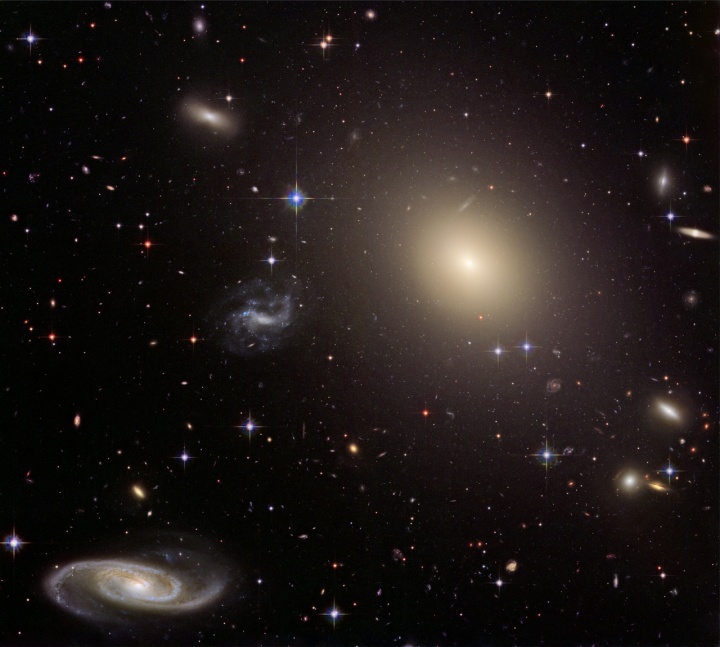
NASA, ESA, Hubble Heritage Team (STScI / AURA) Acknowledgment: J. Blakeslee (Washington State University) Galaxy cluster Abell S0740. |
In the beginning the Universe was created. This has made a lot of people very angry and has been widely regarded as a bad move. Many people believe that it was created by some sort of God, though the Jatravartid people of Viltvodle Six firmly believe that the entire Universe was in fact sneezed out of the nose of a being they call the Great Green Arkleseizure.
The Jatravartids, who live in perpetual fear of the coming of a time that they call The Coming of the Great White Handkerchief, are small blue creatures . However, the Great Green Arkleseizure theory was not widely accepted outside Viltvodle Six, and so one day a race of hyper-intelligent beings built themselves a gigantic computer called Deep Thought to calculate once and for all the answer to the Ultimate Question of Life, the Universe and Everything.
From "The Hitchhiker's Guide to the Galaxy", Douglas Adams
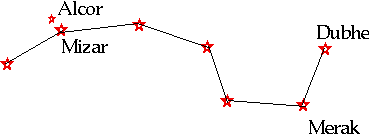
Ingredients for a creation myth:| The brightest stars have names that derive from (usually) Arabic: e.g. Ursa Major |
 |
Subsequently stars named with Greek letters, in order of brightness:e.g. Orion
|
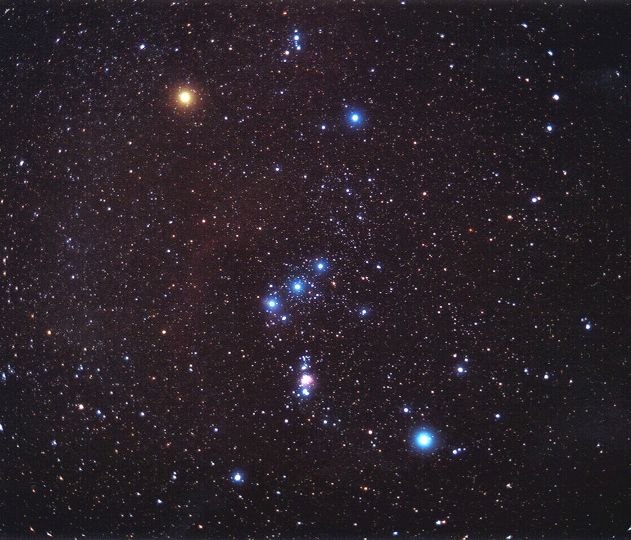 Credit & Copyright: Matthew Spinelli |
The most useful catalogs are ones of specific objects: e.g. Messier (pr. Messié!)
the most famous catalog consists of things that aren't comets(!):
|
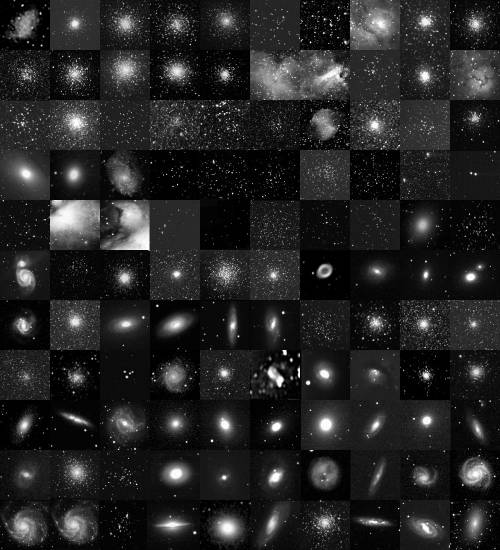 Credit & Copyright: P. Gitto |
Easiest observation about stars is that some are brighter than others.
Space is big. Really big. You won't believe how vastly, hugely, mind-bogglingly big it is.
Hitchhiker's guide to the Galaxy.
| Astronomical unit≈1010m | 10 billion m or 8 light-minutes | 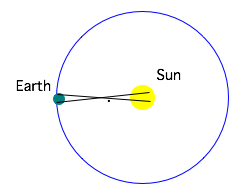 |
| Parallax of Individual stars (Aristotle had problems with this!) | 1018m ∼ 100pc |  |
| Cepheids: supergiant stars which pulsate regularly, can be seen in M100 | 20 Mpc |
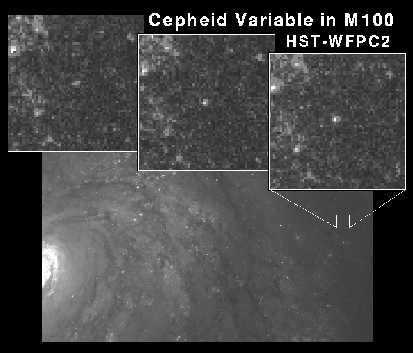 Credit: NASA, HST, W. Freedman (CIW), R. Kennicutt (U. Arizona), J. Mould (ANU) |
| The smallest things we will talk about are galaxies:
typically 10 billion (1010) stars and a size of 20 kpc (1020 m) M51 in Can Ven: HST picture |
 |
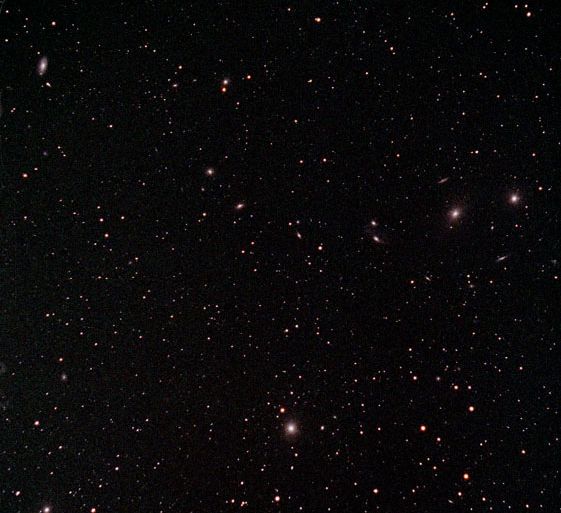
| But most of the time we'll be talking about clusters of galaxies: this is VIrgo. typically 1 million billion (1015) Msun and a size of 2 Mpc (1022 m) |
 |
|
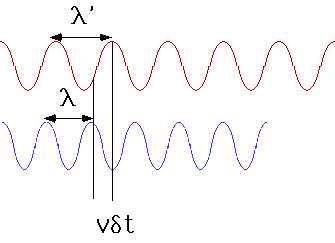 |
| Doppler effect gives
\color{red}{
z = \frac{{\lambda - \lambda _0 }}{\lambda } = 1 - \frac{{{\rm{original wavelength}}}}{{{\rm{measured wavelength }}}}{\rm{ }}}
Vel. of recession
\color{red}{
{\rm{v = zc = c}}\left( {\frac{{\lambda - \lambda _0 }}{\lambda }} \right)}
This formula isn't quite right: we can have z > 1: in fact the furthest known galaxy has z = 4.9. We have to use a relativistic formula in that case. |
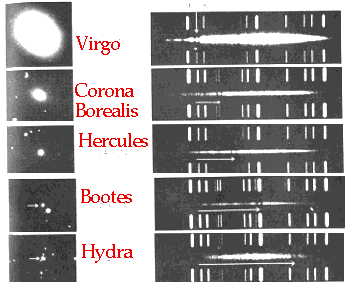 |
| Found in 1920's (Hubble, Humason, Slipher) that faint galaxies show a red shift: fainter the galaxy, faster the recession. |  |
If universe is
|
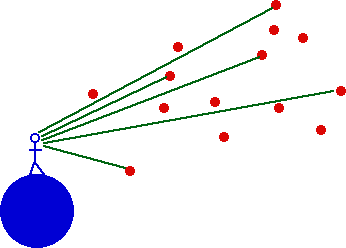 |
But it is for galaxies
| Light from stars falls off as inverse square law (1/r²) | 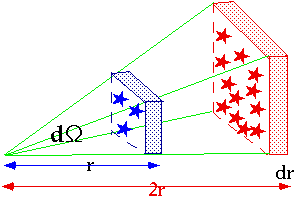 |
But the number of stars increases as r² so the effects cancel
But the matter would by now be hot and radiating
| Light is redshifted to very long wavelengths so objects within ~ 3000 Mpc will have any visible radiation at all | 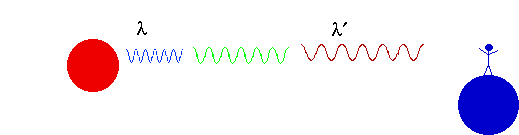 |
But this implies that the universe must be expanding
|
.gif) |
The water beetle was sent on an exploration, and after darting about on the surface and finding no rest, it dived down to the depths, whence it brought up a bit of mud, from which the earth grew by accretion.
Apache Creation Myth| Hubble was able to measure distances to closer clusters and found that velocity ∝ distance
\color{red}{
v = Hd}
H is Hubble constant: As measured by Hubble H = 550 km s-1/Mpc: Now we know
H ~ 70kms-1/Mpc
1 Mpc (megaparsec) = 3x10²² m i.e. the average galaxy at 100 Mpc is receding at 6500 km/s |
 |
| Note although all galaxies are receding from us, does not imply we are at the centre: in the currant cake model all currants see all the others as recediing | 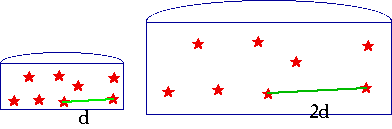 |
| RULE 1 in Physics 100: Never mix your units!)
\color{red}{
v = zc = Hd,H = 70.1 \pm 1.3{\rm{km s}}^{{\rm{ - 1}}} {\rm{Mpc}}^{{\rm{ - 1}}} }
so \color{red}{
H = \frac{{70.1 \times 10^3 }}{{3.1 \times 10^{22} }} = 2.26 \times 10^{ - 18} s^{ - 1}
}
We can invert this to give
\color{red}{
H^{ - 1} = 4.4 \times 10^{17} s = 14 \times 10^9 yr}
|
 |
| What does this time represent? Must be age of universe: if expansion does not change i.e. 14x109 yr. ago, all the galaxies were in the same place. Universe had a beginning, implied by the big bang. Can run Hubble expansion back: we would like to use this to predict what will happen in the end |

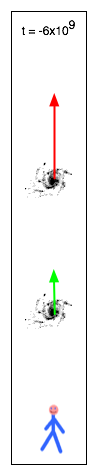

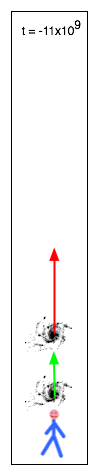
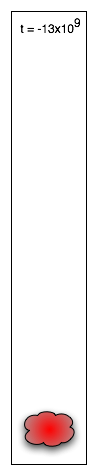
|

The sky becomes black, Earth sinks into the sea From Heaven fall the bright stars The sea ascends in storm to Heaven It swallows the Earth, the air becomes sterile
From the Hyndluljod (Iceland)
Will the universe will expand forever?
|
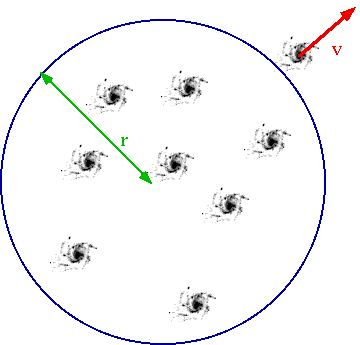 |
Will mostly use \color{red}{\Omega = \frac{\rho }{{\rho _0 }}} because some errors cancel out. The entire future of the universe is given by this one number!!!!!!!!!
I am the Alpha and Omega, the Beginning and the End, saith the Lord. Revelations I v7.
So if
|
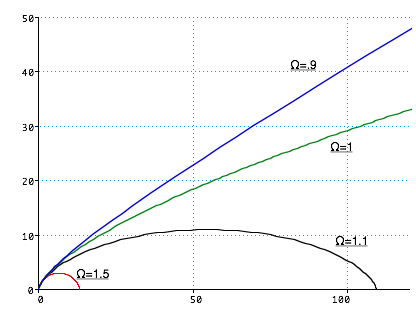 |
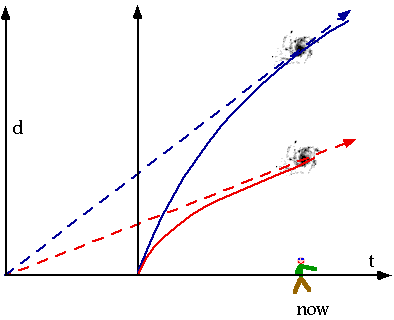
Gravity will slow down expansion in the early stages, so Hubble's constant isn't a constant... when the universe was smaller, v was larger so H must have been bigger. Better "the Hubble parameter" |
 |
There is only a single God, Mixcoatl, whose image they possess, but they believe in another, invisible, god, not represented by any image, called Yoalli Ehecatl, That is to say, God Invisible, Impalpable, Beneficent, Protector, Omnipotent by whose strength alone ... rules all things
Nahuatlan Myth
Count number of galaxies in a region of space, assume they consist of stars much like the sun, so \color{red}{\upsilon = \frac{M}{L} \approx \frac{{M_ \odot }}{{L_ \odot }}}

| Note that although we always show dense bits of the universe there are a lot of voids out there. The biggest void here is 650 Mpc across: no more than a dozen galaxies (each dot is a galaxy: "picture" is slice of universe out to 1.5 Gpc | 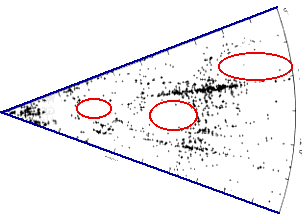
|
| Measurement of velocities of individual stars or clouds of hydrogen (via 21cm line) ⇒ rotation curves | 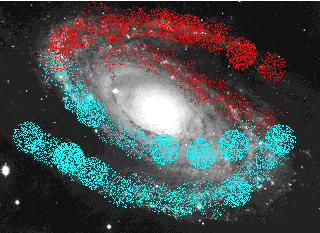 |
| Typical Spiral (NGC3198) R ≈ 20 kpc but outer parts are just seen as H gas |
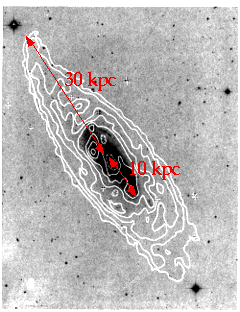 |
| Luminosity of galaxy should reflect mass: brightest at centre, so most of mass should be there. | 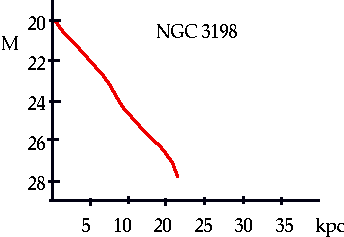 |
| but velocity curve doesn't drop as expected | 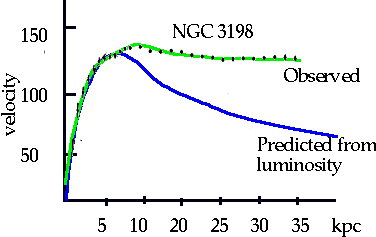 |
| Can fix this by saying that galaxy has halo of dark matter around it.
Halo + core add together to give correct curve |
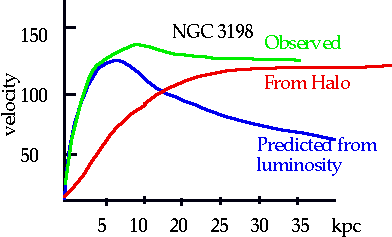 |
| Note this is not unique to NGC 3198: all measured spirals show same. | 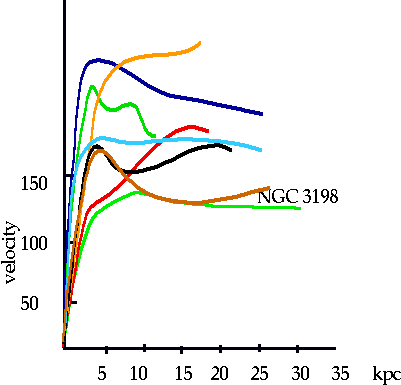 |
|
.gif) |
| A check: The Coma cluster | 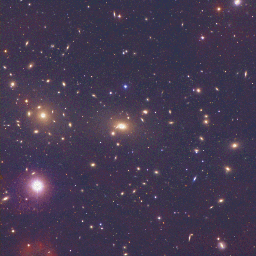 |
| Large clusters contain a lot of hot gas, which is strong X-ray source. (Picture is negative optical + contours of X-rays) X-ray pictures measure density and temp: | 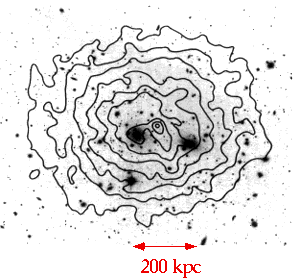 |
| Also large masses bend light, so large clusters show "gravitational lensing" of very distant objects. | 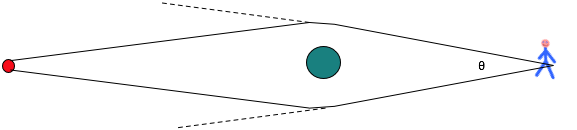 |
| Allows us to estimate the mass. For Abell 2218 we seem to have at least 300 times as much dark matter as luminous matter | 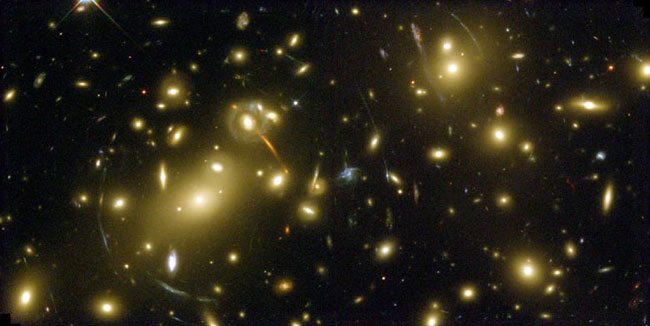 |
a) What the hell? i.e. what is the dark matter?
b) Why the hell? i.e. why is Ω~1 (after all it could be anything?)
It is believed that the first nine inhabitants who had descended from the
skies were sexless and sinless and lived on a kind of flavoured earth. Their
appetites grew and when they took to eating a sort of huskless rice which cooked
itself they became gross and heavy, developed sex and after it crime because
they had to work for a living
Kachin Myth
| However, it was very hot: hot things radiate.... Universe is "full" of light: fossil light from Big Bang, discovered accidentally by Penzias and Wilson (1964) |
 |
Found that "noise" came from universe independent of what angle horn was pointed in: corresponded to a black-body temp of 30K Have to get above atmosphere and point away from Milky Way. |
 |
| Have to get above atmosphere and point away from Milky Way
Subsequent values came from balloon flights: Finally COBE (Cosmic Background Explorer: 2006 Nobel Prize for Mather and Smoot) launched 1990: Note the perfect Black Body curve. |
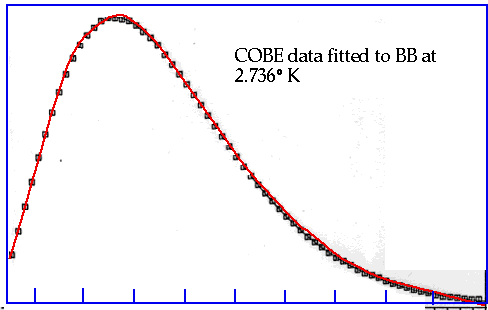 |
Where does it come from?
This is often the way it is in physics: our mistake is not that we take our theories to seriously, but that we do not take them seriously enough. It is hard to believe that the numbers that we play with at our desks have something to do with the real world. Steven Weinberg The First Three Minutes
| As the universe expands, the density of γ's decreases. and also the temperature T falls as each γ gets redshifted. | 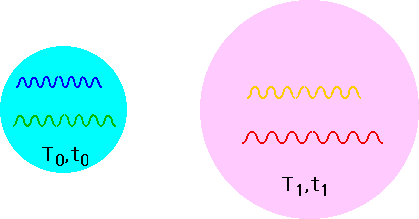 |
| The universe was originally opaque, like a fog, so mean free path of γ's very small. Hence CMBR was at same temp as matter. Then the universe became transparent and photons "froze out." | 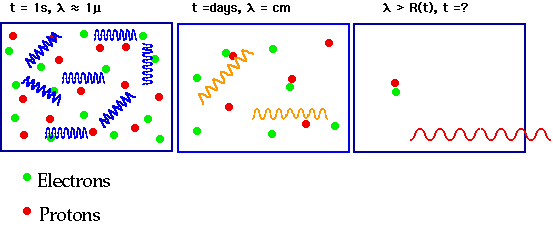 |
| Temp. of the microwave sky in a scale in which blue is 0 K and red is 4 K. Note completely uniform on this scale. The actual temperature of the cosmic microwave background is 2.725 Kelvin. |  |
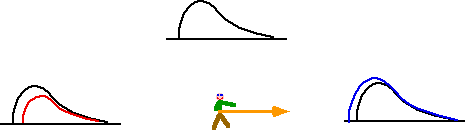
If we are moving through CMBR we would expect to see it "warmer" in front and "colder" behind.
|
|
| so CMBR is blue-shifted in the direction we are going in (note residual effect of galaxy): what do we expect for 600 km/s? | 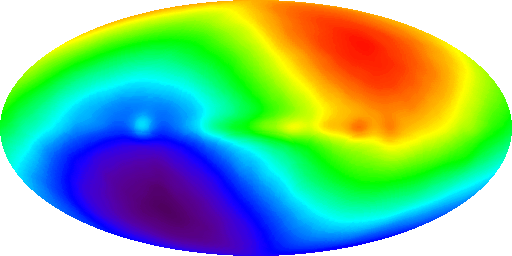
Credit: DMR, COBE, NASA, Four-Year Sky Map |
| shows we are moving towards Leo at≈ 606 km/s | 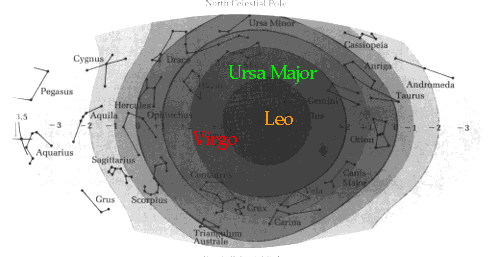 |
| So need a new satellite: WMAP: COBE and WMAP comparison. Indicates that the universe was very uniform back then. Hotter where it is denser, and this shows where the galaxies should be forming Can just see structure at: ΔT/T ≈ 10-6. |
a) What the hell? i.e. what is the dark matter?
b) Why the hell? i.e. why is Ω~1 (after all it could be anything?)
| Combination of lensing (blue) and X-rays (red) in the bullet cluster: |
Strong evidence for non-interacting dark matter:
|
| e.g. Queens-U de Montreal Picasso expt. Nucleus will recoil and transfer energy to super-heated freon liquid and cause transition to gas.
e.g. DEAP (Kevin Graham at Carleton |
 |
| Normally density fluctuations die away (e.g sound waves) but in massive fluid they get amplified by gravity |
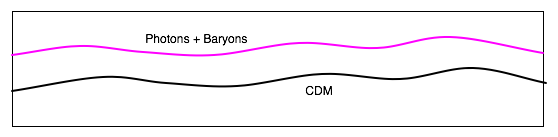
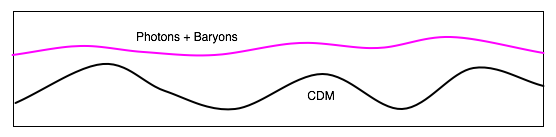
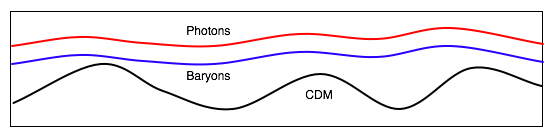
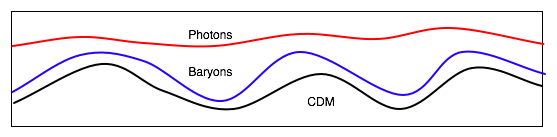
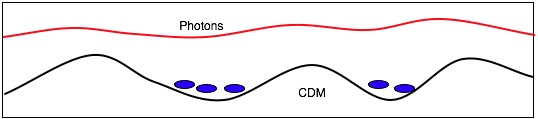
| Can simulate structure formation with (massive) n-body codes (n = 107 gravitating objects): on the large (super-cluster) scale. Note that we get a sort of stringy structure, which looks like what we observe |
| Or on scales of galaxies. {Performed at the National Center for Supercomputer Applications by Andrey Kravtsov (The University of Chicago) and Anatoly Klypin (New Mexico State University). |
b) Why the hell? i.e. why is Ω~1 (after all it could be anything?)
|
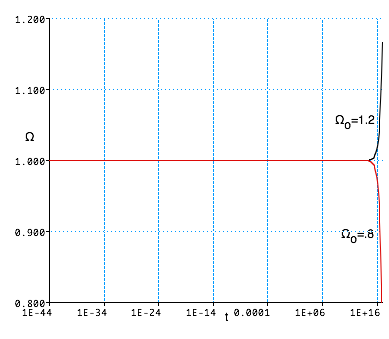
At any time, critical density is given by
\color{red}{
\rho _0 = \frac{{3H^2 }}{{8\pi G}}}
and
\color{red}{
\Omega {\rm{ = }}\frac{\rho }{{\rho _0 }} = \frac{{{\rm{actual\_density}}}}{{{\rm{critical\_density}}}}}
|
 |
| Dark Matter is bad enough, but now dark energy ... |  |
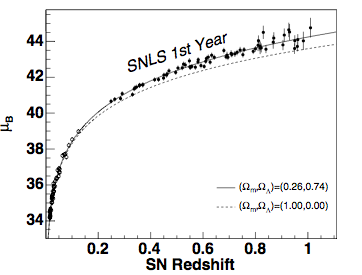
| Type 1a Supernovae Mv = -20 allows us to measure out to 3000Mpc |
| First results from Supernova Cosmology project, Now Canada-France Hawaii Telescope (CFHT) (U of T and others) provides best data | 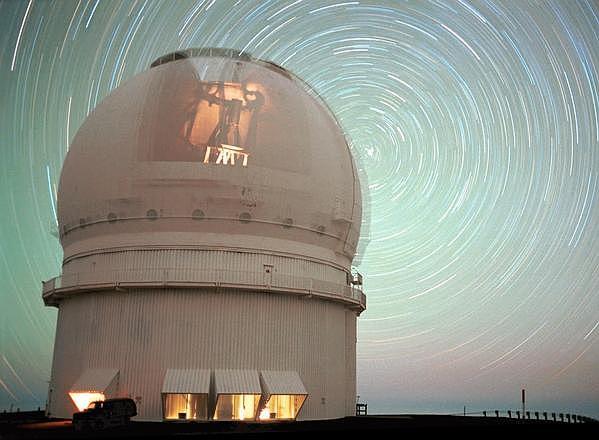 |
|
 |
| Cosmological constant Λ (Einstein's "greatest blunder"): |  |
There have been 3 scientific revolutions, all devastating for man's dignity.

Warning: for the rest of this course, you are on the hairy edge of science!
And God said " Let us make man in our own image, after Our likeness, and let them have dominion....over all the earth Genesis I.26
| Parameter | Value | Definition | Measured | Comments |
| G | 6.673x10⁻¹¹ | Grav. const | Lab | Newton |
| c | 2.998x10⁸ | Speed of Light | Lab | Rohmer |
| α | 1/137 | Strength fo EM coupling | Lab | Maxwell |
| mec2 | 511 keV | Electron mass | Lab | Thomson |
| mPc2 | 937 MeV | Proton mass | Lab | Chemistry/Rutherford |
| mnc2 | 939 MeV | neutron mass | Lab | Chadwick |
| H0 | 70±7 km s-1Mpc-1 | Hubbles constant | Hubble | |
| TCMBR | 2.726K | CMBR temp | COBE/WMAP | |
| ΩB | .03±.01 | Nucleon density | WMAP, nucleosynthesis | Baryon density |
| Ωγ & ν | 3.4x10⁻⁵ | CMBR + BBN | Uncertainty due to ρc, assumes mν = 0 | |
| Ωdm | .26±.02 | CDM density | Spirals/Galaxy clusters | |
| ΩΛ | 0.74 | Curvature energy | Sn 1a | |
| Ω0 | 1.01±.02 | Total energy |
| For heavy nuclei, (1) overwhelms (2), so they are unstable. If the electromagnetic force were 10% stronger |  |
| if the electromagnetic force were 10% weaker | 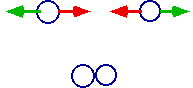 |
Then was not non-existent nor existent
There was no realm of air, no sky beyond,
What covered in and where? and what gave shelter?
Who verily knows and who can here declare it
Whence it was born and whence came this creation
He, the first origin of creation,
whether he formed it all or did not form it.
He verily knows it, or perhaps he knows not.
The Rig Veda X.129 (Hindu)

| Cannot conserve energy (or more precisely, entropy increases every bounce). |  |
| Any part of our universe could achieve the conditions required to trigger inflation. Hence it could give rise to a new "daughter universe". ...Our Big Bang is only for our region of the universe... | 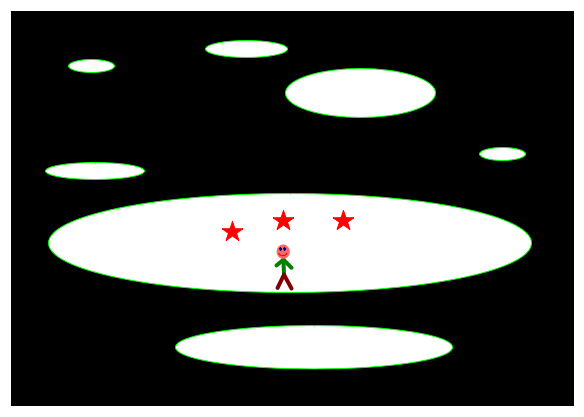 |
Universes tend to happen from time to time!
Note (not for the first time) a failure of language: if the universe is everything, we can't talk about many universes. Hence the multiverse
We have seen that gravity curves space: in a sense, this is going to a larger number of dimensions.
| Kalusza-Klein showed that one could include electromagnetism along with gravity by adding a fifth dimension, but making it compact |  |
| If we have more dimensions which fold up on themselves, is there any particular reason that the "compactification" is unique | 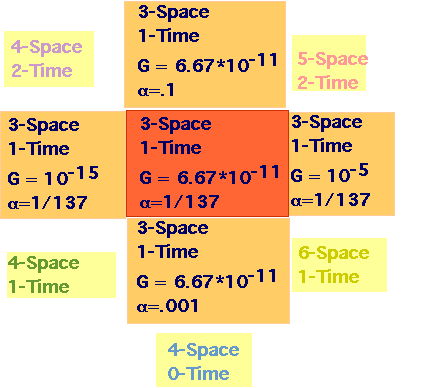 |
In the beginning, God created the heaven and the earth. And the earth was without form, and void; and darkness was upon the face of the deep. And the spirit of God moved upon the face of the waters.