
I think I can safely say that nobody understands quantum mechanics. Richard Feynman.
|
|
I think I can safely say that nobody understands quantum mechanics. Richard Feynman. |
Heisenberg 1927
If an electron is a wave, how can we define its position?
Uncertainty in position δx = Lbut there is also an uncertainty in momentum δp~2p~2h/λ=h/L |
 |
δxδp = L h/L = h
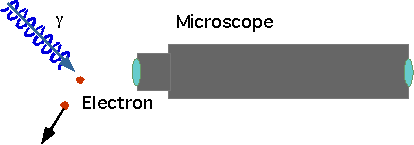
δx >λSo decrease wavelength to get position better, but photon carries momentum p=h/λand some of it gets transferred |
|
δx δp >λ(h/λ) >h
This is a fundamental limitation on human knowledge: can always do worse but cannot do better!
δE δt > h
| 0.08s |
| 0.33s |
| 2.00s |
| 5.00s |
We choose to examine a phenomenon which is impossible, absolutely impossible, to explain in any classical way, and which has in it the heart of the quantum mechanices. In reality it contains the only mystery...Any other situation in QM, it turns out, can always be explained by saying, "You remember the case of the experiment with the two holes? It's the same thing." Richard Feynman, the Characeter of Physical Law
| Since the electron behaves as a wave, can do a Young's slits type experiment, and get usual 2 slit interference pattern: |  |
| Remember: it builds up as discrete events |
| Suppose we close off one slit: | 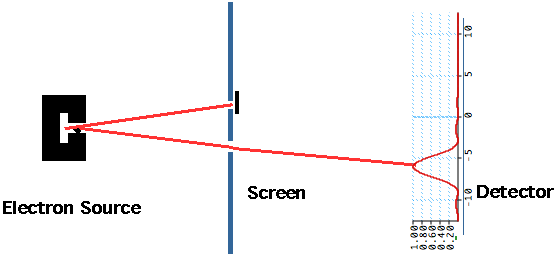 |
| Suppose we close the other slit: |  |
| Note when we add together two one slit patterns, we do not get two-slit patterns. |

|
There was a young man who said "God
Must think it exceedingly odd
That this tree
Continues to be
When there's no one about in the Quad"
Kerner: Now we come to the exciting part. We will watch the bullet to see how they make waves ...The wave pattern has disappeared
Because we looked. Every time we don't look, we get wave pattern. Every time we look to see how we get wave pattern we get particle pattern
Hapggod (Tom Stoppard)
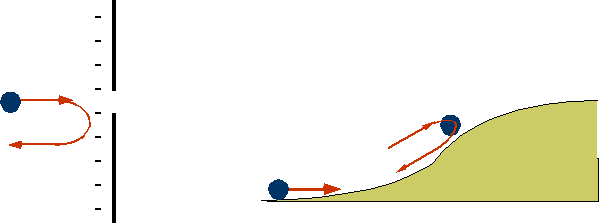
| slow electron is always reflected (low energy)
fast electron always goes over (high energy) |
 |
| Waves do not behave like this: they get partially reflected (remember what happens to light hitting glass). | 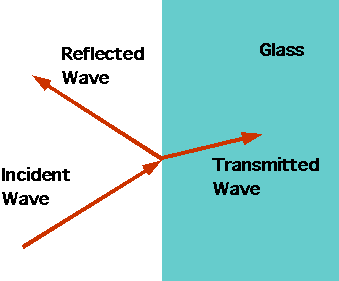 |
| If electron is literally the wave, | 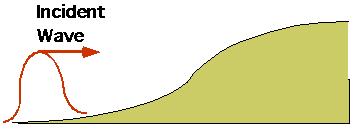 |
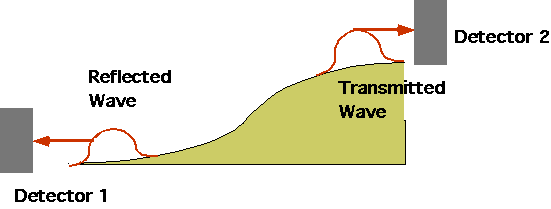
| this would imply we see 1/2 electrons | 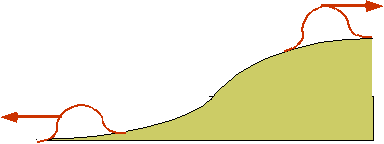 |
| e.g. for the electron in a box, in the first excited state | 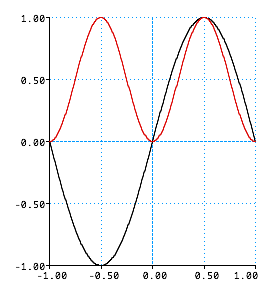 |
Probs must add to 1: P₁ = prob. that electron hits detector 1: P₂
= prob. that electron hits detector 2P₁ + P₂ = 1 |
 |
| If a ball rolls up to a barrier, it gets reflected. | 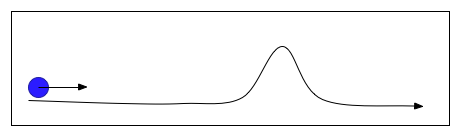
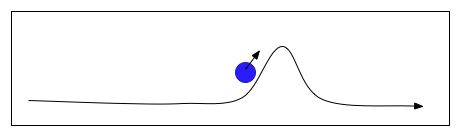
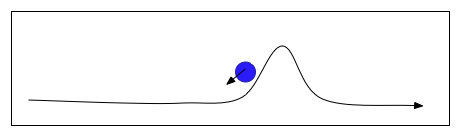
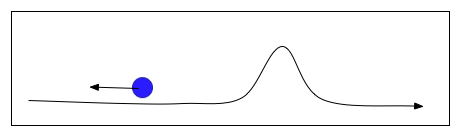
|
                     x
                     C
| e.g a H atom in the first excited state (n = 2)will decay to the ground (n = 1) state in about 10-10 s. and emits a photon | 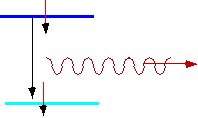 |
| Initially it is almost all the upper state |  |
| After some time it's a 50-50 mixture |  |
| Finally it is almost all the lower state |  |
| By measuring the atom, we can decide which of the two states it is in | 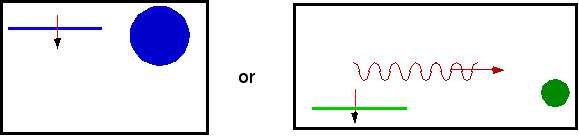 |
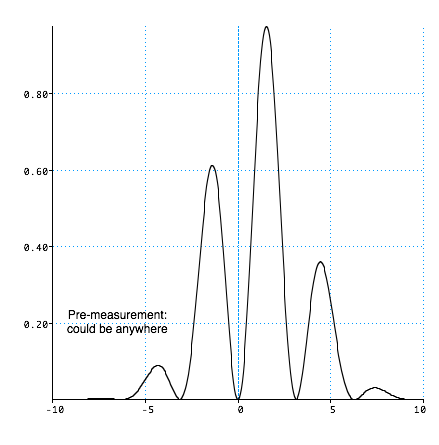
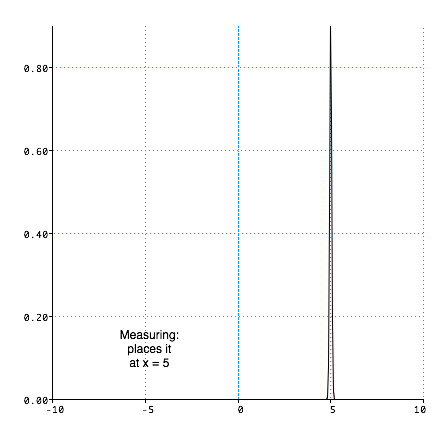
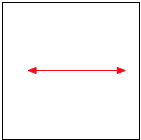
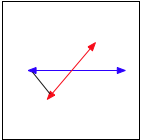
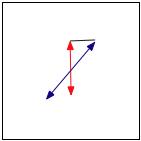
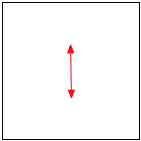
| e.g. consider light going through 2 sheets of polaroid at 90°. | 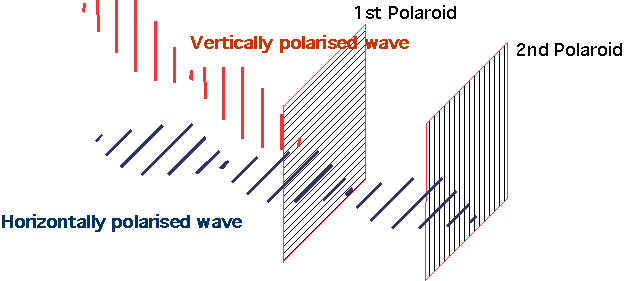 |
|


|
| Now insert a third sheet at 45° between the two | 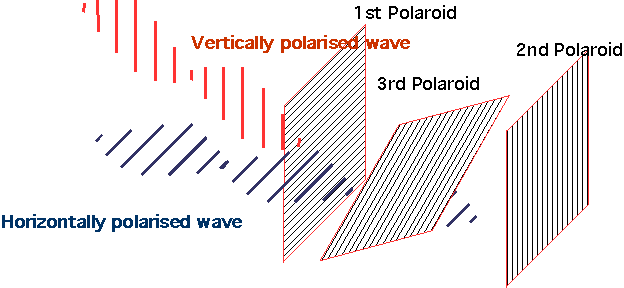 |
They said, "You have a blue guitar,
You do not play things as they are."
The man replied "Things as they are
Are changed upon the blue guitar."
Wallace Stevens
| E.g. go back to our wave function example: | |
| This seemed to say that the electron gets split in half, but we interpreted it as a probability. | |
| We can have a particle with no spin which decays into 2 particles with spin | 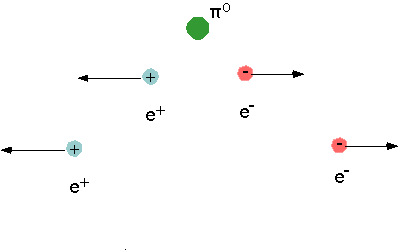 |
| There are two possibilities for the way the spins can arrange themselves: up-down |  |
| There are two possibilities for the way the spins can arrange themselves: down-up |  |
| Quantum Mechanic It is indeterminate until you measure them | 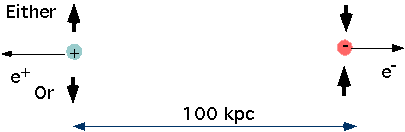 |
God does not play dice. Einstein
| suppose there is a particle which "is" a cylinder, |  |
| but we can only see it as square |  |
| or round |  |
| depending on the observing angle from a detector | 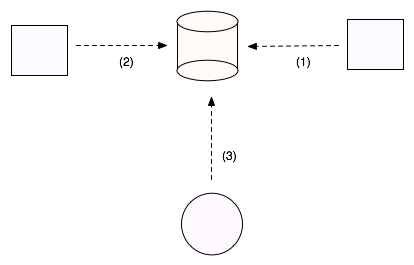 |
| Create two of these, send them in opposite directions. | 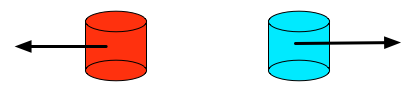 |
| Look at them with two detectors: If the detectors are set at the same angle, must always measure same shape |  |
| Look at them with two detectors: If the detectors are set at random angle, they will measure same shape 1/2 of time | 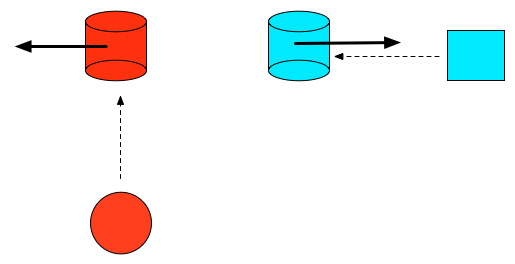 |
| EPR thought the states must be separate | 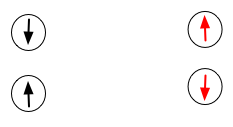 |
| They are actually one "entangled" state | 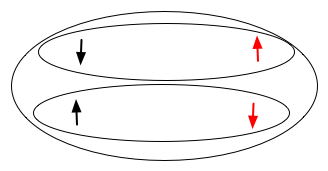 |
| and a measurement destroys it: e.g. | 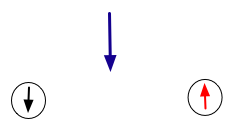 |
| The trivial version: you have a box, with a lid: when it is opened, cyanide gas is released. |  |
| The sophisticated version: you have a box, with a lid and a single radioactive atom: when the atom decays, cyanide gas is released. | |
God not only plays dice, but throws them where they cannot be seen. Hawking
or the "watched pot effect":
| Qubit is Quantum bit: can be encoded in (e.g.) spins
\color{red}{
\psi = \alpha \left| \uparrow \right\rangle + \beta \left| \downarrow \right\rangle }
Classical bit corresponds to poles, qubit to any point on sphere: hence contains much more info
|
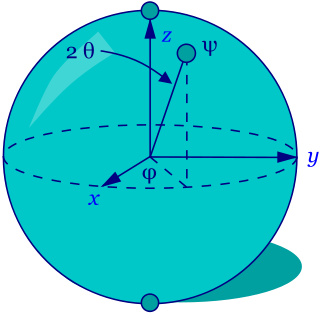 |
| Many-worlds theory: Everett (1957) . Every time a measurement is made, the universe subdivides into separate universes that correspond to every possible outcome | 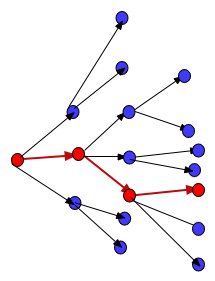 |
| Avoids observation problems, but not testable (?) and not very economical! | 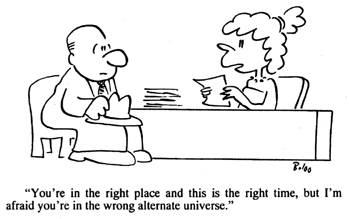 |
In all fictional works, each time a man is confronted with several alternatives, he chooses one and eliminates the others; in the fiction of Ts'ui Pên, he chooses-simultaneously-- all of them. He creates in the diverse way, diverse futures..which themselves also proliferate and fork. The Garden of Forking Paths, Borges.
What might have been is an abstraction
Remaining a perpetual possibility
Only in a world of speculation.
What might have been and what has been
Point to one end, which is always present.
Footfalls echo in the memory
Down the passage which we did not take
Towards the door we never opened
Into the rose-garden.
T. S. Eliot (Burnt Norton)
Quantum mechanics is correct, and there is no "simpler" system
Reality is even uglier than we thought: e.g.
I can only say, there we have been: but I cannot say where.
And I cannot say, how long, for that is to place it in time.
T. S. Eliot (Burnt Norton)