
The scientific approach to the examination of phenomena is a defence against the pure emotion of fear....This made for a kind of harmony and confidence. The sun came up about as often as it went down, in the long run...
Tom Stoppard, Rosencrantz and Guildernstern are Dead
The most remarkable discovery made by scientists is science itself
If I have seen further than other men, it is because I have stood on the Shoulders of Giants.
Isaac Newton
There are things we know that we know.... there are things that we know we don't know. ....... There are things we don't know we don't know. ..... And each year, we discover a few more of those unknown unknowns.
Donald Rumsfeld
An objective reality is assumed, which is not altered by one's viewpoint
Reality: what a concept!!
Robin Williams in Mork and Mindy
...........human kind
Cannot bear very much reality.
T.S. Eliot, Burnt Norton
Essentia non sunt multiplicanda praeter necessitatem (Entities are not to be multiplied beyond necessity)
William of Occam
Hypotheses non fingo
Isaac Newton
(although he was lying!)
Everything Stops
There is something fascinating about science. One gets such wholesale returns of conjecture out of such a trifling investment of fact.
Mark Twain
The distinguishing characteristic of a traditional folk game is that although it has rules they are not written. Nobody knows exactly what they are. The players have a tradition to guide them, but must settle among themselves the details of how to play a particular game.
One Potato, Two Potato: the Secret Education of American Children, Mary and Herbert Knopp.
God is subtle but he is not malicious (Einstein)
Wind is caused by trees waving their branches (Ogden Nash, see also G. K. Chesterton)
A♣ K♥ 10♣ Q♦ 5♣ 6♥ 2♠ 6♦ 2♣ 7♦ 3♣ J♥ 9♠ K♠ 6♦ J♣ 2♥ 8♣ 3♦ 4♣ 7♥ ..................
It must be possible for an empirical system to be refuted by experience. Karl Popper
Note it is often assumed that there is another meta-rule "The universe is constructed in such a way that we can understand it". There is NO basis for this rule: so far we have just been lucky, but wait till we hit quantum mechanics!
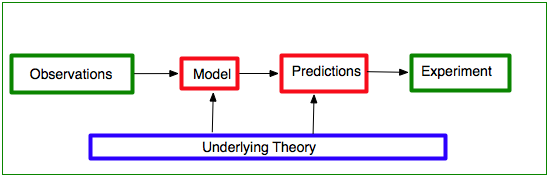
|
|
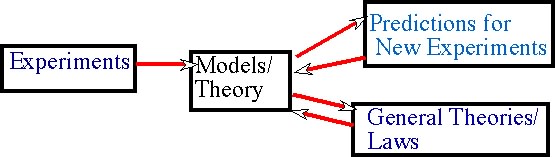
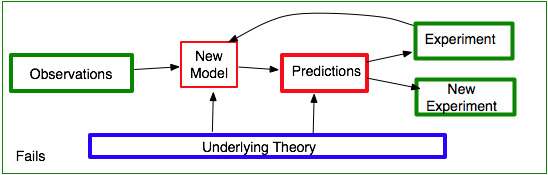
| The logical flow should be: |
|
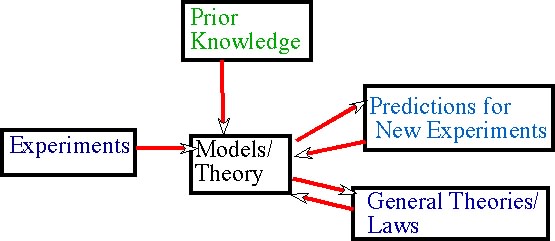
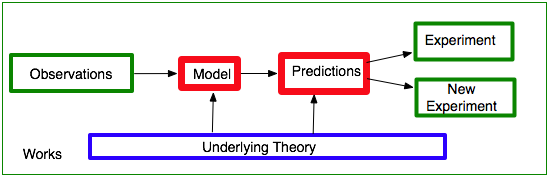
| In fact it is always more complex than this ideal |
 |
Success in research needs the 4 g's: Gluck, Geduld, Geshick und Geld. (Luck, Patience, Skill and Money) (Paul Ehrlich)
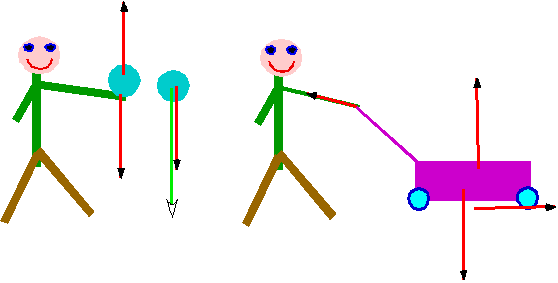
First get your facts, then you can distort them at your leisure (Mark Twain)
It is contrary to reason to say that there is a vacuum or a space in which there is absolutely nothing. Descartes
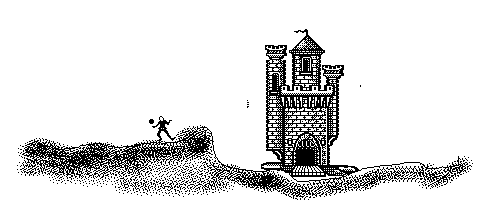 |
Ball will have air resistance, gravity will vary, sun and moon will attract ball, ball won't be a perfect sphere................. |
 |
Note that the world has become an infinite flat plain,we have ignored air-resistance, the child is irrelevant..... |
| e.g for a satellite in orbit, we need to consider the earth as a perfect sphere, 6500 km in radius | 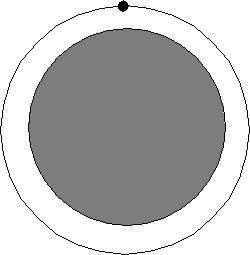 |
| e.g for the earth in orbit around the sun, we need to consider the earth as a point with some mass | 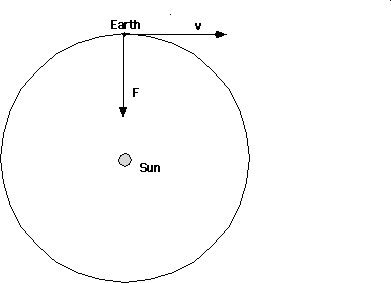 |
What is an electron?
e.g
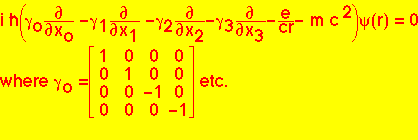
| But for a model of an electron:: A model is a spinning ball of negative charge | 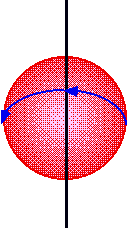 |
Note: this is not reality, but a convenient crutch for thinking!!!!
..Any picture of the atom that our imagination is able to invent is for that reason defective. AN understanding of the atomic world in that primary sensuous fashion ..is impossible. Heisenberg
| This is a computer generated event for the ATLAS detector showing a mini-black-hole being created and decaying. | 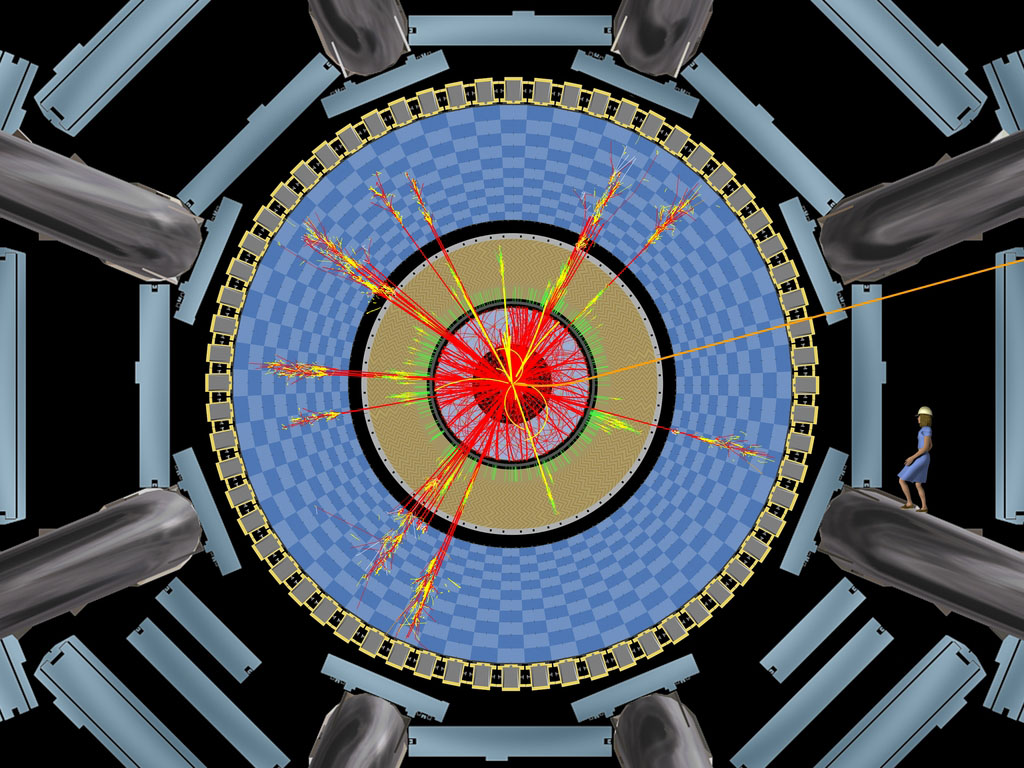 |
There are more things in heaven and earth, Horatio,
Than are dreamt of in your philosophy.

 .
.
What do dreams mean?
"In fact even the realization that meteors seen in the heavens are associated with stones falling from the sky is very recent. The French Academy appointed a committee, led by the chemist Lavoisier, in 1772, to consider the reports of stones falling form the sky, and published such a damning report that museums were persuaded to throw away their specimens. Only around 1800 were the "thunderstones" accepted as real, following anecdotal reports that involved a whole town, and thus were difficult to ignore." |
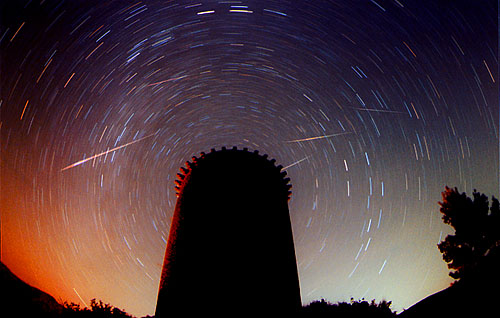
|
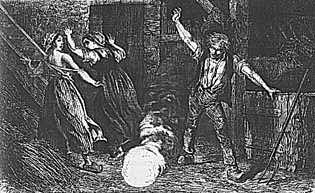
e.g. "Quite suddenly we were aware of a large sphere (I think coloured blue and 60 cm in diameter), traveling very rapidly towards us. It struck the ground a few yards from us with a loud explosion" |
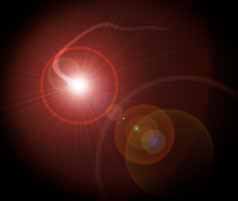 |
"One flash seemed to produce a small fireball which came form outside and entered one of the ventilating windows... the ball was of greenish colour, about 13 cm in diameter and was visible for long enough for me to leave the steel and stand on a wooden climbing board. The ball did not strike the steel supports but moved between them" Several thousand reports of ball/globe lightning (kugelblitz) |
 |
| usually produced in thunderstorm | 75% |
| usually decay with explosion | 60% |
| usually spherical | 90% |
| size | 23 ± 5 cm |
| lifetime | 8 ± 2s |
| brightness | 100-200 W |
| Energy Density | 500 J/cm3 |
| Colour..... | very variable |
More dubious (factoids!)
138 models of the nature of ball lightning
i.e. we don't know what it is!
| Periodic Table and Mendeleev [1869] (Needs quantum mechanics to understand it 1925) | 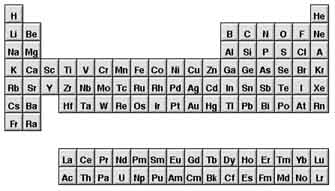 |