How do we know what is "right" in Science
We can learn a lot by looking at the history of wrong ideas. In many cases, the wrong ideas have simply been forgotten. Also, correct ideas have taken a very long time to be accepted. Usually the scientific method works in the end, but prejudice, preconceptions, racism and plain stupidity have hindered scientific progress.
Examples include
- The Ptolemaic Model of the Solar System
- Lysenko and Acquired Characteristics
- Wegener's Theory of Continental Drift
- Freud and Psychoanalysis
- Maclintock and Jumping Genes
- Pons-Fleischmann and Cold Fusion
- Velikovsky and the Solar System
It is not possible for every generation of scientists to check every result, so the question is "why do we believe what we believe?"
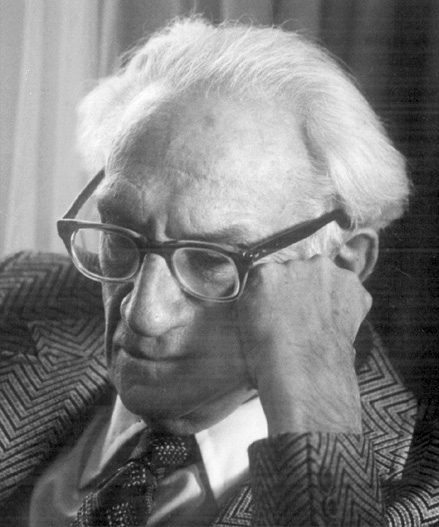
Immanuel Velikovsky
Born Moscow 1895
M. D. 1921
Psychoanalysis Tel Aviv in 30’s
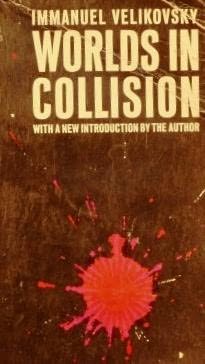
Worlds in Collision (Doubleday 1950)
Earth In Upheaval (Doubleday 1955)
AAAS (American Association for the Advancement of Science) debate with Sagan, Goldsmith, Mulholland (1974)
Honorary degree (Lethbridge, 1978)
Died 1985 |
 |
Immanuel Velikovsky
Thesis: Basic 'experimental' input is vast array of myths from many cultures. These represent the incomprehensible as seen by primitive man, and hence can be interpreted as historically accurate data. Note there is a lot of evidence that even trained observers are incapable of seeing novel phenomena for what they really are.
Secondly: many myths tell the same story: e.g., many peoples tell of magical food falling from the sky.
- Manna that sustained the Israelites,
- Morning dew in the Icelandic Eddas,
- Honey from the clouds in the Rig-Veda of the Hindus,
- Honey from the clouds in the Finnish Kalevala,
- Hera, symbolizing the Earth, was shrouded in ambrosia,
- Maori legends have two magical dews, the heavy for eating and the light for drinking.
All these seem to be associated in the legends with times of great upheaval and darkness
Immanuel Velikovsky
Velikovsky extracted the common features, and welded them into a history of primeval disasters.
- e.g. Exodus:
10 plagues of Egypt
- Nile turned to blood
- Plague of frogs
- Plague of Lice
- Plague of flies
- Death of Cattle
- Plague of Boils
- Plague of hail
- Plague of locusts
- Plague of darkness
- Death of first-born
- Parting of Red Sea
- Provision of Manna in the desert
- Pillar of cloud by day, a column of fire by night
Immanuel Velikovsky
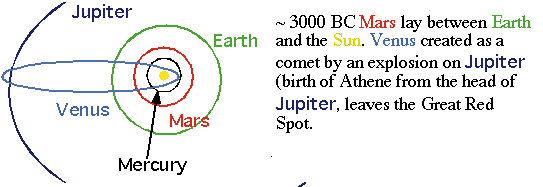
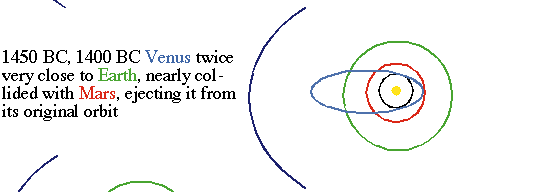
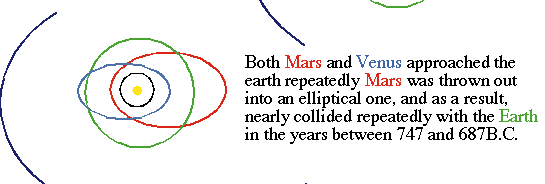
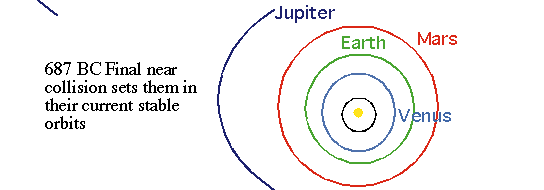
The Model
Immanuel Velikovsky
Analysis: the Biblical story of Exodus.
E.g. 10 plagues of Egypt
- First entry into comet’s tail: ferric dust precipitated, poisons rivers, Babylonian myths have the blood of the monster Tiamat poured upon the earth⇒
- Nile turned to blood
Warmth of the comet's tail ⇒
- Plague of frogs
- Plague of Lice
- Plague of flies
Meteorites from cometary core: Annals of Cuahtitlan "sky rained, not water, but fire and red-hot stones" ⇒
- Death of Cattle
- Plague of Boils
- Plague of hail
- Plague of locusts
- Plague of darkness
Immanuel Velikovsky
Interaction with Venus caused earth’s axis to be stopped and permanently shifted: Iran saw a 3-fold day and 3-fold night, Chinese legends speak of a holocaust during which the sun does not set for several days and the land was aflame ->
Death of first-born
Earthquakes triggered by Venus first drain Red Sea and then trigger tsunamis, which drown Egyptians ⇒
Parting of Red Sea
Hydrocarbons from comets tail are tuned into carbohydrates by bacterial action, allows survival of the Israelites in the desert
Provision of Manna in the desert
Earthquakes and volcanoes triggered by Venus ⇒ volcanic explosions and earthquakes ->
>Pillar of cloud by day, a column of fire by night
| Eruption of Mt. Thera on Santorini destroyed the Minoan civilization on Crete: (Knossos is 120 km away). First explosion on scale of Mt. St. Helen, deposited ash over the eastern Mediterranean, followed perhaps 20 years later by a "paroxysmal eruption" which produced catastrophic tsunamis.
Atlantis legend: a land of great natural wealth and advanced civilization that sank beneath the waves in a single day and night of misfortune. Plato gave Atlantis dimensions of 200 kilometres by 400; pre-eruption Santorini was about 20 x 40.
Huge cloud of dust from Santorini had worldwide effects, extending as far as China, where the beginning of the Shang dynasty also dates from ~1620 B.C. |
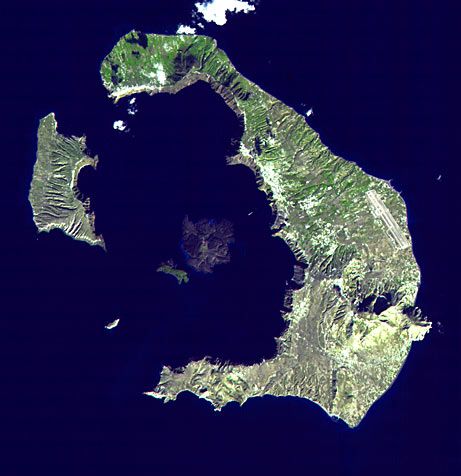
Image courtesy NASA/GSFC/METI/ERSDAC/JAROS and U.S./Japan ASTER Science Team |
Immanuel Velikovsky
But Velikovsky predicts much more:
|
Prediction |
Velikovsky |
Astronomy |
Observation |
V |
A |
|
|
Temperature of Venus |
Hot |
Same as Earth |
800°C |
1 |
0 |
|
|
Cooling of Venus |
Still cooling |
Static |
Prob. static |
0 |
0.5 |
|
|
Clouds of Venus |
Hydrocarbons |
Not known |
Sulphuric acid |
0 |
0 |
|
|
Atmosphere of Venus |
Very thick |
Earthlike |
50 atmos. |
1 |
0 |
|
|
Craters on moon |
Formed in 1450 B.C. |
Prehistoric meteors |
3 billion years old |
0 |
1 |
|
|
Radioactivity on moon |
Strong |
None |
Little |
0 |
1 |
|
|
Magnetism on moon |
Large |
None |
Evidence in rocks |
1 |
0 |
|
|
Jupiter's temperature |
Hot |
Cold |
Clouds cold, Core Hot |
0.5 |
0.5 |
|
|
Radio waves from Jupiter |
Yes |
Never thought of it! |
Seen 1958 |
1 |
0 |
|
|
Jupiter's atmosphere |
Chlorine and sulphur |
? |
Both present |
0.5 |
0 |
|
Immanuel Velikovsky
|
Magnetic reversal |
850 B.C. |
No recent ones |
Maybe in pottery |
0 |
0.5 |
|
|
Martian atmosphere |
Argon/ neon |
Nitrogen, oxygen |
Carbon dioxide |
0 |
0 |
|
|
Total |
|
|
|
5 |
3.5 |
|
it is hard to escape the conclusion that, if we are to judge a scientific theory by its results, conventional astronomy is marginally worse.
Immanuel Velikovsky
- Astronomers at Harvard suppressed the publication of Worlds in Collision, by forcing Macmillan's to reject the book, with the threat that no more academic textbooks would be sent to them for publication.
"frankly, …the publication must cut me off from the Macmillan Company" Howard Shapley, Director Harvard Observatory (Jan 1950)
- Rights transferred to Doubleday
"Several attempts have been made to link such a move to stop the book’s publication to ..the Harvard Observatory. This idea is utterly false" Howard Shapley (Sept 1950)
"This was not only immoral, but a blunder." Isaac Asimov.
- Then why are Velikovsky's ideas unacceptable?
- The short answer is that his solar system doesn't conserve energy, or momentum or angular momentum. So back to reality!