75.223 Astronomy: The Solar System: The Earth-Moon System
The Earth-Moon system should really be regarded as a double planet system.
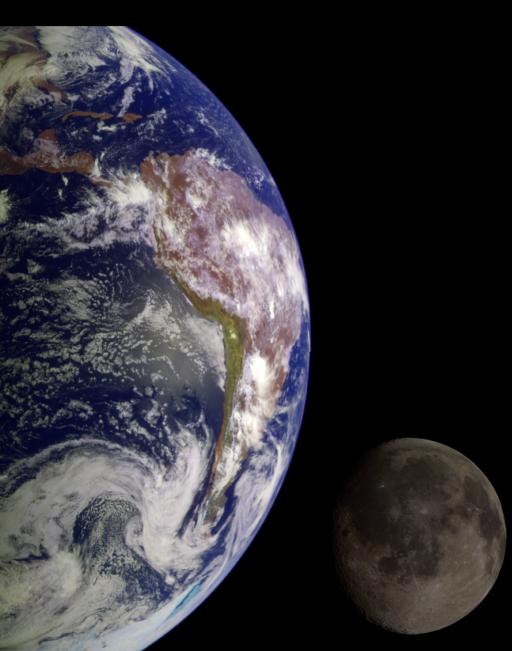
The earth and its moon, as photographed by the Galileo probe on its way to Jupiter.
The Earth
The surface is rather anomalous, since it is heavily weathered (e.g. few craters). Weathering is due to the abundance of water near freezing, and also to strong winds which result from rapid rotation of the planet.
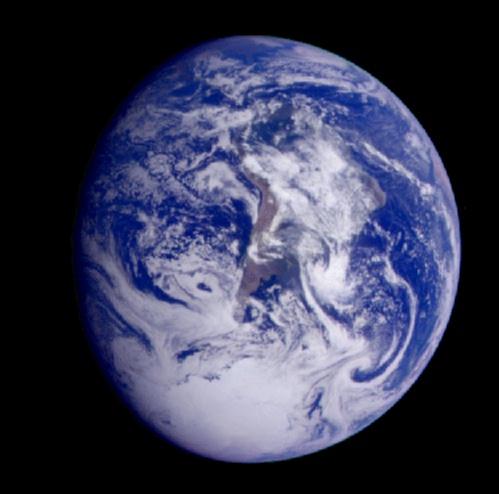
For the surface rocks, ρ ∼ 3500 kg/m³, dated to 3.5吆9 years
Consider earth's geology (as a model for other planets)
The crust is thin (35 km), floating on the mantle. A liquid core of Ni-Fe (∼ 3500km). (There may be a solid centre ∼ 1300 km)
Overall, ρ ∼ 5.5 gm/cm³
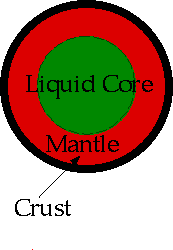
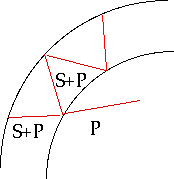
Earthquake Waves:
P (Compression) waves are transmitted through the core, mantle and crust.
S (Shear) waves are only transmitted through the mantle and crust (liquids cannot support shear).
The crust-mantle interface is sharp (mohorovicic discontinuity), as shown by earthquake waves.
The core is molten, due to heat from radioactive decays. The temperature rises 1°/100m.
Power ∼ 2 W m-2 at the surface, but is sufficient to cause the lower mantle to be semi plastic.
Convective motion of the core produces the earth's magnetic field.
The Moon
Radius = 1738 km
Lunar orbiters studied the moon from 1960.
Apollo missions to the moon from 1968.
The moon has no atmosphere.
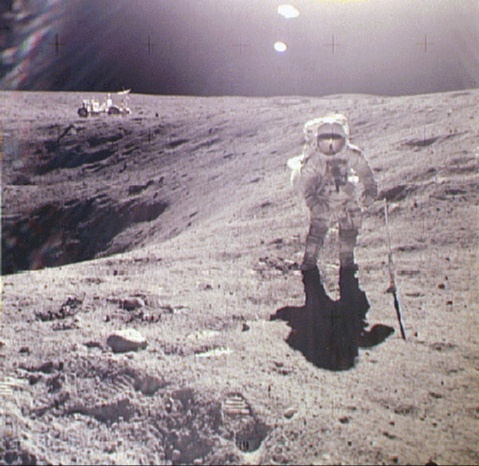
An Apollo 16 astronaut stands near the rim of Plum Crater (30m, or over 200 yards, in diameter) on the moon. Courtesy NASA
Maria are large dark areas on the moon.
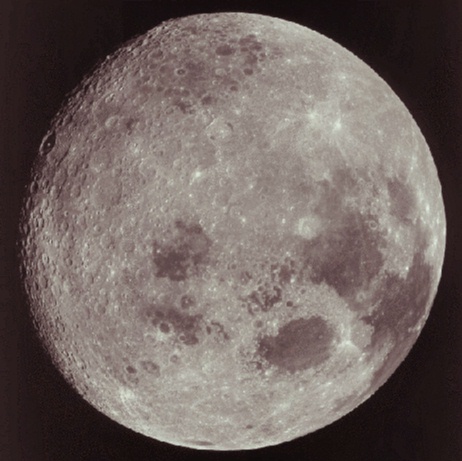
Mountains up to 10,000m (Appennines).
Craters typical.
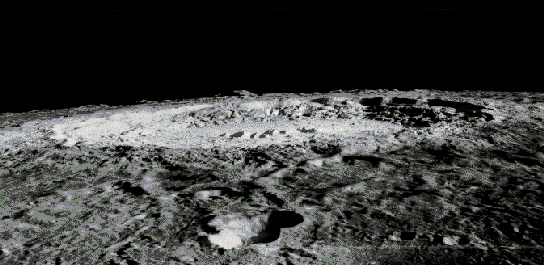
Craters Tycho, Copernicus here, Clavius is 240km diameter.
Some are surrounded by rays, eg. Aristarchus
"Splash marks"
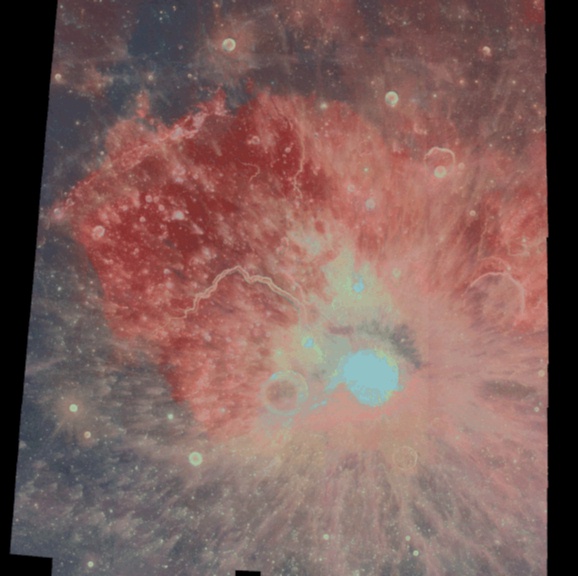
The Aristarchus region is one of the most diverse and interesting areas on the Moon. About 500 Clementine images acquired through three spectral filters were processed and combined into a multispectral mosaic of this region. Shown here is a color-ratio composite. The Aristarchus plateau is a rectangular, elevated crustal block about 200 km across, surrounded by the vast mare lava plains of Oceanus Procellarum. Clementine altimetry shows that the plateau is a tilted slab sloping down to the northwest, that rises more than 2 km above Oceanus Procellarum on its southeastern margin. The plateau was probably uplifted, tilted, and fractured by the Imbrium basin impact, which also deposited hummocky ejecta on the plateau surface. The plateau has experienced intense volcanic activity, both effusive and explosive. It includes the densest concentration of lunar sinuous rilles, including the largest known, Vallis Schroteri, which is about 160 km long, up to 11 km wide, and 1 km deep. The rilles in this area begin at 'cobra-head' craters, which are the apparent vents for low- viscosity lavas that formed vents for 'dark mantling' deposit covering the plateau and nearby areas to the north and east. This dark mantling deposit probably consists primarily of iron-rich glass spheres (pyroclastics or cinders), and has a deep red color on this image. Rather than forming cinder cones as on Earth, the lower gravity and vacuum of the Moon allows the pyroclastics to travel much greater heights and distances, thus depositing an extensive regional blanket. The Aristarchus impact occurred relatively recently in geologic time, after the Copernicus impact but before the Tycho impact.
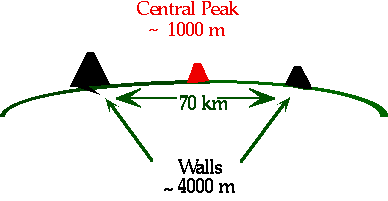
Most craters are meteoric in origin.
Meteors give craters of ∼ 2x radius.
Some evidence of vulcanism (domes and rilles).
Lava flows were produced by old impacts.
Probably by impacts which penetrated the crust when the core was still liquid (note half-buried craters).
Fewer craters in the maria.
Suggests they were formed  3.5 × 10⁹ years ago.
Back of the moon has no large maria, and more craters.
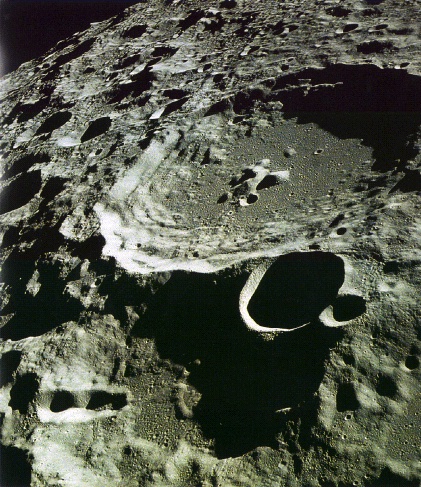
Rocks date to 4.0 × 10⁹ years
Rills are meandering cracks presumably produced by differential cooling, up to 1/2 mile across.
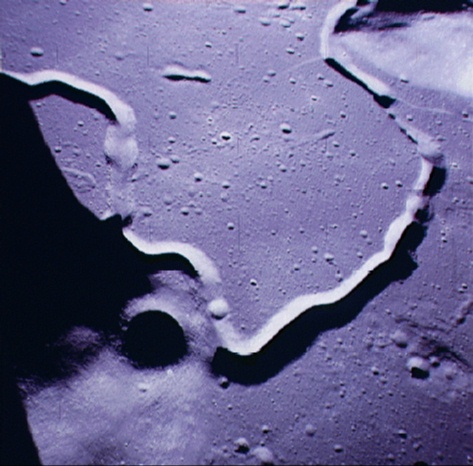
Molten basaltic lava cut this channel, known as Hadley Rille, through the surface of the moon. The channel winds along the base of the Apennine Front, one of the sites explored by the Apollo 15 astronauts. It measures 1500m (nearly 1 mi) wide, 400m (433 yards) deep, and 100 km (60 miles) long. The walls of the channel are very steep, with slope angles of 25 to 30 degrees. Courtesy Jet Propulsion Laboratory. Copyright (c) California Institute of Technology, Pasadena, CA. All rights reserved. Based on government- sponsored research under contract NAS7-1260.
Also Gorges and Valleys (eg Alpine Valley).
Moon Geology (Selenology)
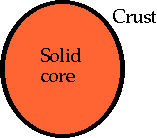
No magnetic field (<10-2 Gauss). Both S & P waves are carried. The moon "rings" when hit, implying it is a solid body now.
Consistent with cooling, from the calculated heat flow. Rocks mostly similarto earthly basalts.
On to the Inner Planets

paterson@physics.carleton.ca