
Distances to Galaxies: Steps out from earth,
| Astronomical unit≈1010m | 10 billion m or 8 light-minutes | |
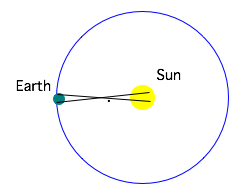
| Parallax of Individual stars | 1018m ∼ 100pc | |
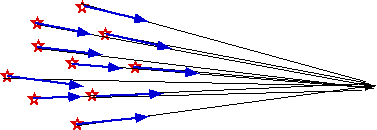
| Moving cluster method (flock of birds seem to be moving towards a point on the horizon) | 1019m ∼ 2kpc |
|
| Novae: smaller stellar explosions: this is Nova Cygni 1991 (expansion of shells) | 2kpc |
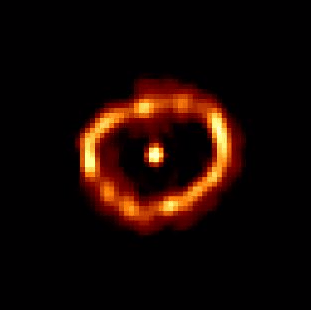
Nova Cygni 1992 Credit: NASA, ESA, HST, F. Paresce, R. Jedrzejewski (STScI) |
| Cepheids: supergiant stars which pulsate regularly, can be seen in M100 | 20 Mpc |
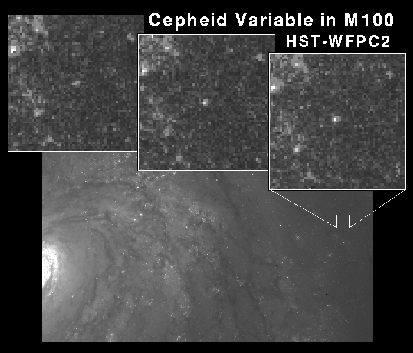 Credit: NASA, HST, W. Freedman (CIW), R. Kennicutt (U. Arizona), J. Mould (ANU) |
| Supergiants , Brightest Mv=-6 | 100 Mpc |
| Type 1a Supernovae Mv = -20 | 3000Mpc |
| Brightest galaxies in clusters | 1000 Mpc |
| Various methods overlap, but still some problems Uncertainty increases at large distances. |
 |
We have found about 108 galaxies. Galaxies cluster together into groups which appear to be gravitationally bound together
| This is the VIrgo cluster: over 1000 galaxies: 3 big ellipticals, including M87 at the bottom. Closest big cluster | 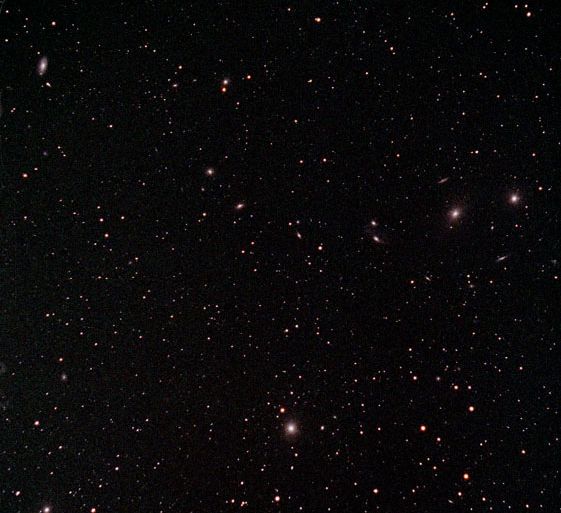 Galaxies Of The Virgo Cluster Credit & Copyright: Matt BenDaniel |
| This is the core of the Virgo cluster: M 84 and M 86 are the big ellipticals: also some small ellipticals and spirals |  Credit & Copyright: Jean-Charles Cuillandre (CFHT), Hawaiian Starlight, CFHT |
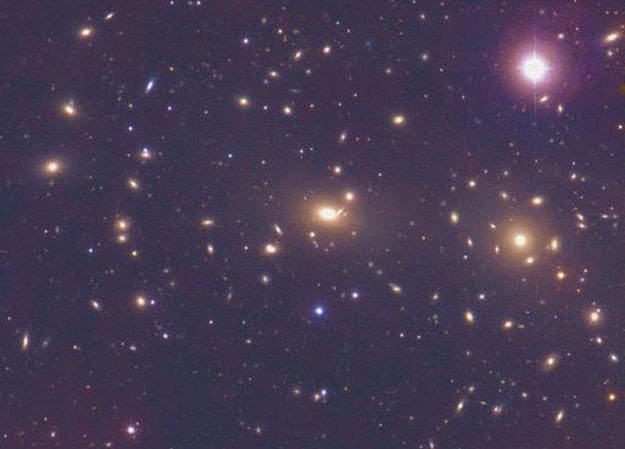
| Coma cluster contains at least 104 galaxies | |
| The Hickson cluster is a very small compact one | 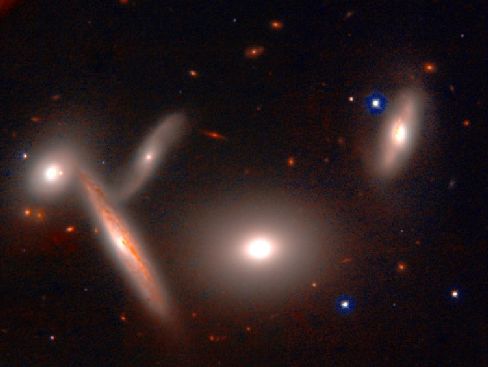 |
| Local group contains Milky Way & about 20 others
LMC & SMC 50 kpc |
 |
| Remainder of local group are almost all dwarf elliptical.
Closest component may be a dwarf galaxy "only" 20 kpc from us, in plane of Milky Way in Pegasus. Maffei I and II, seen as faint galaxies in I.R., but probably giant elliptical and spiral, probably at distance of 1-2 Mpc, and form their own group |
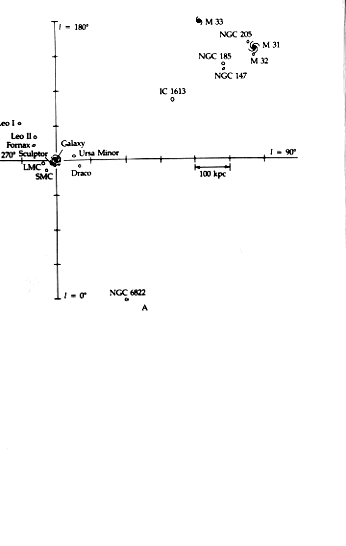 |
Regular clusters resemble globular cluster of stars: spherical symmetry and largest density of galaxies at centre. Usually contain mainly elliptical galaxies. Irregular do not.Local is typical irregular.
Study of clusters shows faint ones predominate, brightest galaxies have M ≈-23.
Doppler effect gives
z = λ-λ₀  =   1 -   original wavelength
        λ                 measured wavelength
Vel. of recession
v = zc =  cδλ
                λ₀
This formula isn't quite right: we can have z > 1: in fact the furthest known galaxy has z = 4.9. We have to use a relativistic formula in that case.
| Found in 1920's (Hubble, Humason, Slipher) that faint galaxies show a red shift: fainter the galaxy, faster the recession. |  |
| Hubble was able to measure distances to closer clusters and found that velocity ∝ distance | 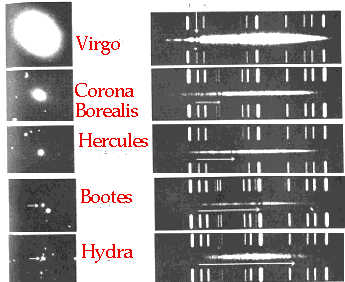 |
| v = H d H is Hubble constant: As measured by Hubble H = 550 km s-1/Mpc: Now we know H ~ 65 km s-1/Mpc : i.e. the average galaxy at 100 Mpc is receding at 6500 km/s |
 |
| Can look at clusters in z: unfortunately random ("peculiar") velocities distort picture | 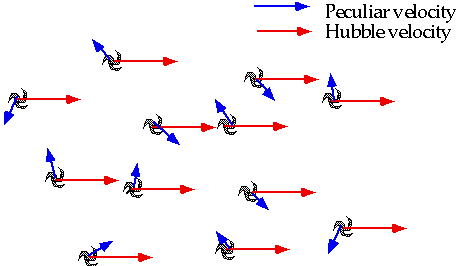 |
| For a single galaxy:
can only measure vel. in radial direction, so radial component of peculiar motion gets added on.t |
 |
| This distorts picture
Coma cluster is close together in space, but velocity dispersion spreads it out in z. |
.gif) |
Clusters appear to form
| local cluster together with Virgo and others form local super-cluster 100 Mpc. across |  |
Do superclusters cluster?
Or how is mass distributed on the largest possible scale?
Might expect Stars ⇒ galaxies ⇒ clusters ⇒ superclusters
becoming smoother at each stage
Instead of super-clusters being approx. spheres of clusters, we seem to see voids separated by clusters
| Voids are very empty: 1/100 th of the density of galaxies that might be expected |
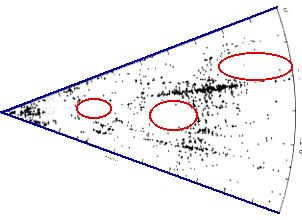 |
| Space is like a foam: voids are like empty bubbles |  |
A possible mechanism:
Universe stared off by being much denser. Early stars (pop III) would have been very massive & hence short-lived.
Collections of these could have formed, gone through supernova and compressed the gas along boundaries, which is the origin of the present day clusters
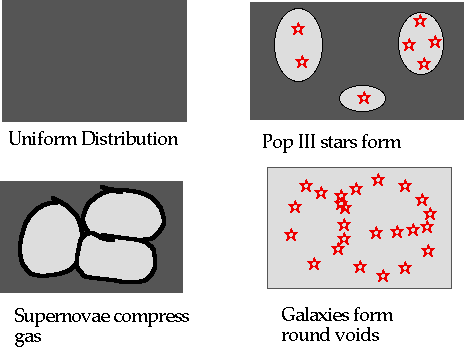
Would suggest that voids should be full of black holes.... No evidence Pop III stars ever existed....
But this is only the beginning: We have measured the position of at least 10 million galaxies.......
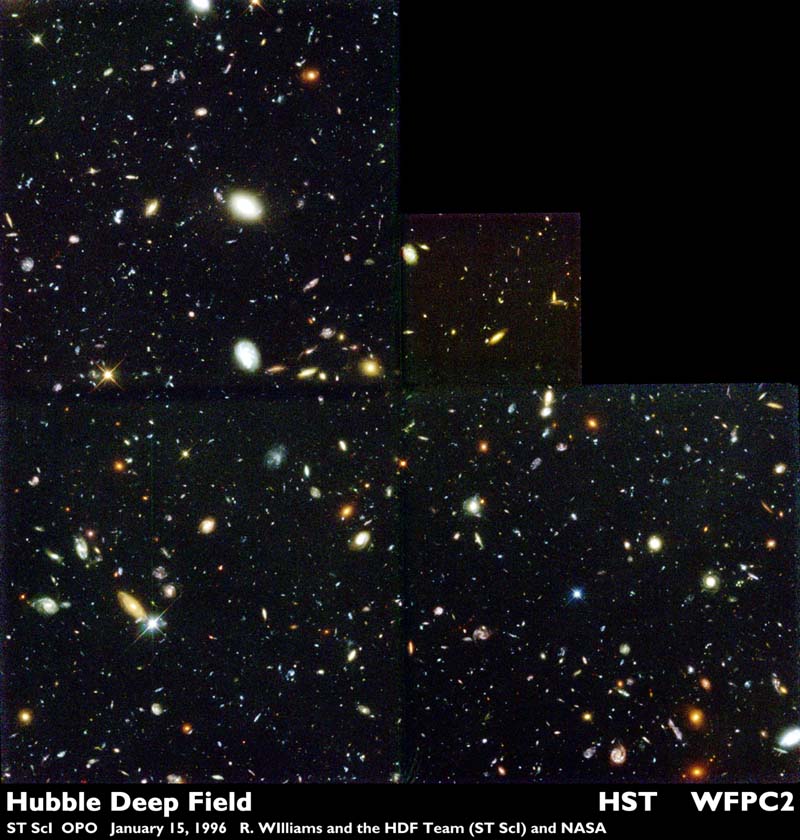 and we can go deeper
And further: this is a cluster of galaxies at a redshift of .5
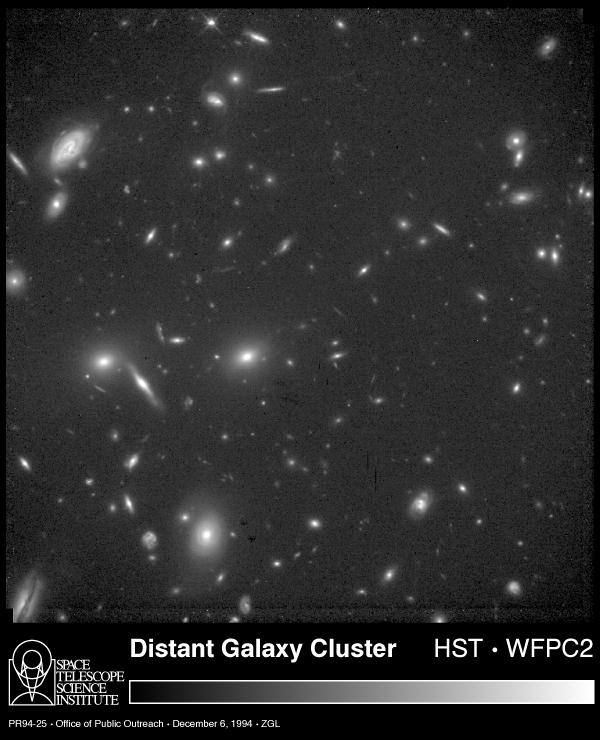
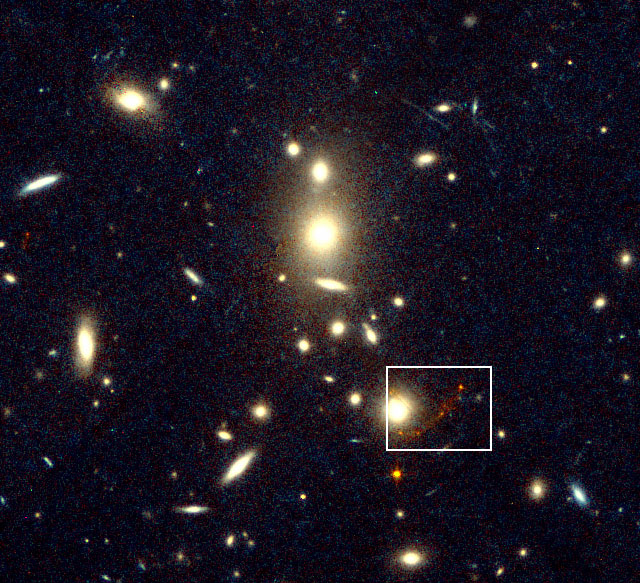
and further: this is a cluster of galaxies which is fairly close, but there the most distant galaxy known is buried in the picture