Essential Physics: Stellar Structure and Nuclear reactions
Stellar Structure
want to understand how stars "work":in particular
What powers a star?
Nuclear reactions: long preamble
requires a knowledge of the forces and particles involved, conservation laws and reaction rates.
Forces
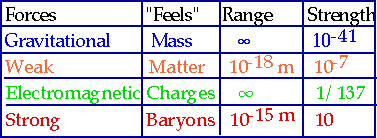
Strong force is the force that binds together nucleons to make nuclei, weak force is force that causes β-decay. Believe there are only 4 forces in nature
Note: "feels" means that this is what the force couples to: e.g. gravity does not care whether a particle is charged, only whether it has mass.
Range: if it is ∞ then F ∝ 1/r², else it cuts off at distance shown
Strength: roughly the relative strength of the forces at a distance of 1 fm.
Although (e.g.) strong force>>>E.M at 1 fm (=10-15 m), it vanishes totally beyond 10-14 m. E.M >>> Gravity, but it tends to cancel out since most matter is electrically neutral, whereas mass accumulates.
The weaker the force, the more particles feel it!
Particles
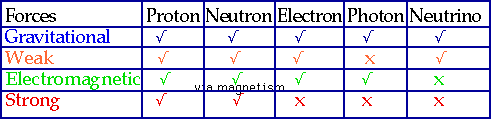
: of the 450 (or so) elementary particles, only 5 are important to astrophysics
Strength also gives us (very roughly) the depth that a particle will penetrate matter without interacting:
e.g. a proton will penetrate a few mm, a X-ray photon a few cm, a neutrino several parsecs!
Antiparticles:
For every particle, with given quantum numbers, there is a corresponding anti-particle with the properties flipped:
e.g. electron has charge -1.6x10⁻¹⁹ Coulomb.
Positron has same mass, charge = 1.6x10⁻¹⁹ C
Conservation laws
Mass-energy conservation:
Usually easier to quote elementary particle masses in terms of energy, measured in eV.
e.g. "mass" of electron \color{red}{m_e c^2 = 511keV}
Conservation of momentum:
Usually (from point of view of astrophysics) means that reactions are:
2 bodies ⇒ 2 bodies
e.g. \color{red}{p + n \to d + \gamma }
is allowed
\color{red}{p + n \to d}
(where the d moves off with the extra energy) is forbidden.
Conserved Quantum Numbers
Conservation of charge
\color{red}{
n \to e^ - + \gamma }
is forbidden: Algebraic sum of charges at end of reaction must = sum at start
note
\color{red}{
\gamma \to e^ + + e^ - }
is allowed
Conservation of baryon number:
The process
\color{red}{
p \to e^ + + \gamma }
is not forbidden by anything: however experimentally it does not occur:
No of (protons + neutrons) is always the same in a reaction:
Easiest to say that p & n carry baryon number B = 1, rest carry 0
Conservation of lepton number: Number of (electrons + neutrinos) is conserved
L is lepton number = 1 for electrons,
-1 for positrons
(\color{red}{{\bar \nu }}
means anti-neutrino: what is an anti-neutrino? one with L = -1).
note for later: in early universe these laws will turn out to be violated: conservation of energy and charge are absolute while baryon and lepton number can be violated
Conservation of angular momentum ("spin"):
Mainly important because some particles carry spin ½:
e.g. n ⇒ p + e- is not allowed since
½ ⇒ ½ + ½ requires creation of angular momentum.
Instead n ⇒ p + e- + ν
½ ⇒ ½ + ½ + (-½)
A bit more subtle than this, since we need to have orbital angular momentum added in
For later, we need to know something about "families". Easiest with leptons:
Lepton #
Charged lepton
Lepton mass
Neutrino
Sample Reaction
Le
e-
.511 MeV
νe
n ⇒ p + e- + ν̄e
Lμ
μ-
105MeV
νμ
μ- ⇒ e- + ν̄e+ νμ
Lτ
τ-
1784 MeV
ντ
τ- ⇒ μ- + ν̄μ+ ντ
How do we know there aren't more? LEP shows we have exactly 3.00 kinds of neutrinos
Why 3 families? We don't know!
Why the masses? We don't know!
How heavy are the neutrinos? Very small but not zero!
Nuclear Physics
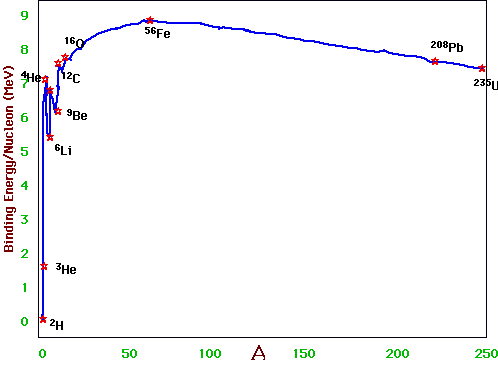
The only extra ingredient we need for astro-nuclear physics is the stable nuclei and their binding energies:
e.g. deuteron is stable: the state (pp) is not:
Rule of thumb: stable nuclei need
Number of protons ∼ number of neutrons
If a nucleus has too many neutrons, one will decay via \color{red}{n \Rightarrow p + e^ - + \bar \nu }
If it has too many protons, it will decay via \color{red}{p \Rightarrow n + e^ + + \nu }
Note that there are no stable elements of A = 5 or A = 8
As a rule of thumb, most reactions up to Fe are exothermic, any past that are endothermic
Since stars get their energy via fusion reactions the most important curve is binding energy vs A
(Put differently): fusion reactions can occur for light elements, since medium-heavy elements are more stable, fission reactions can occur for heavy elements.
How do stars work?
Why do stars need to be hot (or why is there no cold fusion?)
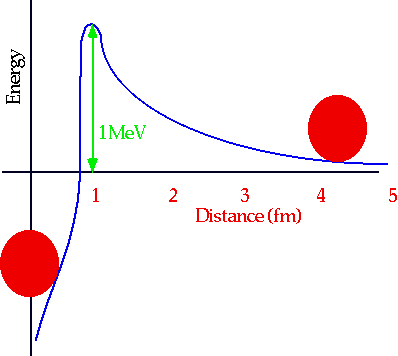
There is a large repulsive E.M. force at large distances between two protons: only if r < 1 fm is the force attractive (fm=femtometre =fermi =10-15m)
Height of this barrier is
\color{red}{E = \frac{{kZ_1 eZ_2 e}}{{R^2 }}}
Hence to "ignite" thermonuclear fusion, it would appear to need temp ~ 1MeV, for Z =1
using E = 3/₂ kT, gives T ~ 8x10⁹ K.
This is temp reached in H-bomb: however the sun can work more slowly! (Central temp is 13x106 K)
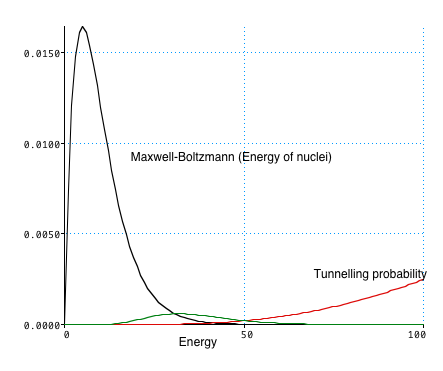
Quantum Mechanics tells us that particles can tunnel through barrier:
For a particle of given energy. Prob of tunnelling
P(E)~ exp(-1/√(E)) which gets larger for large E
However there are very few nuclei with this energy
Ignition Temp T₀~ 107K
Rates depend very strongly on temp and charge of nuclei: e.g. for pp,
R ~ T4
Star starts off as H + 4He: what reactions can occur?
\color{red}{
p + p \to ^2 He + \gamma }
can't occur, ²He doesn't exist
\color{red}{
p + p \to d + e^ + + \nu }
is the initial process
and is very slow (the ν has only weak interactions, and so the whole process must go by that)
Once past this, the reactions are simple:
\color{red}{
p + d \to ^3 He + \gamma }
\color{red}{
d + ^3 He \to ^4 He + p}
or various variations:
Most important is the "executive summary"
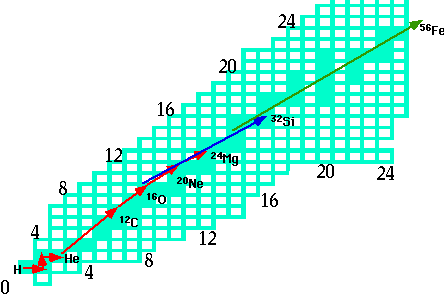
Past H burning, there are various processes that build up heavier nuclei: the crunch comes at A = 8:
8Be is unstable (τ ∼ 10-16 s) but
Triple-α process occurs:
\color{red}{
^4 He + ^4 He + ^4 He \Rightarrow \left[ {^8 Be} \right] + ^4 He \Rightarrow ^{12} C}
Since three particles are involved, Rate ∝ ρ² (Two body reactions ∝ ρ) Means only happens at high (>108K) temps and very high pressures
Beyond 12C processes add whole nuclei until we get to Fe