Longitude is measured around the surface of the earth, at the equator, from a point due south of Greenwich England.
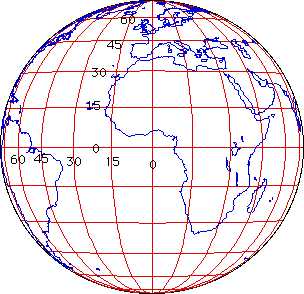

(Wikipedia Commons)
zero of latitude is fixed by the equator,
zero of longitude is fixed by international agreement.
| Latitude is measured as the number of degrees north or south of the equator. i.e. subtended angle at the centre of the earth
Longitude is measured around the surface of the earth, at the equator, from a point due south of Greenwich England. |
|
| Pretend we are surrounded by a "Celestial Sphere": this is an horizon based system (ie. what the earth bound observer sees).
A meridian is a North South line in the sky. The zenith is the point in the sky vertically above the observer. |
 |
Then we can describe the position of a star by its altitude/azimuth.
Declination is the angle measured from the earth's Equatorial plane (the same as latitude) so the north pole has a dec. +900. Stars which always lie to the north for observers at the equator have a δ > 00.
Note that 3600 of longitude (once around the globe) = 24 hrs of time,
Right Ascension (R.A. or α) is the equivalent of Longitude.
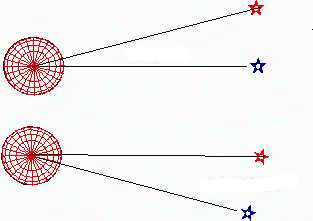
| The first star will rise, (say) 1.5 hrs before the second. After earth has rotated for 1.5 hours, second star is on the observer's meridian
The Hour angle = 1.5 hours. or \color{red}{\theta = 22.5^\circ } . In fact, we define hour angle as the time to cross the meridian. |
 |
The origin of R.A. is also arbitrary.
Earth's equatorial plane and the plane of the earth's orbit about the sun cross each other at any time along a line. Twice each year, the sun crosses the ecliptic. March 21 & Sept 22
| Zero of R.A. defined by position of the sun on March 21, the vernal equinox, | 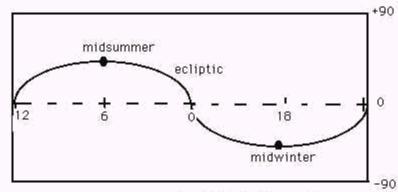 |
Stars in the midnight sky in midsummer have α of ~18 hours, which results from their being 180° (~12h) away from the sun's direction, and the earth's progress of about 1/4 of its way about its orbit (90° ≈ 6h).
Stars in the midwinter midnight sky in have α ~6 hours. R.A. is measured in hours and minutes.
Thus Sirius has R.A.= 6 hr 42.9 minutes, and δ = -16.39°.
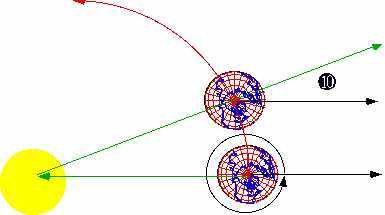
A solar day is the interval between two successive occurances of the sun being due south.
| A sideral day is the interval between two successive occurances of any star being in the same place in the sky.
1 solar day = 1 sidereal day + ~1/365 sidereal day. 1/365 day = 3.95' (minutes). |
 |
| The earth's spin axis is tilted with respect to the orbital plane. | 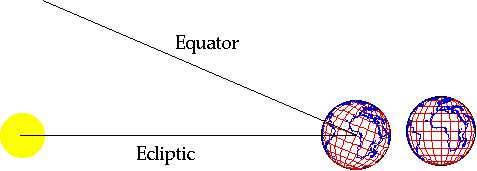 |
Aries, Pisces, Aquarius, Capricorn, Sagittarius, Scorpius, Libra, Virgo, Leo, Cancer, Gemini, Taurus.
| The Earth precesses, like a top. The cycle takes 26,000 yrs. | 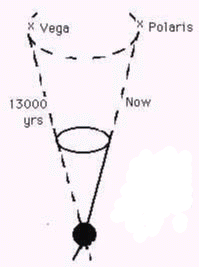 |
| The earth spins about its north-south axis. This axis does not stay fixed with respect to the stars in the sky, but rather it wobbles slowly like a child's spinning top. During this 26000 year period, the earth's spin axis traces out a cone in the sky. | 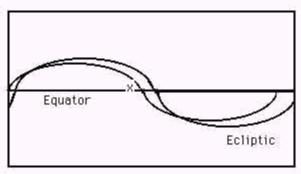 |
| The effect is to move the ecliptic (really, the plane of the earth's orbit is fixed, and the equator is what is tilting). |  |
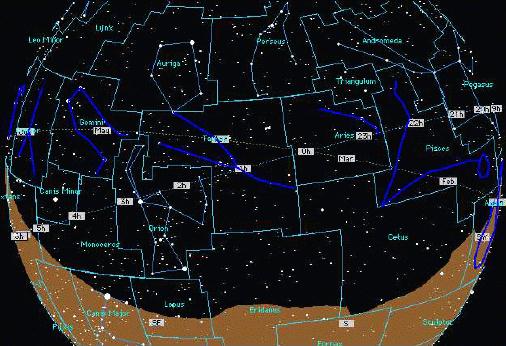
| Note the crossing of the celestial equator and the ecliptic in Aries, as was the case for the Babylonians 3600 years ago. 26000/12 ~ 2200 yrs/Constellation
The crossover was previously in Aries (1600 B.C.). It then moved into Pisces (0 A.D.) Now his is the dawning of the age of Aquarius. |
 |
|
 |
| objects that lie in the ecliptic are associated with the solar system: e.g. asteroids. This is 250 brightest | 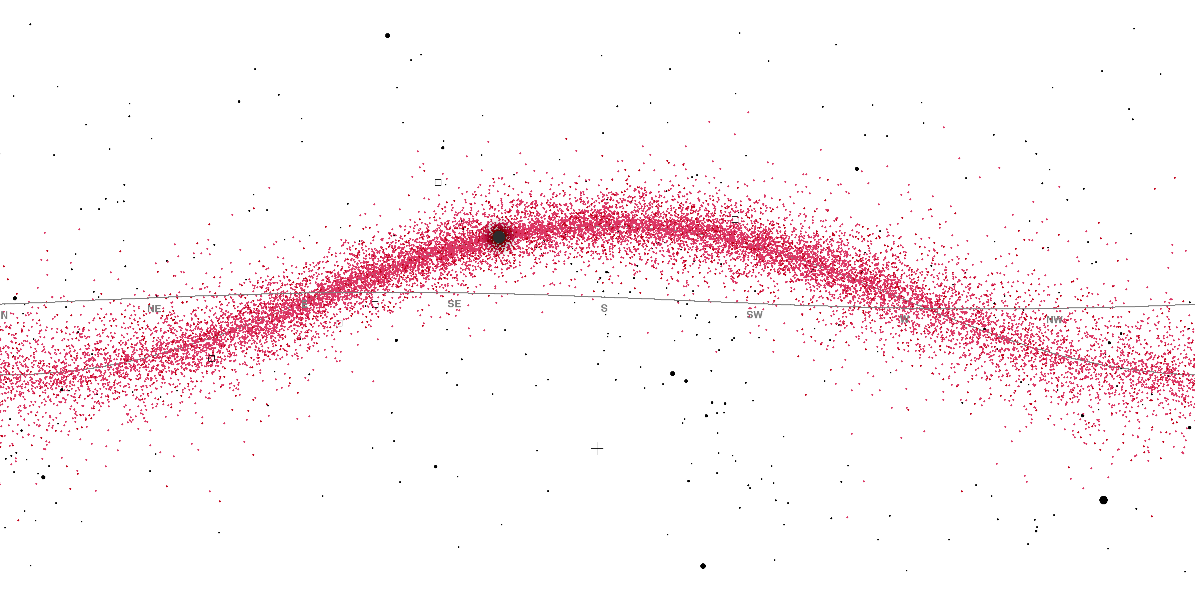 |
| Objects that lie in the galactic plane are associated with the galaxy (e.g. pulsars) |  |
| Objects that are randomly distributed are either close by (e.g. comets) or far away (e.g. γ-ray bursters [GRB's ]) |  |