

Monica Ladner-Gabney: solar spectrum from bus-shelter
| 99.9999% of our information about the universe comes as EM radiation: | |
| But light is part of the whole electromagnetic spectrum: wavelengths we can detect go from 10-16 m to 104m |  |
We "see" only one octave. Compare to sound, we hear (well, some of us!) 10 octaves (20Hz to 20000 Hz: middle C is at 252 Hz.)
| Why do we see so little of the spectrum? Answer lies in the transparency of the atmosphere. This ignores extra problems like clouds and "twinkle". |  |
In more detail: electromagnetic radiation tells us
Remarks apply to any part of the spectrum. Simplest spectrum is black-body: produced by any object above 0 K Note: we will always use Kelvin temp scale: 0 K ∼ -273°C
Stefan-Boltzmann Law:
black -> red -> orange -> yellow -> white -> blue
0°K -> 900°K -> 2000°K -> 5000°K -> 20000°K -> ... Wien's Displacement Law:
Combined in the Einstein-Planck radiation law:Intensity at a given wavelength
h = Planck's constant, c = speed of light
Graph shows the distribution of photon intensities due to a radiating block body at the temperatures of 2500K, 4000K, and 5000K. Note that as the temperature increases
|
 |
Radiation from atoms and molecules. All atoms show same general features:
| Emission spectrum consists of bright lines on a dark background: e.g. sodium (Na). This gives the characteristic bright yellow colour of sodium lights (there are some other weaker lines) |  |
|
Usually in stars we see Absorption Spectra:
Dark lines on a rainbow continuum Note that lines occur at same place as in emission. |
 |
| e.g. Hydrogen: Easiest to understand theoretically and most important (H is 90% of universe by number). Line at 656 nm is responsible for red colour of (e.g.) nebulae in Orion . |  |
| Line at 656 nm is responsible for red colour of (e.g.) nebulae in Orion. (note the star colours in this picture are B-B colours!) |  |
When do we see spectral lines?
Boltzmann's constant: k = 1.38x10⁻²³J/K = 8.625x10⁻⁵ eV K-1
i.e. a gas molecule at room temp has an average energy of
This is described by Maxwell-Boltzmann equation:
| What does this look like? The Maxwell-Boltzmann distribution is shown here for three different peak temperatures, those being 650K, 800K, and 1000K. Note that as the temperature increases, the distribution becomes more broad, and the peak of the distribution declines in magnitude. |  |
A more complicated molecule has more degrees of freedom.
(...just what we need to bring us back to emission spectra...).
A useful rule of thumb: At the atomic level, nothing happens until the energy required is comparable to the average energy: say (say 1/10 E) e.g.:
The g's are "spectroscopic factors": can usually assume they are 1
Hence probability of first excited state of hydrogen (ΔE = -13.6+3.4 = 10.2 eV) and second state (ΔE = -13.6+1.51 = 12.1 eV).
|
 |
| Emission lines arise from an electron in an excited state decaying to one in a lower state |  |
| Absorption lines occur when all wavelengths are incident on an atom, and an electron can make a jump to a higher level. Hence H gas will absorb light from a continuum spectrum |  |
| Hence absorption occurs by removing a few wavelengths from continuum. |  |
| Need considerable optical depth of material, so difficult to show. |
where χ is the ionisation energy, m is the electron mass.
| What this means is that as the temperature increases, the electron is more and more likely to be removed from the atom. |  |
|
 |
But there is one more complication (you were surprised?). Ions can emit their own characteristic radiation, which has no relation to atomic spectrum. Also different ions of a given element exist at different temperatures. Nomenclature:
Note: pronounced this un-ionised, not union-ised!
Since considerable energy is required to ionise an atom many times, ionic spectra show high temperatures.
i.e. red Balmer line show up at 1/4 wavelength of H.
| A typical diatomic molecule shows a rotational spectrum. |  |
Binding energy small (H2 => 2H at 4eV), so molecules don't exist in stars (except for TiO) but do exist in dust clouds. Spectrum mainly in IR. Final line spectrum is
.
| Energy difference arises due to magnetic interaction of electron and proton (hyperfine interaction). |  |
| During the time taken to emit one wavelength, the emitter moves away a distance v ΔT, i.e. λ' = λ + v ΔT. Time taken to emit one λ is ΔT = λ/c. Hence$$ \color{red}{ \lambda ' = \lambda \left( {1 + \frac{v}{c}} \right),\nu ' = \frac{v}{{\left( {1 + \frac{v}{c}} \right)}}} $$ | 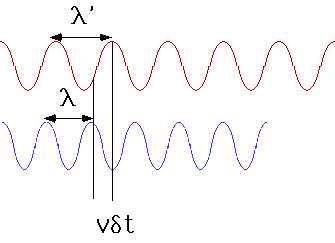 |
This is red-shift: v >0, λ' > λ and ν' < ν. This is only true if v << c: we might need the relativistic formula:
$$ \color{red}{ \nu ' = v\sqrt {\frac{{1 - \frac{v}{c}}}{{1 + \frac{v}{c}}}} } $$In general, define red-shift, z, via
$\color{red}{\lambda ' = \lambda \left( {1 + z} \right)}$ so $z = \frac{v}{c}$ for non-relativistic shifts, relativistically $$ \color{red}{ z = \sqrt {\frac{{1 + \frac{v}{c}}}{{1 - \frac{v}{c}}}} - 1} $$ Typically| Zeeman effect: Atomic levels become split in a mag field, since Electron in orbital acts like magnetic dipole |  |