|
|
Circular Motion: Body moving in circle at constant speed will accelerate towards the centre
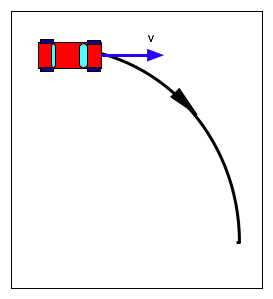
| Note constant speed does not mean constant velocity. e.g. consider a car travelling round a quarter circle, radius R, speed v | Car on a curve
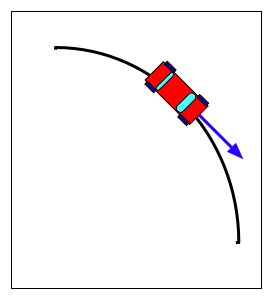
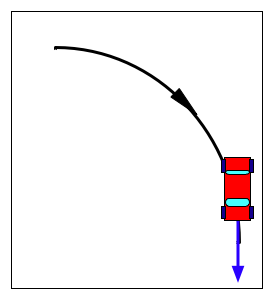
|
Dimensionally: must be combination of v and r that gives dimension of accn.
so that only possibility is |
a = v2 = (LT-1)2
    r     L
= L2T-2 = LT-2
   L
|
This is called centripetal accn. It is NOT centrifugal accn. (which is the apparent accn. that a body feels in a rotating frame of reference)
Centripetal force is force required for centrip. accn. It does not exist as a force in its own right: it has to be supplied by another force: e.g.
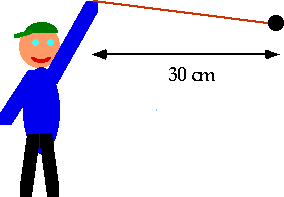
A kid whirls a stone around which is tied to a piece of string of length 50
cm. The string has a breaking strain of 20 N, and the stone weighs 400 gm. How
fast is the stone going when it the string breaks?
|
 |
A car rounding a corner on a flat road relies on friction to provide the centripetal force. e.g.
|
 |
Note that friction provides an acceleration here: the speed does not change
| On a banked curve, the friction can be replaced by the horizontal component
of the reaction e.g.for the car in the last example, what would the slope need to be so that there was no sideways force on the wheels? |
 |
On race tracks, curves are usually banked with the steepest part of the bank at the top. This is because
|
 |
Kepler's laws : founded on observations by Tycho Brahe
| Planets move in ellipses, with one focus at the sun |  |
| A vector drawn from the planet to the sun will sweep out equal areas in equal times | 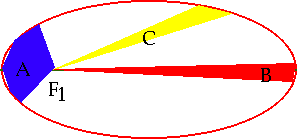 |
| The period (P) and the semi-major axis (r) are related by | P2= constant r3 |
| Obviously | v = 2πr
P |
| and centripetal force | F = m v2
r |
| = Gravitational force | F = mg |
Scratch one theory
Need extra ingredient of Kepler's laws
| What kind of gravitational force can give | P2= constant r3 |
| Obviously | v = 2πr
P |
| and centripetal force | F = m v2
r |
| So | F = k
R2
|
But this only refers to Sun: need to find law of same form, which depends on the mass of the planet, and the mass of the sun.
Given that the dimensions of force are MLT-2, what are the dimensions of G?
Applied to earth-moon: need to know mass of earth (M) and G (not mass of the moon, since it will cancel out),
| but we do know g at earth's surface | g = G M
R02 |
where R0 is the radius of the earth, and all we really need is the product GM
| Hence at the moon | F = mg (R0/R)2 |

| Gravitational force between any two bodies, masses M1 and M2 separated by distance R is given by Newton's Law of universal gravitation |
\color{red}{
F = \frac{{Gm_1 m_2 }}{{R^2 }}}
|
| Note that this imples that grav. force gets weaker as we move away from the earth | 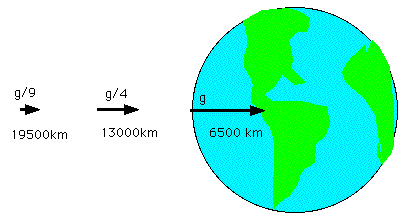 |