This shows a region in Andromeda: υ And. is a star believed to have 3 planets. Note M31, M33 and a small cluster of stars: everything else are just Milky Way stars.
 .
.or
Notes are (will be) on
http://www.physics.carleton.ca/~watsonSpace is big. Really big. You won't believe how vastly, hugely, mind-bogglingly big it is.
Hitchhiker's guide to the Galaxy.
How big? Could it be infinite?
Firstly, a quick look at the skies:
This shows a region in Andromeda: υ And. is a star believed to have 3 planets. Note M31, M33 and a small cluster of stars: everything else are just Milky Way stars. |
. |
| The best known cluster is the Pleaides: (Seven Sisters except we can only see 6 now) |  |
| A closer look: the Pleiades are a very young group of stars, about 107 years old, and very close: about 40 light-years, so light takes 40 years to travel from them. |  |
| M31 is a massive spiral galaxy, rather like the Milky Way with about 1010 stars |  |
| M33 is a slightly smaller galaxy, rather further away | |
| M74 is another spiral |  |
| This is M87 (a giant elliptical galaxy) in Virgo. Almost perfectly spherical: about 1011 stars |  |
| A very pretty spiral (ESO 269), Note the very distant galaxies in the background! |  |
We have found about 108 galaxies.
Galaxies form clusters:
| The Hickson cluster is a very small compact one |  |
| Virgo cluster is closest large one with about 1000 galaxies in it |  |
| Coma cluster contains at least 104 galaxies |  |
But this is only the beginning: We have measured the position of at least 10 million galaxies.......
 and we can go deeper
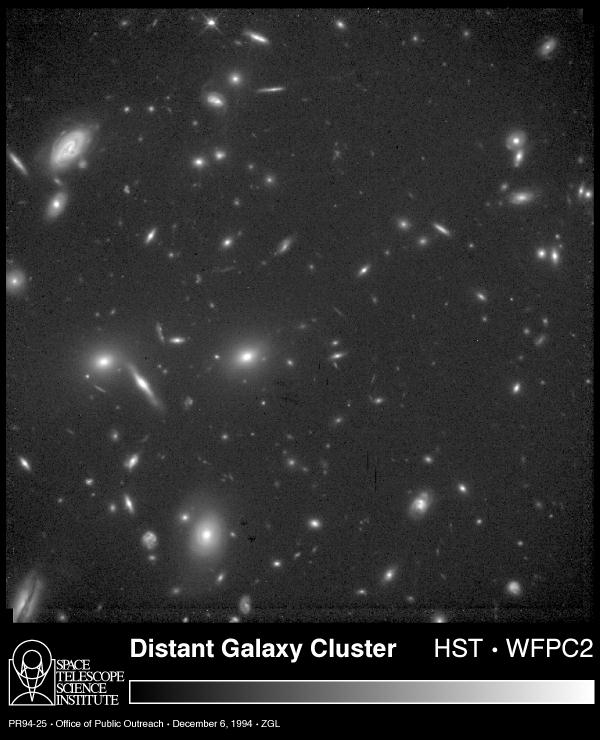
And further: this is a cluster of galaxies at a redshift of .5
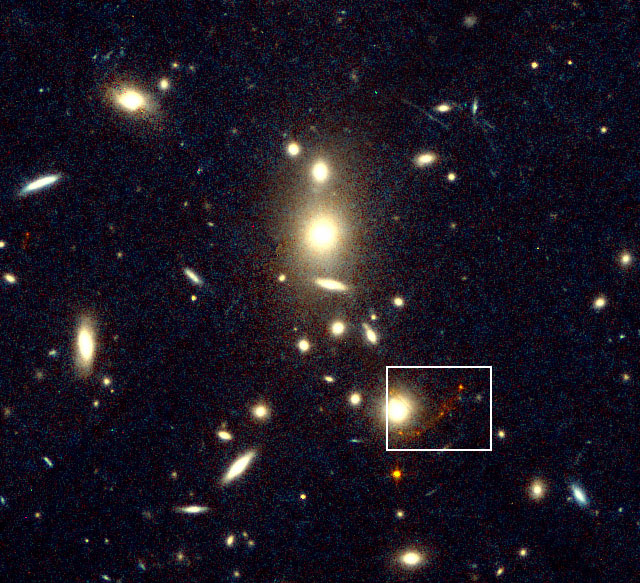
and further: this is a cluster of galaxies which is fairly close, but there the most distant galaxy known is buried in the picture
Slipher-Hubble-Humason found light from most galaxies is redshifted: i.e. light which is emitted at one wavelength is observed at a longer one. This tells us that they are moving away from us
Doppler effect gives
z = λ-λ0 = δλ
λ λ
Measurement of Distance. Popular one is the light year: distance traveled by light in 1 yr ~ 1016m. Astronomers usually use the "parsec": 1pc = 3*1016 m. Closest star (α Centauri) is at a distance of ~1.3 pc. Sirius is at about 5 pc, M31 at 1.5 Mpc.
Vel. of recession
v = zc = cδλ
λ0
This formula isn't quite right: we can have z > 1: in fact the furthest known galaxy has z = 4.9. We have to use a relativistic formula in that case.
Hubble
found vel. of recession ∝
distance zc = Hd = v H ~ 65kms-1/Mpc 1 Mpc (megaparsec) = 3x10²² m |
 |
RULE 1 in Physics 100: Never mix your units!)
H= 65x103= 1.8x10⁻¹⁹ (m s-1)/m
3.1022
We can invert this to give H-1= 5.4x10¹⁷ s =1.7x10¹⁰ yr. What does this time represent? |
 |
Must be age of universe: if expansion does not change i.e. 17x109 yr ago, all the galaxies were in the same place. Universe had a beginning, implied by the big bang. Can run Hubble expansion back: we would like to use this to predict what will happen in the end |
 |
Where was the Big Bang?

A 2-D analog is the surface of a balloon: it has no centre in 2-D space. Deflating it reduces it to zero size
At the moment of the big bang, not only matter was created, but also space and time
What's going to happen in the end?
The sky becomes black, Earth sinks into the sea From Heaven fall the bright stars The sea ascends in storm to Heaven It swallows the Earth, the air becomes sterile
From the Hyndluljod (Iceland)
How can we tell if the universe will expand forever?
As a model, consider this as an escape velocity problem. How hard do we need to throw a galaxy on the "outside" so that it escapes? Note: our calculation had better not depend on r! 1 mv2 - GMm = 0 2 rbut v = Hr and the total mass of the universe inside
M = 4π/3 ρ r3 |
 |
so...
H2r2 = 2G4π/3 ρ r2
(we got lucky: the r cancels out!). We can turn this round and write it as an equation for ρ
ρ0 = 3 H2
8π G
Hence the critical density
ρ0 ~ 6 x 10-27 kg m-3 ~ 3.6 Hydrogen Atoms m-3 (Number is flaky:we'll use 3). Also use
Ω = ρ
ρ0
because some errors cancel out.
The entire future of the universe is given by this one number!!!!!!!!!
So if
More important:we live forever if Ω ≤ 1, (well maybe). |
 |
So how do we weigh the universe?
a) First Guess
Count number of galaxies in a region of space, assume they consist of stars much like the sun
M = M0 ~ 5x10 5 kg W-1 L L0
(say 1μW/kg) � Density
Ω = ρ ~ .01
ρ0
Note all these numbers are uncertain to ± 50%!)
Obviously must average over large enough volume such that universe is smooth R > 100 Mpc, and the universe is a very lumpy place!
We live forever (Hooray!)
But wait a moment...
There is only a single God, Mixcoatl, whose image they possess, but they believe in another, invisible, god, not represented by any image, called Yoalli Ehecatl, That is to say, God Invisible, Impalpable, Beneficent, Protector, Omnipotent by whose strength alone ... rules all things
Nahuatlan Myth
Can only see luminous matter: how much Dark Matter is there?
ρdm ~ 0 so M = M0
L L0
ρdm ~ 1 so M ~ 2M0 ρlum L L0
ρdm ~ 2 so M ~ 3M0 ρlum L L0
(first direct evidence for D.M.)
| Measurement of velocities of individual stars or measurement of hydrogen via 21cm line ⇒rotation curves |  |
| Luminosity of galaxy should reflect mass
Typical Spiral R ~ 20 kpc but outer parts are just seen as H gas. Should be able to calculate rotational speed, since most of the light is fairly concentrated, so this should be good approx to the mass. These should show rotation curves that drop as expected. Can fix this by saying that galaxy has halo of dark matter around it. Halo + core add together to give correct curve |

|
Note this is not unique to NGC 3198: all measured spirals show same. (Have to have spiral that is not "flat on", since no Doppler, or "side on" since cannot separate different parts)

For spirals
10M0 < M < 40M0 L0 L L0
Large clusters of galaxies: By measuring vel. cpt. in line of sight (via Doppler) can get estimate of M
<K.E.> = -1/2<P.E.>
(Just like measuring mass of a planet via orbits of its moons)
M ~ 100M0 L L0
This gives much higher masses than individual spirals. A check: large clusters contain a lot of hot gas, which is strong X-ray source
X-ray pictures measure density and temp:

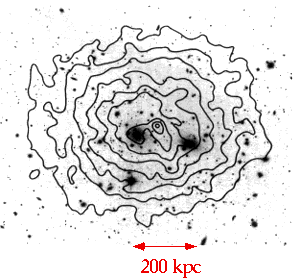
Also large clusters show gravitational lensing, can get quantitative estimate 
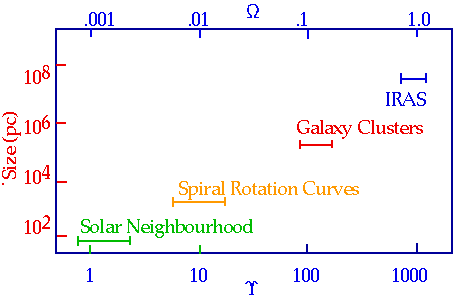
Finally IR sky surveys suggest that the total mass may be much higher
Note that the larger the object, the more massive (proportionately) that it is.
a) What the hell? i.e. what is the dark matter?
b) Why the hell? i.e. why is Ω~1 (after all it could be anything?)
Actually, there is a limit
Ω < 3
otherwise the universe would be younger than the earth (wouldn't that make the creationists happy!!)
What the hell:
Which is it? We don't know! However, all of the above have problems.
The Generic Candidates for Dark Matter :
No-Nameons: CDM candidates
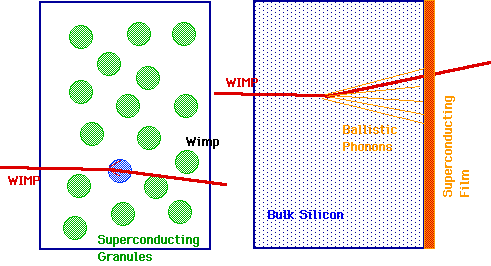
....and there is a tooth fairy Although these are similar cosmologically, they are very different from the point of view of detection. A lot can be ruled out by "in vitro" experiments (e.g. OPAL at CERN puts limits on LSP's
NeutrinosBest bet: we know they must be there, and SNO/Kamioka experiments show they have some mass. Need Mν ≤30eV if they were the only ingredients Why the Hell?Why is Ω = 1 so important? 
Since we now measure Ω ~ 0.1, this means that at the time of the BB it must have been ~ 1 - 10-60 i.e. Ω = 1 is an unstable critical point Dark EnergyDark Matter is bad enough, but now there is an extra problem.
LBL & Harvard have been measuring the distance more accurately than ever before by looking at supernovae (Sn1a: all have the same light curve). The implication is that the expansion of the universe is accelerating: q0,< 0(!)
Implies a very different picture for the expansion of the universe What can dark energy be? We can parametrise the expansion Ṙ=-4π/3Gρ(1+3w) Rwhere w = P/ρ is the "equation of state parameter". if w<-1/3 we get a positive energy density, but (effectively) a negative pressure which overcomes gravitational attraction at very large distances.
This implies a cosmological constant &Lambda (Einstein's "fudge factor") Hubble Diagram
We don't know (although there are models..................). Note that w need not even be constant with time However, there are major problems (what, more?). Dark energy implies that the vacuum has an energy density: ρΛ. Can write baryon energy density (units are c=ħ=1) ρBDM≅10-13 eV4. We can understand ρΛ ≡ 0. : The only working theory for particles (the standard model) gives ρΛ ≅ 10100 eV4 - V0 where V0 is a (unknown) correction. in fact ρΛ ≅ 10-8 eV4., so we need cancelation to 110 places of decimals. Secondly, ρΛ and ρMatter are almost equal at present. In the past they would have differed by 1040 If w(t) is increasingly negative (whihc is best fit) universe will accelerate out of control ⇒ Big Rip in ∼ 35 *109 years A final aspect of this: there have been 3 scientific revolutions, all devastating for man's dignity.
Some references
|



 .
.
